
In the second installment of our series on pilot vision, we look at how the eye adapts to low lighting conditions, and the first group of visual illusions.
Dark Adaptation and Night Vision
Night flying introduces a different set of visual challenges.
Dark adaptation is the process by which the eyes become more sensitive to low light. This process primarily involves the rods and takes approximately 30 minutes to reach maximum effectiveness, although significant improvement occurs within the first 5 to 10 minutes (PHAK, Chapter 17, p. 17-6).
However, dark adaptation can be lost very quickly. Exposure to a bright light—even briefly—can significantly degrade night vision and require time to recover. Because rods are in the periphery of the retina, the central blind spot is exaggerated, so pilots should use off-center viewing at night. Instead of looking directly at an object, you should look slightly to the side of it to place the image on the rod-rich portion of the retina.

To preserve night vision, pilots should minimize exposure to bright lights, use dim flight deck lighting when available, and allow adequate time for adaptation before flight.
There are several specific techniques you can use to dark-adapt quickly and preserve your night vision:
- Before sunset, wear neutral density (N-15) sunglasses or equivalent while outside. This will increase the rate of dark adaptation and improve night visual sensitivity. (PHAK Chapter 17, page 17-24).
- Minimize the brightness of cockpit lighting. Buy flashlights based on how dim they are, not how bright they are.
- Always set pilot-controlled airfield lighting set to the lowest usable setting. If operating from a towered airport, ask the controller to set the lowest usable setting.
- Practice good light discipline with the external lights on your aircraft so you don’t blind other pilots.
Hypoxia and Vision
Vision, particularly night vision, is highly sensitive to oxygen levels. Even mild hypoxia can degrade rod function before the pilot becomes aware of other symptoms. This means that night vision can be impaired at relatively low altitudes.
The FAA notes that night vision degradation can begin at altitudes as low as 5,000 feet MSL (PHAK, Chapter 17, p. 17-7). This makes supplemental oxygen an important consideration during night operations. Protecting your vision requires managing your physiology, including oxygen levels, hydration, and overall health.
The Brain, Perception, and Optical Illusions
Vision is not just about the eyes—it is about how the brain interprets what the eyes see.
The brain constantly processes visual information, filling in gaps and relying on past experience to construct a coherent image. While efficient, this process can lead to systematic errors known as optical illusions. These illusions are particularly dangerous during approach and landing (Instrument Flying Handbook, Chapter 3, p. 3-9).

In aviation, illusions are predictable phenomena that every pilot must understand and manage.
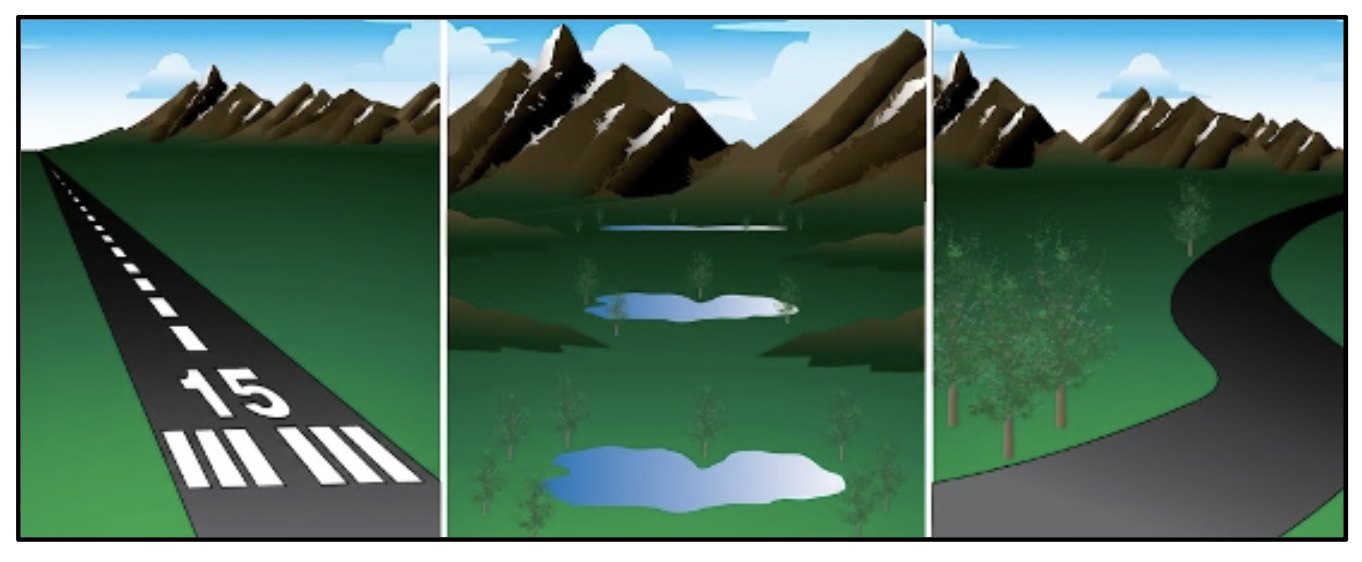
- A runway width illusion occurs when a runway is narrower or wider than expected. A narrow runway creates the illusion of being too high, leading to a low approach, while a wide runway creates the illusion of being too low, leading to a high approach.
- Runway and terrain slope illusions occur when the runway or surrounding terrain is sloped. An upsloping runway creates the illusion of being high, while a downsloping runway creates the illusion of being low. In both cases, pilots tend to make incorrect corrections.
- A featureless terrain illusion, often called the black hole illusion, occurs when approaching over water or unlit terrain at night. With few visual references, pilots may perceive themselves as being higher than they actually are and descend too low.
- Water refraction, haze, and fog can all distort distance perception. Haze tends to make objects appear farther away, leading to low approaches, while fog can make them appear closer, leading to high approaches.
- Ground lighting illusions can cause pilots to misidentify roads or other light sources as runway environments, particularly at night. These illusions are well documented in FAA guidance and are a known hazard during approach and landing (Instrument Flying Handbook, Chapter 3, p. 3-9).
Distance Estimation and Depth Perception
As pilots, we are constantly making judgments about distance—how far away traffic is, how high we are above the runway, and how quickly we are closing on an object. These judgments are collectively known as depth perception, and they are far less precise than most pilots realize.
Unlike a laser rangefinder, the human visual system does not directly measure distance. Instead, the brain infers distance using a combination of visual cues. Under ideal conditions, these cues work remarkably well. But in aviation—where distances are large, lighting conditions vary, and visual references are often limited—these cues can become unreliable or even misleading.
The FAA emphasizes that visual perception is heavily dependent on environmental conditions and can be easily degraded, especially during approach and landing (PHAK, Chapter 17, p. 17-8). Understanding how these cues work—and when they fail—is critical to safe flight.
The FAA has a set of rules regarding how close VFR pilots can fly to clouds. Determining your distance from a cloud is surprisingly difficult. As an example, keep this challenge in mind as we look at Motion Parallax, Geometric Perspective, Aerial Perspective, and Binocular Vision.
Motion Parallax
Motion parallax is one of the most powerful depth cues available to a pilot, particularly at low altitude.
As you move through space, nearby objects appear to move rapidly across your field of view, while distant objects appear to move more slowly. For example, when flying low over terrain, trees and buildings seem to rush past, while distant mountains appear almost stationary. Your brain uses this relative motion to estimate distance:
- Faster apparent motion → closer object
- Slower apparent motion → farther object
- This cue is especially useful during:
- Low-level flight
- Traffic pattern operations
- Flare and landing
However, motion parallax becomes less effective at higher altitudes, where everything appears relatively stationary. This is one reason depth perception becomes more difficult during high approaches or when flying over featureless terrain.
One technique for determining the height of clouds above you is to compare their apparent motion with the ground below you. If you know your altitude above ground level (i.e., your absolute altitude), you can use the relative apparent motion to roughly estimate how far the clouds are above you. (Obviously, this requires that the wind speed be a small fraction of your airspeed.)

Geometric Perspective
Geometric perspective refers to how objects appear smaller as their distance increases. In aviation, this shows up clearly in:
- Runway width and length
- Taxiway spacing
- Terrain features
For example, parallel runway edges appear to converge in the distance, even though they are actually parallel. Your brain uses this convergence to estimate distance and alignment.
However, this cue depends heavily on familiarity. If a runway is narrower or wider than what you are used to, your brain may misinterpret the geometric perspective, leading to the runway width illusion discussed earlier. Similarly, unfamiliar terrain can distort your perception of height and distance.
Clouds don’t include parallel lines or much predictable geometry. As a result, geometric perspective is not a valid technique for estimating your distance from a cloud.
Aerial Perspective
Aerial perspective is the effect of the atmosphere on how objects appear at a distance. As distance increases, the atmosphere scatters light and reduces contrast. Distant objects appear:
- Less sharp
- More faded
- Slightly bluish or gray
Your brain interprets this reduction in clarity as increased distance. In aviation, this cue can be misleading. On clear days, distant objects may appear closer than they actually are because they remain sharp and well-defined. Conversely, in hazy conditions, objects may appear farther away than they are, leading to low approaches.
This is one reason haze is particularly dangerous—it subtly alters depth perception without the pilot necessarily realizing it (Instrument Flying Handbook, Chapter 3, p. 3-9).
Using aerial perspective on clouds is problematic as they are not normally well-defined, and they can appear various shades of blue or gray due to light refraction and cloud density.
Binocular Cues
Binocular cues arise from the fact that you have two eyes separated by a small distance. Each eye sees a slightly different image, and the brain combines these images to create depth perception. This process is called binocular disparity.
While this is a powerful cue in everyday life, it has a very limited range—typically effective only out to a few hundred feet. Beyond that distance, the difference between the images seen by each eye becomes negligible.
For pilots, this means that binocular vision plays only a minor role in:
- Traffic detection
- En route navigation
- However, it is still important during:
- Close-in maneuvering
- Taxi operations
- The landing flare
Even then, monocular cues (like motion and perspective) tend to dominate.
Binocular cues don’t work well for clouds. Typically, you need to be closer than the regulations permit for binocular cues to become effective.
The key takeaway is that depth perception is not a single system—it is a collection of cues, each with its own strengths and limitations. When one or more of these cues is degraded, your ability to judge distance can be significantly impaired.
This becomes especially important in situations such as:
- Night operations
- Haze or reduced visibility
- Featureless terrain
- Unfamiliar airports
Distance estimation in aviation is an inference, not a measurement. Your brain is constantly making educated guesses based on incomplete information. A proficient pilot understands which cues are available, recognizes when those cues are unreliable, and supplements visual perception with objective references.
In these environments, pilots must rely more heavily on instruments and known references rather than visual estimation alone. A stabilized approach, proper use of visual glide slope indicators, and disciplined instrument cross-checking are essential defenses against errors in depth perception.
In the third installment of this series, we’ll look at more illusions found at night, and how to mitigate them—especially important as we head into the wintertime in the Northern Hemisphere.

Wow! Hands down the best article I have ever read on airplanes and vision. This goes far beyond the basic visual education you receive during private pilot training. Thankyou!
I look forward to the continuation.
A night vision trainer at Navy Miramar years ago taught us how night vision can be so different than daylight. Was very interesting.
I see what you’re sayin’