

As a pilot, your eyes are your primary flight instrument. Even with modern avionics, most of your decision-making—especially under VFR—depends on what you see and how well you interpret it. The FAA system is built around the concept of “see and avoid,” and the responsibility for collision avoidance ultimately rests with the pilot (14 CFR §91.113). But here’s the important part: Your eyes are not perfect sensors, and your brain is not a perfect processor. Understanding both the capabilities and the limitations of your visual system is essential to safe flight.
The FAA makes it clear that human vision is subject to significant physiological limitations and is a major contributing factor in spatial disorientation and visual illusions (Instrument Flying Handbook, Chapter 3, p. 3-2). Many accidents occur not because the pilot didn’t look, but because the pilot didn’t understand what they were seeing.
Anatomy of the Eye and Visual System
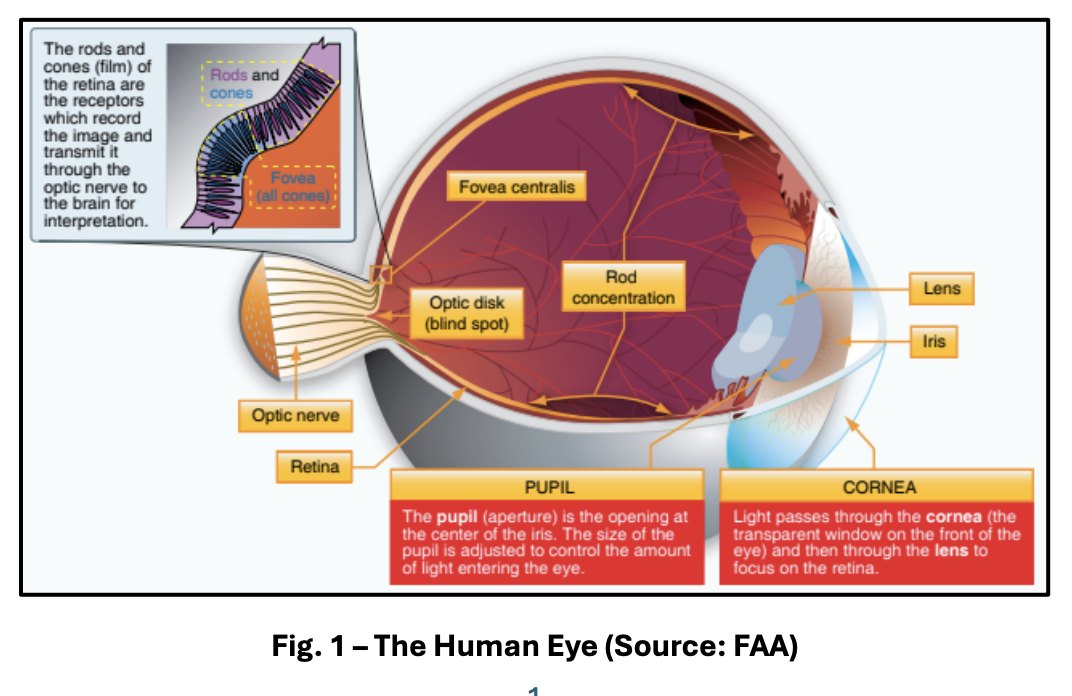
To understand how vision can fail, we first need to understand how it works. Light enters the eye through the cornea and is focused by the lens onto the retina. The retina contains two primary types of photoreceptors: rods and cones.
- Cones are concentrated in a small central area called the fovea and are responsible for sharp, detailed, and color vision. Most human eyes have three types of cones: Red, Green, and Blue. That’s why old TVs had “RGB” inputs, why LED TVs can “make” colors with just three LED colors, and why dogs (whose eyes are tuned differently) won’t typically watch TV with you.
- Rods are distributed around the periphery of the retina and are much more sensitive to low light, but they provide less detail and no color perception.
At the point where the optic nerve exits the eye, there are no photoreceptors. This creates what is known as the physiological blind spot. Normally, you are unaware of this blind spot because your brain fills in the missing information based on surrounding visual cues. The optic nerve transmits signals from the retina to the brain, where they are processed in the visual cortex. This is where “seeing” truly occurs. The brain does not simply display what the eyes detect—it interprets, filters, and even modifies the information. This interpretation process is efficient, but it introduces the possibility of error. In aviation, those errors can manifest as misjudged distances, false horizons, or other dangerous illusions (PHAK, Chapter 17, p. 17-2).
Types of Vision
Your visual system operates in different modes depending on lighting conditions, and each mode has distinct strengths and weaknesses.
Photopic vision occurs in bright light and relies on the cones. This is your best visual mode, providing sharp detail, depth perception, and color discrimination. During daytime operations, you are primarily using photopic vision.
Mesopic vision occurs during transitional lighting conditions, such as dawn, dusk, or hazy environments. In this mode, both rods and cones contribute to vision, but neither performs optimally. Visual acuity decreases, contrast becomes more difficult to detect, and depth perception begins to degrade. This degradation is subtle and often goes unnoticed.
Scotopic vision occurs in low-light or nighttime conditions and relies almost entirely on rods. While rods are highly sensitive to light, they do not detect color and provide poor detail. Because rods are not concentrated in the center of the retina, central vision becomes less effective at night. This is why looking directly at a dim object can make it disappear. The FAA emphasizes that these differences significantly affect a pilot’s ability to detect traffic and interpret visual cues (PHAK, Chapter 17, p. 17-3).
The Central Blind Spot and Empty-Field Myopia
Every pilot has a blind spot, and under certain conditions, it can hide an entire aircraft.
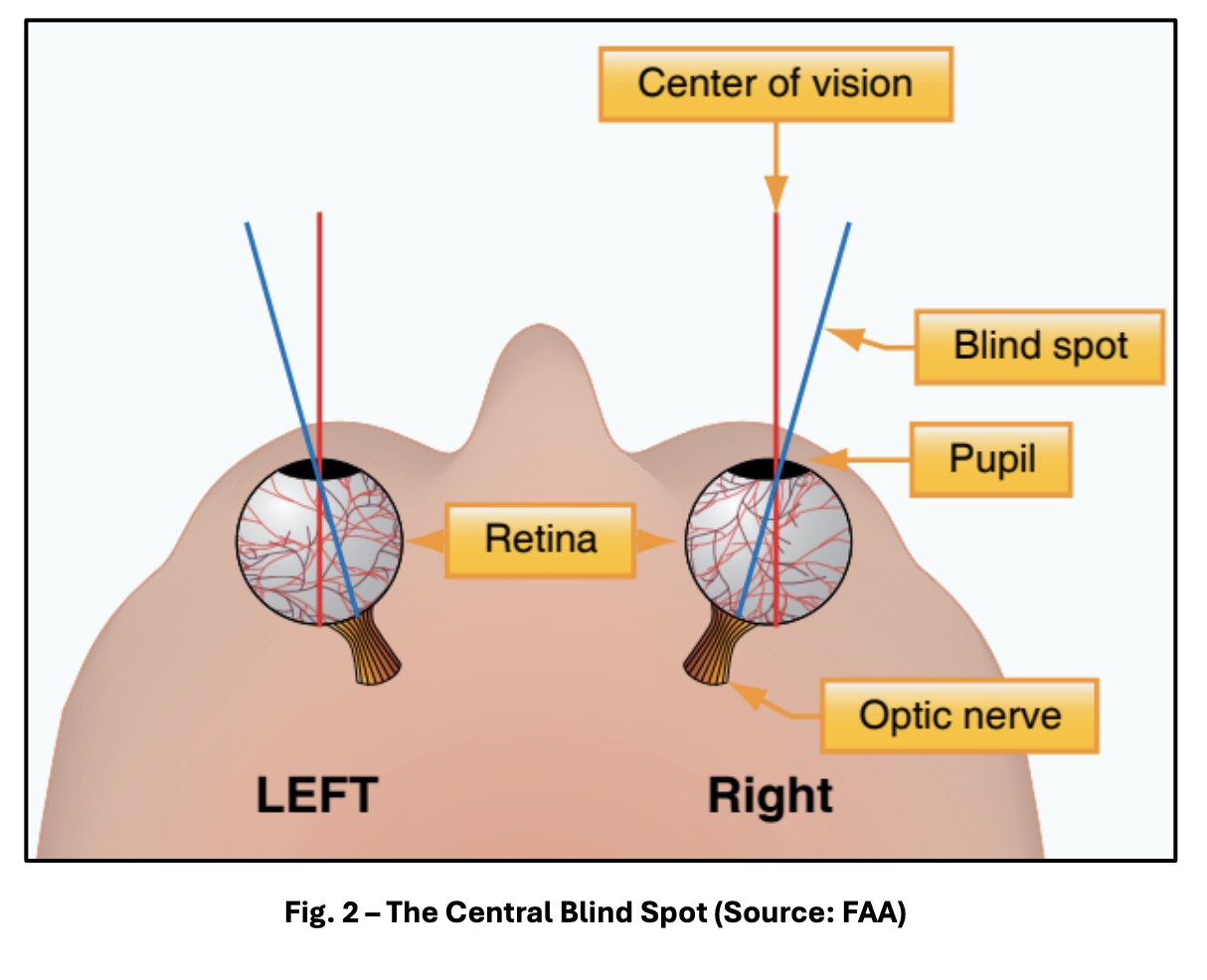
The central blind spot exists where the optic nerve exits the retina. Although your brain fills in the missing information, this compensation is not reliable when scanning the sky for traffic. If another aircraft happens to fall within that blind spot, you may not see it at all.
Compounding this issue is empty-field myopia. When you stare into a featureless area—such as a clear sky—your eyes naturally relax and focus at a relatively short distance, typically only a few dozen feet in front of you. Aircraft that are miles away remain out of focus and are therefore much harder to detect. These limitations mean that simply looking for traffic is not enough. The FAA recommends deliberate scanning techniques to overcome these physiological shortcomings (PHAK, Chapter 17, p. 17-4).
In the Pilot’s Handbook of Aeronautical Knowledge, the FAA includes the following experiment which allows you to “see” your central blind spot. Using the image below (Fig. 3), do the following:
- Cover one eye. (Use a sheet of paper so you don’t close or press on the eye. We don’t want any damage.)
- Hold the image in Fig. 3 about arm’s length away, and focus on the airplane (on the left). You should be able to see the ‘X’ in your peripheral vison.
- Slowly move the image closer while you continue to focus on the airplane. At some point, the ‘X’ will disappear.
- Keep moving the image closer, and the ‘X’ will eventually reappear.
This will work with either eye, and is a great way to visualize how large your central blind spot is.

Because of the blind spot and empty-field myopia, effective scanning must be intentional and methodical.
Effective Visual Scanning Techniques
A proper scan divides the sky into small segments, typically about 10 to 15 degrees wide. The pilot briefly focuses on each segment for a second or two before moving to the next. This pause allows the eyes to properly focus and detect motion or contrast changes. Rapid, continuous sweeping of the eyes is ineffective and reduces the probability of detecting traffic. Pilots should also periodically shift their focus between near and far distances to prevent the eyes from locking into a short focal range. High-risk areas—such as traffic patterns, final approach paths, and converging flight paths—should receive additional attention.
This is a learned skill that requires deliberate practice.
In the next installment, we’ll look at night vision and how hypoxia affects your vision.

Another great article. I see what you’re saying.
Rob: If I was taught about the ocular central blind spot when learning to fly, either I was not paying attention or I simply forgot. Thank-you.