

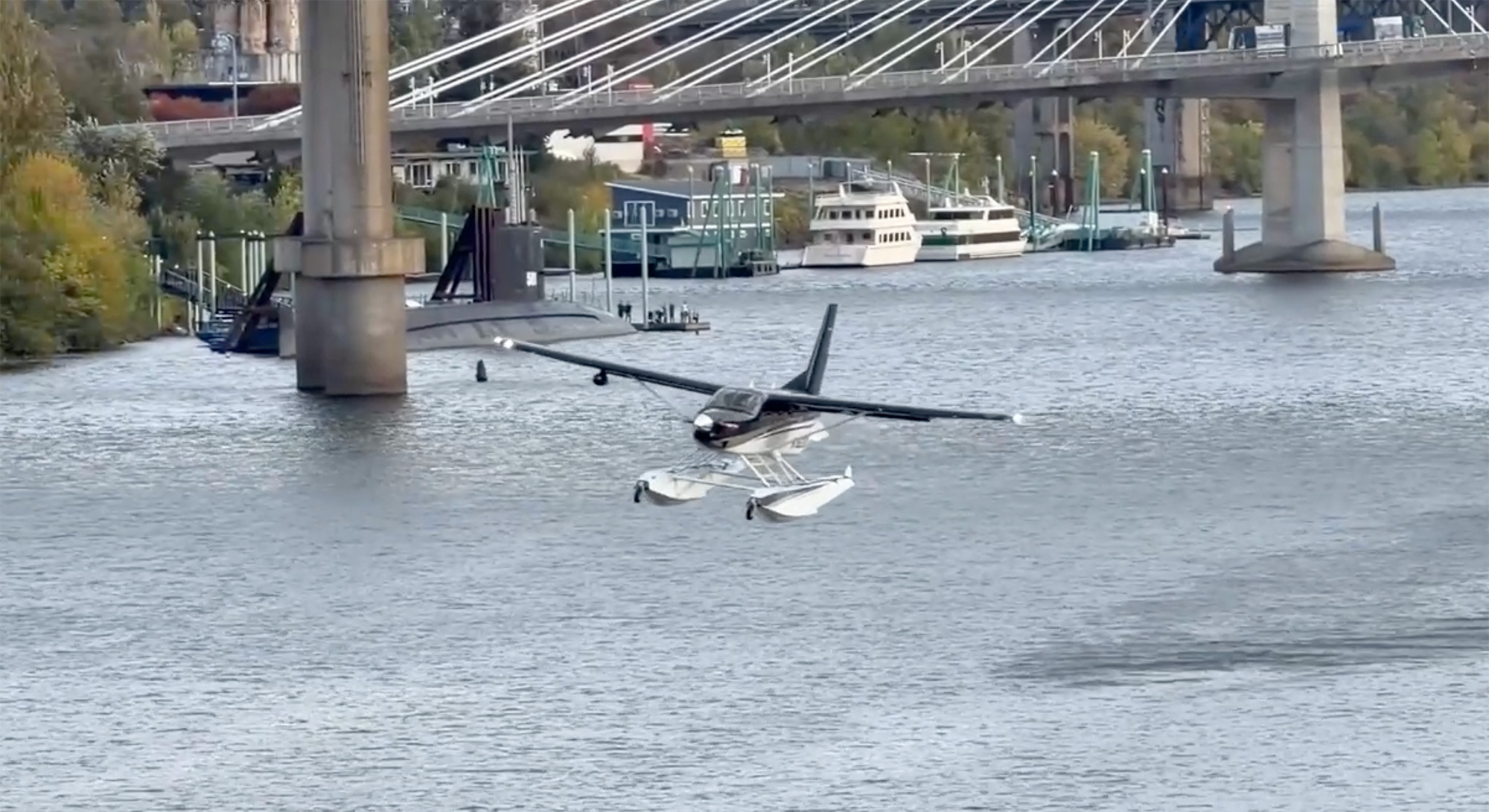
The FAA says it will have something to say about a video making the rounds from Portland, Oregon, showing a Daher Kodiak 100 on floats flying under a bridge over the Willamette River near the city’s downtown core. The video, shot by Cabel Sasser and shared with local news outlet OregonLive, shows the aircraft on a takeoff run then starting a steep climb immediately after lifting off. It abruptly levels off and makes a slight turn before flying under the Hawthorne Bridge and then resuming that steep climb. We’ve asked the FAA for comment and so did OregonLive. We haven’t heard back but OregonLive said the agency responded that it will comment this coming week.
i have lived here my whole life, and i have never once seen a plane take off from the Willamette… …let alone do THIS. wtf.
— Cabel Sasser (@cabel.panic.com) October 9, 2026 at 6:07 PM
[image or embed]
Meanwhile the video has garnered a lot of attention in Portland, most of it characterizing the incident as a stunt and using terms like “daredevil.” The incident occurred on a stretch of river with numerous bridges. It’s not clear why the plane, which is registered to a Seattle company, ended up on that particular piece of the river. The FARs give pilots a lot of latitude during takeoff and landing, however, and it would seem likely the pilot will get a chance to explain his thinking soon. He began the takeoff run about 2,000 feet before the bridge he flew under. Daher lists the water takeoff distance to clear a 50-foot obstacle as 2,332 feet. The deck of the bridge is about 50 feet above the river. We’ve marked up a Google photo of that stretch of river for context.


The level-off upon leaving the water was likely a late (but safe) decision not to outclimb the bridge and rather stay low. Other than quick and rough control (which may look terrifying to someone with the word “panic” in their user-name) there was NOTHING resembling a stunt or dangerous behavior. It wasn’t even a particularly steep climb-out. The Kodiak is a fairly capable aircraft.
Looks like Mr. Sasser finally got some long desired viral attention and his surprise and lack of knowledge got him many many new dedicated followers. Congratulations!
The only question remaining to be answered is if operating the seaplane there was legal and approved. I’d guess PDX would have been in contact with the pilot of KQ.
Some social media comments and posts are at their best if they remain saved in drafts. A lot of people have never seen a whole lot of things and one could hope that this isn’t always cause for asking the regulator for words of wisdom.
Totally agree. Staying low was an instantaneous decision and the safe thing to do. Better a field of water ahead than a steel bridge. And yes there may be legit questions as to what he was doing on that part of the river.
Yup. The correction was quick and solid.
Fortunately flying airplanes is NOT (yet) a social media- or news- popularity contest.
I find it sad, that stuff like this even gets any attention. The FAA is inherently unqualified to comment on the maneuver, if anything is worthy of regulators attention, its the part of being legally authorized to operate on this body of water – or not. If the answer is yes: STFU and move to the next sensationalist social media clown, thinking he/she/or it has some regulatory mandate.
Feeling tells me it was perfecly legal or at least legally justifiable. Kudos to the pilot for deciding to stay safe and underfly the bridge, rather than working the issue by the numbers.
All it takes for a seaplane to screw the numbers is a minute change in wind or water- current.
Lets hope for better news days in the aviation news business. 😉
This is a deeply selfish attitude that dismisses legitimate concerns about public safety and accountability. Our community should not be expected to accept behavior that falls outside the bounds of what is normal, responsible, and socially acceptable. Aviation safety is not solely a matter of an individual pilot’s judgment; it also requires respect for the rules, the public, and the community affected by those decisions. Dismissing these concerns as sensationalism does nothing to address them. Our community has every right to expect responsible conduct, and this kind of behavior should not be normalized or excused.
But, it IS sensationalism…..
Also, Nathan, I don’t see what the hazard to non-participants was. Can you identify one? I doubt it.
Meanwhile, I see this headline from the Portland station:
5 dead, 3 seriously injured, including 2 officers, after crash
Maybe you should pay attention to highway safety, or something you have some actual knowledge of…
Deleted
The FAA is authorized by Congress to regulate this activity, including the determination of whether this action violates the Federal Air Regulations. Our opinions of the FAA’s judgments on such matters are quite irrelevant. Absent “an in-flight emergency requiring immediate action”, the only thing that 14 CFR 91.3(a) does in matters like these is make the PIC personally responsible to the FAA for any violations of those regulations committed during a flight, not authorize the PIC to choose to violate those regulations without consequences.
True. We the people have had little say in our government for over 100 years now.
The safest decision would have been not to use that stretch of water in the first place. This was downtown Portland, not an isolated body of water free from surrounding infrastructure and public-safety concerns. Praising a split-second decision to fly beneath a bridge overlooks the more fundamental question of why the pilot put himself in that situation to begin with. Safety requires sound judgment before a crisis develops, not simply reacting once the options have narrowed. In this case, the decision-making that led to the situation deserves serious scrutiny, and I don’t believe the circumstances warrant celebrating the outcome as good airmanship.
I said it before you did. “there may be legit questions as to what he was doing on that part of the river.”
^ this.
The issue is not whether the Kodiak is a capable aircraft or whether the pilot made a last-second decision to remain low. The issue is whether the pilot’s decision to conduct this operation in the middle of downtown Portland complied with federal aviation regulations and applicable operating restrictions.
Several FAA regulations are directly relevant:
– 14 CFR § 91.13(a) — Careless or reckless operation. No person may operate an aircraft in a careless or reckless manner so as to endanger the life or property of another. The fact that an aircraft is capable of performing a maneuver does not establish that performing it in a congested urban environment is safe or lawful.
– 14 CFR § 91.119 — Minimum safe altitudes. Except when necessary for takeoff or landing, aircraft must maintain altitudes that permit an emergency landing without undue hazard to persons or property on the surface. Over congested areas, the regulation generally requires an altitude of 1,000 feet above the highest obstacle within a horizontal radius of 2,000 feet. Whether a particular takeoff falls within the takeoff exception does not eliminate the pilot’s other safety obligations.
– 14 CFR § 91.103 — Preflight action. Pilots must become familiar with all available information concerning a flight, including relevant operating restrictions and conditions affecting safety.
The question of whether this particular operation was authorized also requires examining the applicable airspace requirements, any relevant airport or waterway operating restrictions, and the circumstances of the departure. A determination of illegality requires establishing which specific requirements applied and whether they were violated.
Aircraft capability is not a legal defense, and avoiding a collision at the last moment does not retroactively establish that the preceding decisions were safe. The proper question is not whether the pilot managed to get away with the maneuver. It is whether the operation complied with federal regulations and applicable authorizations in the first place.
That is precisely why an FAA review is appropriate. Dismissing legitimate safety concerns as ignorance or an attempt to gain social media attention does nothing to answer the regulatory questions.
Unless operation in this area was unauthorized (which is subject to determination at this point) your wall of text does not change the fact, that the PIC has final authority and every right to decide to stay on the safe side.
Again, fortunately the P in PIC does not stand for Popularity. IOW, you may elect to preemptively pass judgement and treat this like a clear cut case from the comfort of your Couch – but at the end of the day:
The pilot will answer to the FAA.
Move along.
Good answer.
You forgot 14 CFR § 91.119
“when necessary for takeoff or landing”,
End of discussion
Wiley’s Seaplane Base is just a mile or so upstream on the Willamette R. The area is under a 2300 MSL shelf in the PDX Class C.
Dave Wiley was an FAAST member, DPE, CFI &CFII, A&P with IA and much more. I had several students take SES rides with him. Very practical and knowledgeable guy. He took my girl friend on a flight in his Taylorcraft on floats after her check ride in which they flew along several mikes of the river right through this area low and slow. He wanted her to see that you need that perspective to adequately inspect any potential landing area. And that you need to get comfortable in that regime of flight. Not dangerous if you get to know it well and use it wisely.
This Kodiak pilot made the right decision after he got airborne, however he probably should have taxied to a better takeoff location downstream.
The fact that experienced pilots have flown low along this stretch of the Willamette River does not establish that this particular operation was safe, legal, or appropriately planned. There is a difference between deliberately conducting low-level flight for a legitimate operational purpose and departing from the water in a manner that places a downtown bridge directly in the aircraft’s flight path.
If the pilot needed to remain low rather than climb to avoid the bridge, that raises a legitimate question about whether the takeoff location and departure path were appropriately selected in the first place. A pilot’s ability to recover from a compromised situation does not make the decisions that created that situation sound.
The relevant question is not whether the Kodiak is capable or whether an experienced pilot can safely fly low over water. It is whether this departure was properly planned, complied with applicable FAA requirements, and adequately accounted for the bridge, surrounding development, and other potential hazards.
Good piloting is not simply making the right decision after becoming airborne. It is making sound decisions before takeoff so that an avoidable conflict with a major downtown bridge never develops.
If you can point to a rule broken, go ahead and do so.
Otherwise, dry up.
100% – it was extremely unprofessional
And Dave was killed in that same TCraft that he had flown and maintained for years after it literally came apart in flight due to severe corrosion in the airframe. Corrosion that should have grounded that airplane in a periodic inspection years before it came apart.
My point is, I don’t think I’d use Dave’s judgement as a good example in this case, and I doubt the family of his student that day would…..
This is a stunt in every definition of the term I can think of. There is a major airport literally next door where that amphib COULD have landed, and Wiley’s sea base has MUCH more room to operate than this stretch.
This is how seaplane ops get prohibited, actually.
I agree that Dave’s death was the result of poor maintenance judgement; deadly poor. This flying under the bridge doesn’t appear to be related to poor maintenance but poor technique.
Dave’s understanding and what he taught about getting a float plane from being a boat with lots of water drag up to the speed needed to lift out of the water and fly as soon as possible is something this pilot clearly lacked. This is basic and is definitely taught best in a low power airplane or by using reduced power in a higher powered airplane. This takeoff run was made much longer than needed by having a high pitch attitude throughout the step phase and dragging the tails of the floats.
I had a student last week in a 185 and we did a lot of step taxiing at less than full throttle while trying to find the optimum low drag planing attitude. He found that very small pitch attitudes allowed for slight accelerations on the water whereas small errors in optimum planing attitude resulted in loss of airspeed. I was glad when we discussed this video that his immediate comment was “he was dragging the tails all throughout the step phase”.
This seems to be a good example of the fact that having a very powerful high performance float plane doesn’t make up for poor technique. The phrase pitch plus power equals performance was drilled into me during instrument training and it applies equally well here.
I doubt that technique was significant factor here, frankly. If he’d got off a little quicker, he’d still have had a tough time getting over the bridge. Would have been REALLY close either way. So my point was, this was ALL about judgement. Poor judgement to be specific.
The October 9 seaplane takeoff beneath Portland’s Hawthorne Bridge was an outrageous display of recklessness that should not be dismissed as a daring stunt or entertaining spectacle.
Flying a turboprop aircraft beneath a heavily traveled bridge in the middle of Portland presents an obvious and unacceptable risk to public safety. The Willamette River is a shared public space used by boaters, pedestrians, and others who have every right to expect that aircraft operators will exercise sound judgment rather than engage in dangerous maneuvers that could endanger innocent people.
What makes this incident particularly troubling is that the aircraft was registered to an out-of-town owner in Seattle. Visitors are welcome in Portland, but that does not give anyone the right to come into our community and disregard the safety of its residents. Operating an aircraft in this manner demonstrates a profound lack of consideration for the people who live, work, and recreate here.
Portland is not a playground for pilots looking to impress an audience or manufacture a moment of excitement at the expense of public safety. Our community deserves better than behavior that forces witnesses to wonder whether they are about to watch a plane crash into a bridge or kill someone on the river below.
The fact that the aircraft successfully passed beneath the bridge does not make the maneuver acceptable. A reckless act does not become responsible simply because nobody was injured. The outcome could easily have been different, and the consequences of an aircraft accident in this location could have been catastrophic.
The Federal Aviation Administration should investigate this incident thoroughly, determine whether any regulations were violated, and take appropriate enforcement action if warranted. The public deserves a clear explanation of the applicable safety requirements and whether this flight complied with them.
Our community standards should be clear: public safety is not negotiable, and the people who use Portland’s waterways should not be subjected to unnecessary risks because a pilot decides that ordinary operating procedures are insufficiently exciting.
This was not merely a spectacle. It was a serious lapse in judgment that deserves scrutiny, accountability, and a clear message that such conduct is unacceptable in our community.
Nathan Nielsen
You need to lay off the coffee
Thank you Nathan!
So if the pilot chose to remain on the water until past the Hawthorne bridge before getting airborne it would be no different than a boat cruising down the river. You take issue with him getting airborne early due to the performance of the aircraft then choosing wisely to stay below the bridge before climbing out safely at a higher speed. Maybe the wind shifted or the downstream current increased. Being judge and jury based on someone’s online popularity video leaves out a whole lot of facts.
Thats what these holier than god armchair quarterbacks like to do. Rather than giving one of the peers a half second worth of benefit of the doubt, they swing each other into a hack- frenzy without ever having heard a single word from the pilot. CFR’s are tossed around like candy. All before a single statement has been made by the regulator.
You don’t need NIMBY’s with colleaques like this. 😆
Considering Portland commercial real estate is going for 25 cents on the dollar, they could use some fly-in activity.
14 CFR § 91.119
“when necessary for takeoff or landing”,
End of discussion.
You clearly weren’t around when there was a seaplane base operating on the Willamette. Writing a dissertation doesn’t change that his actions are covered under the regs, period.
The maneuver was acceptable. Your assertions are not.
What’s Martha’s take on this?
This takeoff looked perfectly fine to me and we are seeing the classic mountain out of a molehill response that is so prevalent today. And sadly, Avbrief is contributing to this by “asking the FAA to comment.” Poking the bear in cases like this only makes it worse for us all in the future.
And, ironically, most of those who will scream loudest about this will support far more dangerous actions like having an open border to let terrorists in. People today make no sense and have no common sense.
You’re wrong, Voyager. Asking the FAA about this is precisely our role in this. We have access to the FAA that most of our readers don’t have and it’s our job to gather that information rather than try to hush it up. We routinely poke various bears on your behalf:)
If the goal is to maintain what little freedom of aviation we have left, then I am right.
If the goal is to become like Europe and regulate private aviation into near oblivion, then you are right.
It all depends on the objective.
No, Voyager. There is no way that such an interesting video was not dispatched to the FAA within milliseconds of it showing up on social media.
Russ (probably along with every TV station in the area) was simply asking the FAA for a comment. It’s all pro-forma. Everyone knows that the FAA ain’t gonna say anything of interest until they’ve done an investigation and made a determination of some sort. Expect an update on their investigation sometime next year.
Sometimes the FAA surprises us.
How about finding the PIC, and asking him to comment first?
Are you trying to portray a journalist or a tattle tail?
While you do make a couple ‘valid’ points Voyager …assuming that AVBrief would’ve been the ‘only’ entity to bring this ‘event’ to the FAA’s attention is dubious …and extremely unlikely.
But even if that were the case here …’Good-Journalism’ generated by an ‘authentic’ and reputable Journalistic operation inherently ‘requires’ obtaining ‘a-statement’ from any/all controlling authorities /governments applicable when reporting on any ‘issue/event’ …regardless of how it has entered into the public domain.
My goal is to uphold and apply journalism standards to everything we do.
Aviation is under the microscope. There is a lot more social media today and everything out of the norm will focus the public attention to GA, most of them from the people who don’t know anything about aviation rules and regulations, and most of them not favorable to GA. A lot of GA pilots don’t know everything about them either. When I fly close the the public, I want to be a good ambassador to our recreation. Yes I only fly for recreation and I don’t want to see it restricted because somebody unnecessary stir up something. Flame away
Just because you can do, it doesn’t mean you should.
Pat— 100% agree.
We are under a microscope, like it or not. So we should all do our best to not do stupid pilot tricks and wind up on a viral video.
That said (and this is not to Pat, but the group at large), I do believe that there are always at least 3 sides to every story—to keep it simple, yours, mine, and the truth. Let’s give the pilot and the FAA a chance to find that truth
Please note that there is NO regulation specifically prohibiting pilots from flying under bridges. 91.119 (minimum safe altitudes) applies, but has an exception for takeoff and landing. 91.13 (careless or reckless operation) could apply, but is usually used only in conjunction with another specific violation. If the takeoff run had been under the bridge with the liftoff just past the bridge (a common seaplane operation), nobody would even be talking about this. And from a safety standpoint, flying 50′ under a bridge is no more dangerous (and probably safer) than flying 50′ over it.
Exactly. From the hapless video footage of this social media user, the only conclusion anyone could reach would be a fairly abrupt correction to stay low and underfly a bridge that was quite possibly planned to be overflown. Imagine the screams if that Kodiak crossed this bridge with a low altitude.
If that qualifies as careless and reckless or even a dangerous “stunt” we have reached the top of the hill. It can only go down from here.
I am not sure how many bridges I have passed under with seaplanes. According to this audience, I should probably be in jail. 😆
…Not ‘ALL’ of “this audience”.
‘Mostly’ Agree.
As suggested above; while he certainly could’ve began his run a bit further back and accelerated (on the surface) UNDER the previous bridge, upon evaluating his at-the-moment, present conditions, our pilot, based on previous experience, believed he had sufficient room to begin the take-off from where he did.
However, perhaps at his lift-off point, he was forced to re-evaluate and then felt /believed he could not continue on a climb-gradient sufficient to comfortably clear the (Hawthorn) bridge ahead …then simply made the decision to continue /accelerate in ‘ground-effect’ until past it …then definitely assured ample ‘energy’ for a ‘brisk’ climb to clear all remaining obstacles (bridges ahead) thereafter??
As you postulated; “If the takeoff run had been under the bridge with the liftoff just past the bridge … nobody would even be talking about this”
If immediately after lift-off, he held the airplane a (barely-perceptible) 1 foot above the surface, rather than the 15-20 feet he appeared to, while continuing to accelerate in ground (water!) effect, there would also been no practical (read “0”) effect in the ‘Safety’ of the operation …and again, we probably wouldn’t be “talking about this”.
Relative to my ‘over-all’ (Aviation) experience, Seaplane is quite limited. However I too have witnessed T/O runs, both on and slightly above the water, ‘under’ bridges on a number of occasions …without the slightest bit of ‘Pucker-Factor’, or concern.
I do however find all this immediate (unfortunately all-too-typical) arrogant-assumption, rush to (negative/damning) judgment(s) …without actually hearing the ‘PIC’s initial intentions and explanation of why he chose /executed whatever options were /became available … unprofessional, extremely distasteful, disingenuous …and just plain unkind.
An old (Aviation?) adage; “There Are Those Who have …and Those Who Will” When it becomes our time to be the one “who will”
…how would we wish /hope ‘our’ piers to evaluate us?
But of-course …don’t ‘hold-your-breadth’ expecting the new ‘Kinder-and-Gentler’ FAA to see it that way!
I’d hate to be docked by one of my piers.
😉
The video screenshot shows the wide variety of transportation options we have available to us in the greater Portland area: seaplane, boat, light rail, and attack submarine.
Although not visible in the first picture, don’t forget steam engine & aerial tram.
Regardless of what the FAA determines, as Mike V points out, this is how seaplane ops get prohibited. The State of Oregon regulates use of watercraft, such as the Kodiak, on the Willamette River. As a seaplane pilot my concern is that the pilot’s decision will result in new state regulations about seaplane operation on the river.
91.119 Minimum safe altitudes; general
Except when necessary for takeoff or landing,……
Looks to me like they were taking off and chose to go under instead of over. No harm, no foul, nothing to see here.
The first Pan Am China Clipper flight did the same maneuver going under the SF Bay Bridge. What was surprising is about 20 photographic chase planes from the press followed the China Clipper under the bridge!
yes, but the FAA was created in 1958 with all those FAR’s! 🙂
Yes but there was the Bureau of Air Commerce from which many FAR’s are derived. Then the CAB/CAA. All the FAA Act did was combine parts of the CAB with the CAA creating the FAA leaving the CAB to concentrate on air carrier economic regulation.
However—under the Bureau of Air commerce it was fragmented and the enforcement of these newly created FAR’s was not enforced across the board as it began with the creation of the then new FAA in 1958.FAA Creation — Federal Aviation Administration Origins
The Federal Aviation Administration (FAA) was created by the Federal Aviation Act of
This law established the Federal Aviation Agency — the predecessor to today’s FAA — to replace fragmented federal oversight of civil aviation with a single national authority for safety, regulation, and efficient use of U.S. airspace. Enforcement was across the spectrum.
Nathan, et al, it would be best if you would actually do some homework before you jump to judgment. Like asking an experienced seaplane operator that flies in the NW. But no, you jump right into Cabel Sasser’s narrative on Bluesky (are they still around?) about bad, bad, dangerous seaplane risk lives.
So let’s actually look at the law – OAR 738-040-0016(2): “Seaplanes may land, take off or operate on waters of this state open to motorboats, unless specifically prohibited…” FYI, Oregon is what we call an “open water” state for seaplanes. And lots of boats, large and small, frequently use the Willamette River in Portland. The Willamette River through Portland is NOT closed waters to seaplanes. When on the water, the seaplane is regulated by the Coast Guard as a boat. As soon as it’s airborne, the FAA regulates it.
No one has even asked where this seaplane came from, i.e. where were they docked? Given his location, I would guess that he was docked at Riverfront Public Dock which is a great place to walk for lunch. He then went down river as he was running his pre-flight checklist with wind coming out of the south. Why do I know this – I have done the same thing several times!
Flying into Portland and having lunch downtown is an awesome, safe adventure. As is flying out of Lake Union is downtown Seattle. I disagree that the pilot made a quick decision to level and fly under the bridge. That would have been his plan all along since he needed to clear the Marquam I-5 bridge which is tall. So he needed to be airborne before the Hawthorne bridge, level off, pick up speed, fly under the Hawthorne bridge, and then pull up and climb slightly to the West to clear Marquam.
Of all forums, this forum is read by pilots of all types. I know that us seaplane operators are in the minority, but come on! Also, this was a Kodiak seaplane, one of the most powerful and respected seaplanes flying. I fly a lowly T206 on amphib floats and have done this type of flying, i.e. under bridges, under wires, around bends in a river, all the time. And you plan it out very carefully. Just like my friends in the backcountry flying community.
I love Cabel’s narrative: “i have lived here my whole life, and i have never once seen a plane take off from the Willamette…” I guess he doesn’t get downtown much. Or was trying to build a scary narrative for clicks.
Thank-You for one of the most ‘Authoritive’ assessments here.
Now we can only hope that the controlling FSDO (still?) have some ‘experienced’ hands-on Inspectors without superiority-complexes, and believe in ‘Standardization’ …who will make quick-work-of this and not muck-it-up for the rest of us!
Thank you, John. This is the well informed post I came looking for, with both your local and seaplane knowledge that offers the perspective I lack, not being familiar with that part of the flying world myself.
Good planning? Good technique? Good grief.
I ain’t a pilot, and I don’t feel like I’m qualified to comment on any rights and wrongs of airmanship. So I won’t.
But I do know something about public affairs.
What I see here is a buncha pilots all taking clip shots at each other, while not thinking about how the narrative happening outside the bubble can be controlled. Just saying that on-line hysteria is ill-informed idiocy is probably correct, but to think that it is not relevant or can be dismissed with a FFS is is naive beyond belief.
Once influence of the narrative is lost, that’s the end. It’s usually irrecoverable. Seal hunt, multiple closures of viable airports, emissions scandal(s), airlines beating the sh!t out of their PAX, and on and on and on. Who is right and who is wrong does not matter, the point is that the narrative was lost, followed shortly thereafter by the loss of the war.
My advice to those in the piloting community would be to consider the public discourse, and get that sh!t shut down ASAP, before it becomes another datapoint to be used against them. The absolute last thing that you guys want is an open exchange of opinions in a public forum.
Nobody here is trying to create or control a narrative, Austin. There are no public relations goals involved. Ultimately this is about flight safety and accountability and pilots tend to have strong opinions about both.
“The absolute last thing that you guys want is an open exchange of opinions in a public forum.”
Heaven forbid!
The absolute last thing that you guys want is an open exchange of opinions in a public forum. Why so? Given the disparate opinion to be found in this forum, an opposing actor needs only to read the material to gather professionally-informed, freely-offered commentary that supports their narrative, no matter what that is.
Nobody will remember this event in a few weeks. Probably. Or just maybe it gets woven into a broader narrative that some might like to spin. Tabloids and influencers selling followers’ attention, lawyers making money from a manufactured crises, contra-av special interest groups, local politicians seeking to elevate their profile, and all of the other Niccolò Machiavellis. Do you agree, Richard Daley?
An occasional pastime is to play with unlikely, but possibly justifiable, themes. Let me play that game now.
SATIRICAL, BUT PLAUSIBLE: WE DON’T KNOW IF ALL PILOTS ARE STONED, BUT WE SHOULD FIND OUT (All caps for tabloid readers.)
Why was that pilot in such a hurry? Did he need to get out of there fast with a load of drugs? I don’t know, but it has happened thousands of times before, and those are just the cases that our law enforcement agencies know about. And here’s a buncha pilots seemingly saying that there is no problem with this hurried departure, that it does not even need to be investigated. I don’t know what the situation is. And I don’t know if all pilots are drug addicts protecting their suppliers. But I do know that some pilots have been arrested for drug-taking. Some of them were commercial pilots in charge of airliners even bigger than this one. “No investigation warranted.” Yeah, right.
VERY RISKY, BUT COULD BE EMOTIONALLY POTENT: 9/11 WAS AN OBSCENITY, AT LEAST TO MOST OF US
Some pilots seem to give the appearance of being quite happy to risk an airliner full of passengers to plowing into a civilian bridge laden with cars and pedestrians. Is this how they really feel? A ball of fire rolling through innocent lives? We’ve been here before: 9/11. I don’t know if pilots seem to want to risk it again, but they sure do wanna cover for this guy. Traitors are not routinely shot, but we sure can ban hazardous water-toys. Let’s show what patriotism means around here.
FAMILIAR, BUT EFFECTIVE: WE’VE HAD IT WITH THE PRIVILEGED
The government says that a pilot’s license is a privilege. Why do taxpayers fund privileges? I grew up with nothing. The government never gave me handouts. Sure must be a nice life for some. And this is what they do in our city. With MY tax money. Well, change is a-commin’
Okay, let’s wrap this up. I’ve got no skin in the game. To me, it’s just an interesting video. I really don’t care if or how dangerous it was; thermonuclear apocalypse is higher up my agenda. I’m just musing on reaction to the video for free, and, to be honest, for fun. And while free advice might be worth its cost, it might also have some value. What I can promise, however, is that if a PR brain is ever contracted to help try to reinstate amphibious aircraft access to whatever locale, should it go that way, then that advice will, with unlimited certainty, attract a handsome level of compensation. Consider this to be a free sample.
Excuse me!
How about hearing from the pilot before we hang him? We’ve got plenty of opinions. What we need are facts.
If you can whistle him/her up, Raf, there are dozens of us who have offered them that opportunity.
Russ, your “him/her” suggests the pilot hasn’t been identified.
Did AvBrief contact the registered owner of N182KQ, or the pilot?
If so, a line in the story saying so would have answered my question and Chuck’s.
The owner is an LLC with an office in downtown Seattle. Still working on finding him or her.
He/ She (and his/ her) horse was hung, the moment some self-declared regulatory experts walzed in and threw regulations around like sugar-candy. Then, some holier than god voices from the industry itself piled on an described the pilots conduct as careless, reckless and dangerous. Judged and executed by peers. No FAA needed. All common sense and logic destroyed.
I still fail to recognize the news in, or purpose of the story itself – but by now the PR damage is done and this article serves nothing other than another poor example of aviation people serving ammunition to the very mob they try to defend against.
Austins statement is the best one yet, apart from a largely ignored pilot with obvious flying experience from that area. He tried to explain that underflying the bridge would be the sensible thing to do…
Lets see what our wise regulator has to say upon determining legality (or illegality) of the operation in that part of the river.
Maybe some FAA Inspector will be capable of getting the facts from someone who was there, rather than jumping to conclusions based on a few second amateur video.
I’m guessing the interview with the pilot is set up and may even be over already.
It looks to me that the pilot made a choice of either safely going under the bridge or trying to fly over which was unlikely. He would most likely not made it thereby pieces would most likely have rained down on the bridge causing damage to the bridge and everything on it. He made a split second decision and because some fool was driving while making a video the pilot may be in trouble but the fool gets more followers.
Yes I think the worst decision made here was the takeoff location. Had he not been airborne at the time he passed the bridge, there would be nothing to discuss. But he was, and he knew he couldn’t climb past it so he stayed close to the water. Simple and reasonable decision, I don’t have a problem with his decision, setting it back down in the water would have been the only other safe choice he had. It isn’t great but I’ll give the guy a mulligan on this one, don’t make a habit of flying under bridges but doing it once in your life, on takeoff, in reasonable safety, well, fine. Mistakes get made. Go and sin no more.
Survived a major screw up. Very unprofessional – 5 minutes with the POH and Google Earth would have avoided his change of pants.