

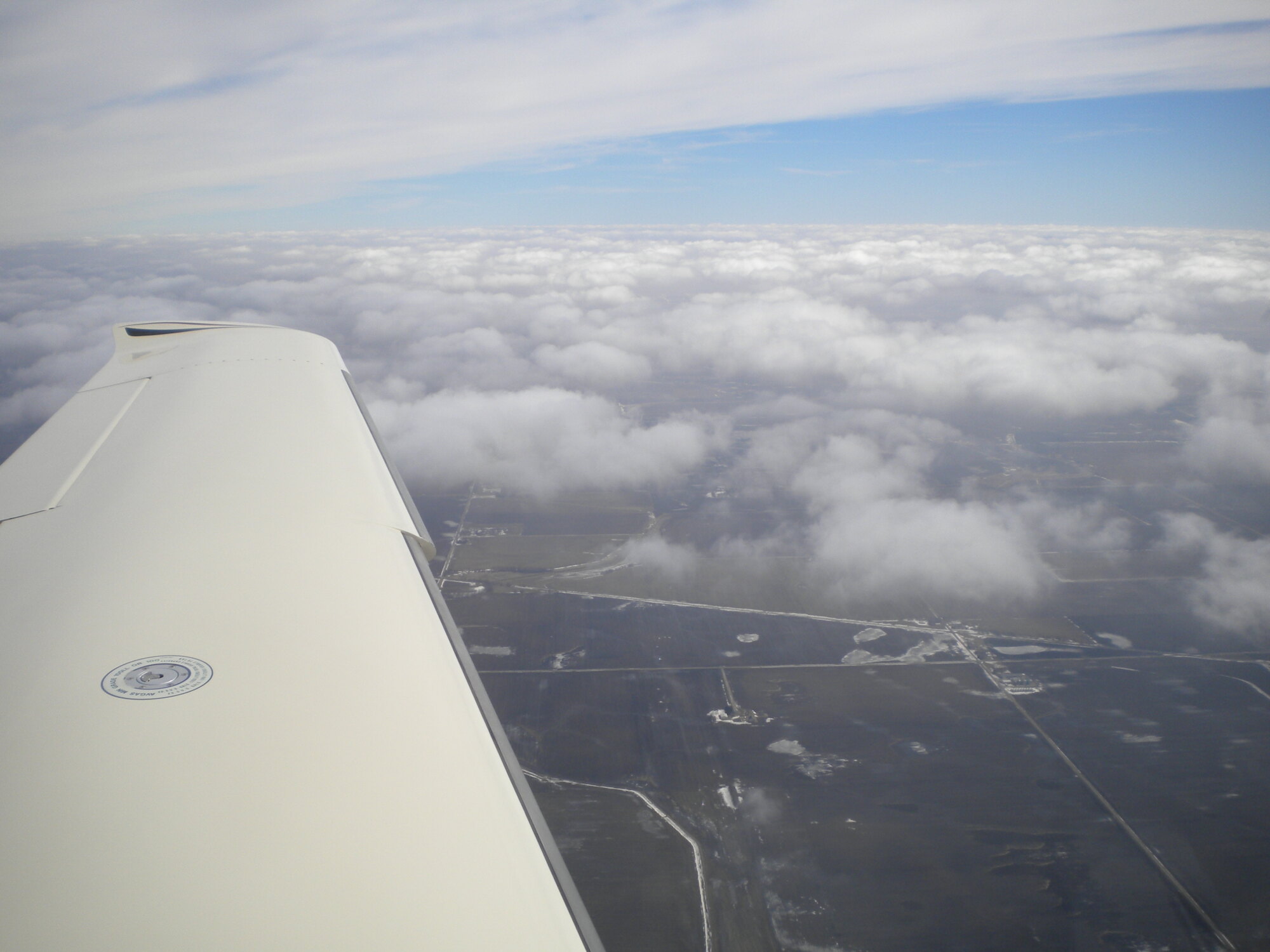
It’s ironic that among the many debatable elements of IFR flying, topping the list is the visual approach. Can you “do what you like” so long as you see the airport? Is canceling better? Is an IAP always safer? Compared to a published procedure, the visual approach is indeed open-ended. It’s based on a set of rules, to be sure, but has many variables for the pilot building an arrival to the runway that fits the situation—or not, as the case may be.
All In Sight
The related irony is that visual approaches are the most common IFR procedures you’ll get when flying around as a means of travel. That is, unless you’re one of those “weather chasers” who file altitudes between the bases and tops and use ILS approaches to wash the airplane. Or, you might be based on the coast, in which case you need to venture inland and log some “actual VMC.” Otherwise, visuals happen all the time in the system. Yet they get little to no attention in training and are absent from IPC requirements. As a result, they’re often misunderstood, mismanaged, or avoided altogether even on CAVU days (“I’ll take vectors for the RNAV 27.”) It’s just fine to opt for an IAP when ATC offers choices, but there are other tools that could fit the environment or traffic flow more efficiently. The visual approach is one of them.
The general rules are in the AIM, with emphasis on “general.” One of the hard limits is airport weather; it must be at least 1000-3 (you need both). If the airport has no weather reporting, there must be a reasonable expectation of the minimum conditions. For towered airports, a visual works much like a VFR approach, with an assigned runway and instructions on proceeding. In busy airspace, ATC can use an instrument approach fix to sequence traffic on visuals. The open ends are mostly at non-towered airports. No runway’s assigned and you don’t have to tell ATC which one you want. You can request a visual or ATC can initiate one. For the controller to say “cleared for the visual,” you must report the airport in sight (most common) or a preceding aircraft to follow in sight. You’ll be handed off to advisory soon after receiving the clearance, similar to when flying an IAP. Visuals, as the name implies, require remaining clear of clouds while flying visually to landing. What can possibly go wrong?
Rules of the Road
For starters, there’s weather. You’re still IFR on a visual, so it’s up to you to flip back to ATC if conditions degrade and you need a new clearance. Visuals don’t include missed approach procedures. That’s because the weather is supposed to be good enough to remain in VMC for go-arounds, flying the traffic pattern and landing when able. If you can’t remain visual (say a fog bank rolls over the field) or you can’t remain clear of clouds without unnatural maneuvers, it’s never too early to speak up. If all goes well and you haven’t canceled in the meantime, cancel on the ground just as you would after landing from an IAP.
Then there’s traffic. The prescribed pattern (direction and altitude) at a non-towered airport is for all visually flown approaches, IFR or VFR. It’s often thought that IFR visuals are supposed to be an instrument-like approach with a long final, five to 10 miles and sometimes a long base added. This is by no means required. It can be legal, but note the AIM language for non-towered airports: “aircraft are expected to remain clear of clouds and complete a landing as soon as possible.” It’s likely there’s VFR traffic in the pattern, and right-of-way-rules apply. The lower altitude airplane, not necessarily the one under IFR, has the right of way. And everyone’s supposed to coordinate with each other. Even if that’s you calling dibs on the runway, e.g., “10-mile final for Runway 27,” it’s not the preferred method. At worst there’s a close call, or at the very worst, a collision—a number of which appear in the accident records.
Wider and longer, when feasible, can be done safely with careful timing, communication, and see-and-avoid. Put a TBM 850 on a 5-mile final to a 6000-foot runway. Add a Cub (a yellow, slow VFR airplane for you weather-chasers). It just took off and the pilot called “left closed traffic.” By the time she’s midfield downwind, the TBM pilot has hangared the airplane and gone home. Just kidding … he’s on short final and can easily turn off by the time Yellow-Slow completes the base leg. Thankfully, Cubs cannot fly IFR. They don’t have enough fuel for a 5-mile final, anyway.
More Open Ends
Another consideration, especially when going wide, is airspace. Be aware of what’s around. Airspace incursions can and do happen in these situations; a visual usually comes with expectations for you to set up a predictable path to a pattern leg. You still have a lot of discretion on maneuvering, but if it’s excessive and the controller can still see you on the scope he might ask if you are OK. Or, someone might be waiting for an arrival or departure clearance. Whatever you do, there might not be extra ATC coordination as with an instrument approach. So give a heads-up if you want lots of space, ask for vectors to a visual, or avoid straying too far.
To elaborate on the weather trap, canceling while flying a visual just clear of clouds can violate airspace rules because if in Class E airspace, VFR requires remaining 500 feet below clouds. If visibility is 3 miles, you could lose the airport turning base 4 miles out. Class E most commonly has a floor of 700 feet AGL in the IAP-protected areas around airports; E can also go to the surface. Class G, which starts where E ends in otherwise non-designated airspace, requires under VFR 1 mile visibility and clear of clouds, which is still below the requirements for an IFR visual approach.
Get the Visual
If that’s not enough to put yellow caution tape around visual approaches, these procedures shift responsibility for avoiding terrain and obstacles to the pilot. Here’s an interesting example: It’s a marginal-VFR, fall day and you’re headed to Macon County Airport in Franklin, North Carolina. Flying a Cessna 182 with an IFR GPS is quite an upgrade from the Cub, so you enjoyed the flight from northern Georgia at 8,000 feet. The route, just above a broken layer, goes direct to an initial approach fix, DAYEL, for the RNAV (GPS)-A. With an approval from Center for a straight-in, you can skip the course reversal. Caveats: The approach is the only one there and is circling only. That’s certainly feasible with a broken ceiling at 3,000 feet, visibility 5 miles and a circling MDA of 3,620 feet (about 1,600 feet AGL). Winds are 10 knots from the west, so you can cross midfield for the right downwind to Runway 25. That’ll be a good way for you to check out the airport while complying with the traffic pattern.
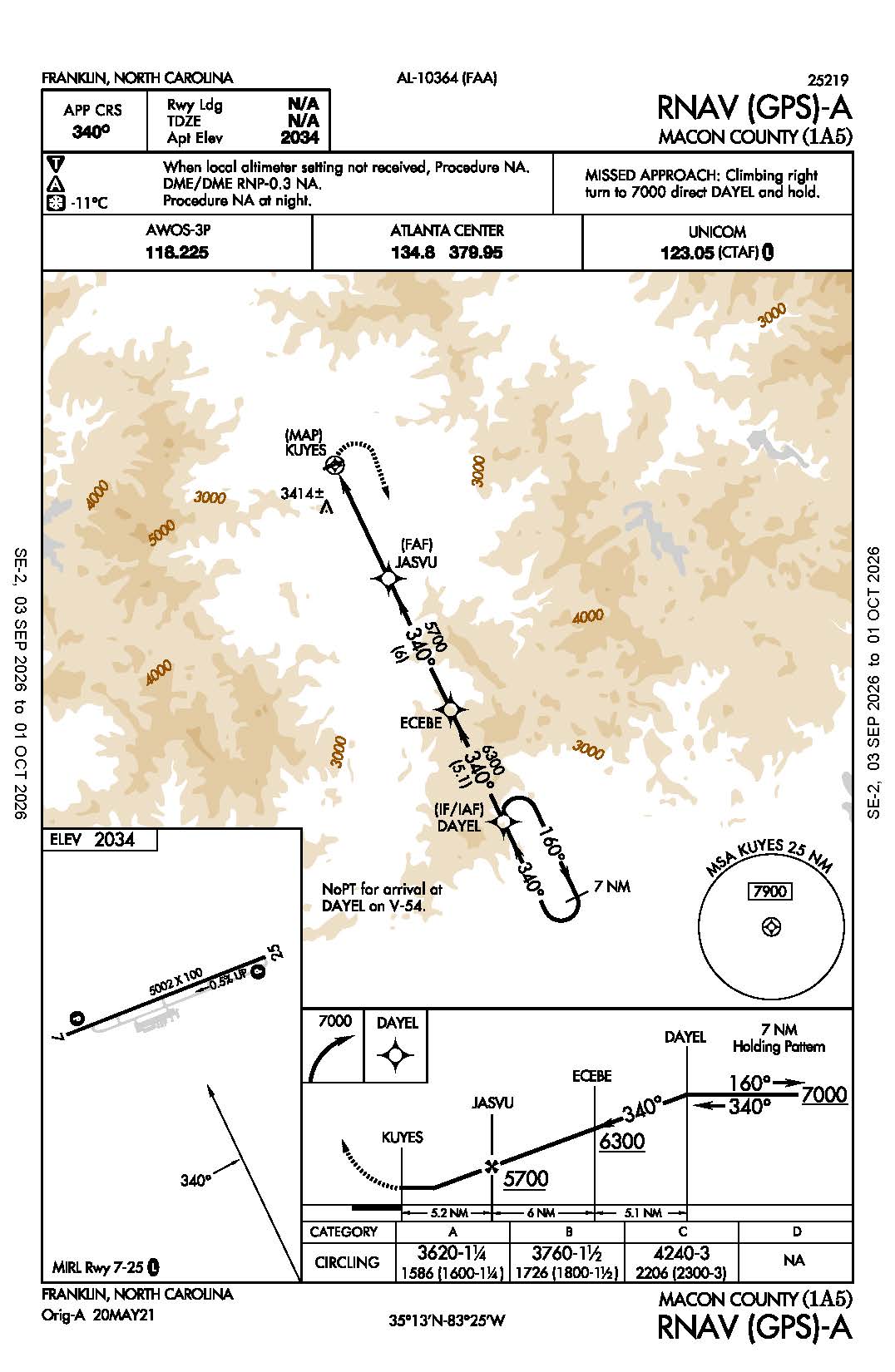
Meanwhile, 20 miles from DAYEL you’re now in and out of IMC. Rime ice accumulates on the windshield. Meantime, the ground elevation is rising. That you did plan for. At the airport, the Chart Supplement notes: “Rpdly rsg trrn all quads.” That’s one reason why you filed for 8,000, anticipating a descent to 7,000 as you get clearance for the approach. The IAP has stepdown fixes to keep you safe from “trrn” prior to descending to the MDA. But the icing was unforecasted. Options? Climb and go to the alternate. Which you didn’t file. Because it was VFR. No matter, you can always ask to pop over to Asheville. Or, you can elect to continue. Maybe your fuel state’s a concern, or the clouds and icing are worse to the east. You can escape all that by getting clear of clouds to reach Macon County. The ceiling just to the west of your position has broken up to scattered, revealing the highway leading to the city and the airport. A vector in that direction to set up for a visual approach will allow you to skip the IAP, sidestep to lower terrain over the road, and remain at a safe altitude to circle down over the runway. You can then fly a normal pattern at 1,000 feet AGL (3,034 feet).
This use of the visual approach isn’t for every day, but if conditions allow, the procedure can be a way to manage an issue with weather or equipment and land in less time than can be done with an instrument approach. In VFR conditions it can be a rewarding way to end an IFR flight. Your hard-earned skills still come into play while flying a visual approach, which as we discussed is a common operation. Visuals require in-flight decisions while working with ATC, and often transitioning from IMC to VMC. Then you’re managing a stabilized path to a landing while hand-flying most of it. In the meantime, the clouds will be there soon enough.

Just a minor typo in an otherwise super article: 1,000 AGL here is 3034, not 2134.
good eye—fixed.
I think it’s worth noting that while the legal minimum for a visual is 1000-3, that’s not a practical condition. Since the controller can’t take you below the MVA, you’ll have to be able to see the airport from the MVA or higher, and MVA’s usually don’t let you get below 2000 AGL or maybe a tad lower. To have a good view of the ground from the MVA, the ceiling will have to be 2000-2500 or better, depending on how low the MVA goes. Also, since they can’t let you conflict with other traffic at the airport until you’ve got them in sight, you pretty much need at least 5 miles visibility to be able to call airport/traffic in sight before the controller has to turn you away and send you off to a standard approach. So, from a practical standpoint, if the weather at your destination is less than 2000-5 or so, a visual probably isn’t feasible even though you’ve got the legally-required 1000-3.
One other nit to pick — you don’t get “dibs on the runway” by announcing you’re on a 10-mile final. All that does is let traffic in the pattern know you’re inbound so they will have make sure they turn base and land before you get there, and if they can’t do that, extend behind you. Being on a long final does not prohibit traffic from turning in front of you if they can do that without interfering with the completion of your approach and landing. OTOH, absent an emergency, if you turn in front of another plane already on final forcing them to alter or abandon their approach, you’ve violated 91.113(g). For the legal ramifications of that, see Administrator v. Fekete (Spoiler alert: Emergency Revocation).
Wouldn’t this situation be tailor-made for a contact approach?
And a contact approach must be requested by the pilot. A controller cannot suggest or assign one without that request. It permits the flight to wander as necessary and does permit much worse weather conditions. Use one only cautiously.