

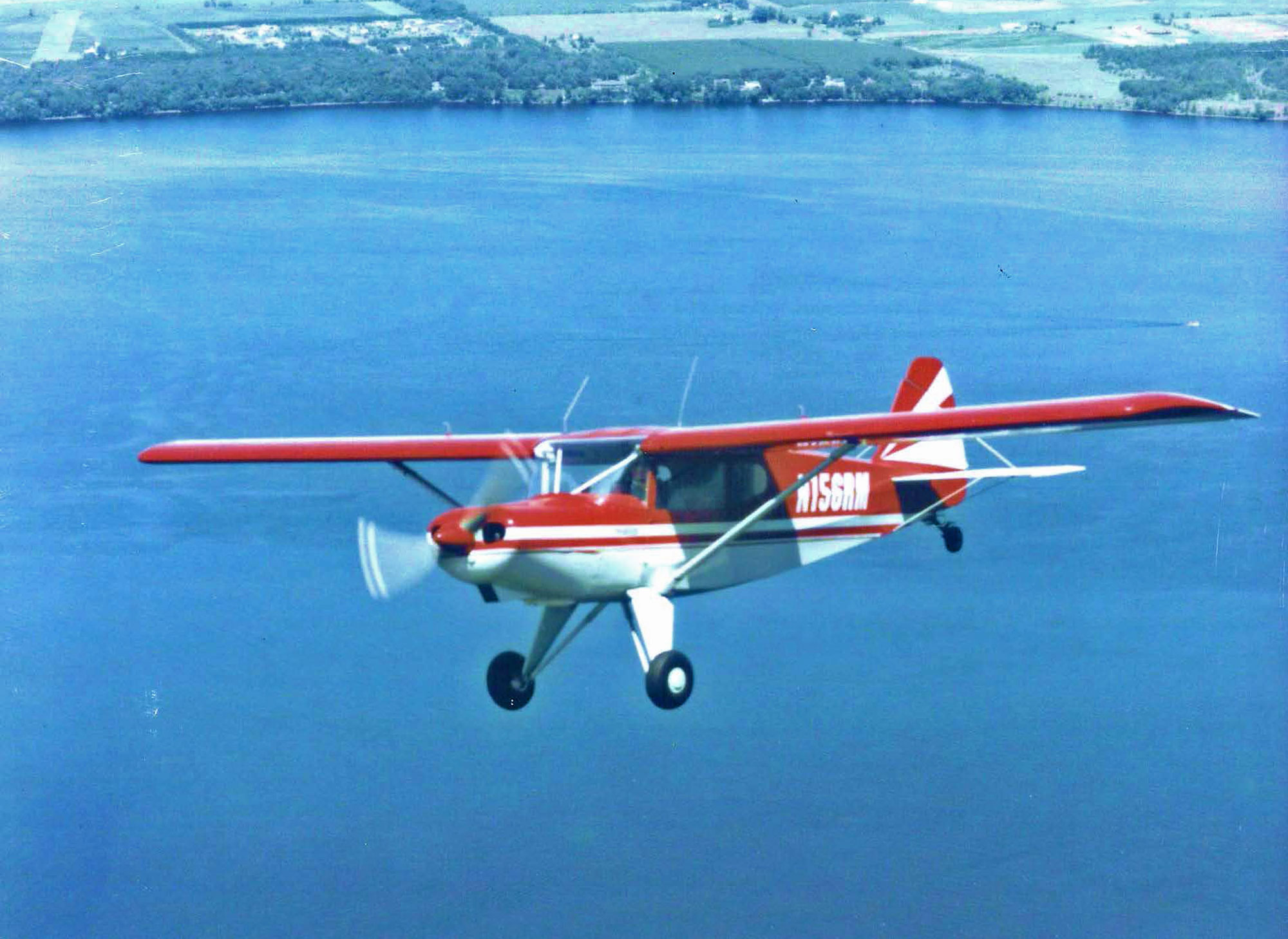
Let’s go back in time 30 years. The year was 1995. Bill Clinton was the president. The Ford Taurus was the most popular car. Toy Story and Apollo 13 were two of the most popular movies.
Most Sport Aviation magazine readers know who Budd Davisson is. He is a contributing writer on various aircraft projects and his Shop Talk builders’ tips. Back in 1995, Budd was … you guessed it … a contributing writer for Sport Aviation magazine.

In the October issue of that year, Budd wrote a flight report on a new aircraft design called the Barrows Bearhawk. Budd’s story about this straightforward, high-wing, four-place airplane resonated with many readers. This at a time when fast glass and RVs were dominating the homebuilt aircraft scene. The article stated that construction plans were available for scratch builders.

Robert “Bob” Marek was one of those readers. Bob was already a “repeat offender” airplane builder. He had built a couple of niche aircraft: first a kitbuilt Moni motor glider, then a plansbuilt Bounsall Super Prospector. Neither proved to be what he was looking for in an airplane.
While reading Budd’s article, Bob realized the Bearhawk was a legitimate four-place aircraft. It had impressive capabilities and looked affordable to build. He wanted one. He recognized it would be a big project, but the prospect of building one did not scare him. “I really liked the looks of that airplane,” Bob recalls. “If it flew like they said, that would be something.”
Bob wasted no time ordering construction plans from designer Bob Barrows and he received Bearhawk plans serial Number 19 in the mail. The drawings were traditional blueprints from hand-drawn engineering drawings. While old school, they effectively communicated what was needed to build the aircraft.
Bob placed orders for sheet aluminum, steel tubing, and sheet steel from material suppliers. He built form blocks and fixtures and started crafting wing parts. There was no kit back then—the airplane had to be scratchbuilt.

Flying Farmer

Bob was a dairy farmer in Cadott, Wisconsin, and his days were filled with feeding and milking cows, planting and harvesting crops, repairing machinery, and doing whatever needed to be done. He was no stranger to hard work and long hours.
Farming taught him to be self-sufficient. Welding, fabrication, and repair were vital skills to keep the farm going. Those skills, along with watching his time and sticking to a schedule, would be key factors in building his airplane.
Bob owned a Citabria that he enjoyed flying off his farm strip. But building airplanes was a hobby he liked even better.
Bearhawk Genesis
(You may have noticed there are two Bobs in this story—I will try to keep them straight for you.)
Robert “Bob” Barrows designed the Barrows Bearhawk in the early 1990s as an engine parts hauler. It supported his aircraft engine building business. He previously used his Cessna 170 to pick up engine parts and deliver completed customer engines.
Barrows longed for better performance than his 170 could offer. He put his mechanical engineering background to work and designed a suitable replacement he called the Bearhawk. The name signified the brawniness of a bear with the excellent flight maneuverability of a hawk.
Barrows was also a “repeat offender” airplane builder. He had built a Midget Mustang, an RV-3, a Pietenpol Air Camper, an original design called the Grasshopper, and a Pitts-type aerobatic plane. He also did some rebuild projects. He was well qualified to design and build a new aircraft.
The Wings
Meanwhile, Bob Marek was building his Bearhawk wings in his farmhouse basement. The process was straightforward but labor-intensive—the parts count is high in an all-metal wing. Bob subscribed to Bob Barrows’ monthly newsletter called Bear-Tracks, which provided valuable builder tips and instructions in support of the construction plans. The wings took 18 months of “spare time” building to complete.

Retirement

In 1997, Bob Marek and his wife Jeanine decided to retire and sell their farm. They turned their attention to building themselves a new home, hangar, and grass airstrip. This was on farm property they had set aside from the sale, and the projects took 10 months of hard work. Neighbors and friends helped when they could, but Bob and Jeanine handled much of the effort themselves.
When they finally finished, they took a well-deserved break, which Bob used to fulfill a long-held dream by flying his Citabria to Alaska. He spent two weeks exploring the 49th state. “I was camping above the Arctic Circle and experienced the midnight sun,” said Bob. “It was very different to have daylight in the middle of the night.” For her part, Jeanine decided to stay back and keep the home fires burning. “My adventurous spirit wasn’t as big as Bob’s,” she recalled.
The Fuselage
When Bob returned home from Alaska, he turned his attention back to the Bearhawk project. His completed wings were safely stowed away, so it was time to get started on the steel-tube fuselage.
He built a long table in his new garage and started cutting and fitting fuselage tubing. This was a departure from the wings project. He went from cutting, forming, drilling, and riveting sheet aluminum to cutting, fitting, drilling, and welding chromoly steel tubing and sheet. Bob’s gas welding skills from his farm days served him well during the fuselage build.

Bob made rapid progress. “Being retired and done with my building projects really helped,” he reminisced. “No more cows to milk or nails to pound. I could focus on the airplane.”
His build progress compared favorably to other plansbuilders, even with the time he took off to build his new home and to fly to Alaska. The Bear-Tracks newsletter published builder progress updates. Bob never thought about being the first Bearhawk completed from Bob Barrows’ plans. He was focused on building and flying a promising-looking airplane.
Bob Barrows Visits Bob Marek

In the summer of 1998, Bob Barrows and Mike Meador flew from Virginia (their home base) to Alaska in Barrows’ prototype Bearhawk. Their epic journey was chronicled in the Bear-Tracks newsletter later that year. On their return trip, they dropped in to visit with Bob and Jeanine Marek and check on their Bearhawk build progress.
The Home Stretch
“We completed the fuselage structure in 1999,” Bob recalls. “We then attached the wings and tail feathers and ran all the cables to the control surfaces.” With the help of Jeanine and another Bearhawk builder from the local EAA chapter, Bob covered the fuselage and tail feathers with Poly-Fiber. He painted the metal parts with Aerothane and the fabric areas with Poly-Tone.
When it came time to find an engine, Bob ran into some good fortune. “Bob Barrows told me about the availability of a low-time Lycoming O-360 with a prop and starter,” recalls Bob. “I purchased the engine and replaced the starter with a lightweight Sky-Tec model and added a Nippon Denso 55-amp alternator.” Bob installed the engine on his completed fuselage and made all the connections.
He then turned his attention to the instrument panel. Bob used all round “steam gauges” to produce an effective VFR setup. Keep in mind, glass panels were not on the scene yet.
He upholstered his seats, installed seatbelt harnesses, and completed the remaining finishing touches.

Final Assembly
When Bob weighed his new Bearhawk, it came in at 1,192 pounds with no back seat installed. This compared favorably with the Barrows prototype. Bob Barrows has a reputation for building light for optimal performance. Bob’s Bearhawk was inspected on May 3, 2001, and was signed off for flight.
First Flight
Bob test-flew his new Bearhawk on May 4, 2001. “I was a little nervous about making sure I had everything covered before I attempted to fly it,” he remembers. And for good reason. He was the first plansbuilder to finish. Only Barrows’ prototypes (180 hp and 260 hp) had flown before him. “But I did trust my work,” he said.
Bob intended to run a series of taxi tests. But as he started moving, he realized the airplane handled just like his Citabria. “Everything felt good,” Bob recalled. “The side-by-side seating versus the tandem I was used to was not an issue. The visibility was great.”
Bob decided to make a takeoff run. Applying throttle smoothly, the airplane accelerated quickly, tracked straight, lifted off, and climbed better than he expected. Bob got it up to altitude and flew it around the farm strip to feel it out. Its flight manners were superb. The performance was beyond his expectations. His new aircraft felt flawless. The first landing was uneventful.
Since he had no issues on that first flight, he promptly launched again. He was having fun. He continued to do this until the fuel he allocated for his first test hop had been used up. It was then he realized he needed to fill up his fuel barrel for further flight testing.

Almost five and a half years since starting construction, he had an aircraft he was excited to fly. He was thrilled with the results.
Once he flew off his flight-test requirements, Bob used his Bearhawk to visit many local and regional airports. He loved its short-field capabilities, great handling characteristics, and cruise speed performance. He regularly cruised at 130 mph and landed around 50 mph. Stalls were in the high 30s. Not bad for a 180-hp four-place backcountry airplane.
Those who flew with him would rave about the flying qualities of this aircraft. It was also a boost for those builders pursuing their own Bearhawk aircraft.
The Builder’s Itch
Bob flew his Bearhawk for many years. But the itch to build again was there. “I missed having an airplane project,” said Bob. “I love the building process. But I didn’t want another large project like my Bearhawk.”
Finding a deal on plans and materials for a Thatcher CX-4 in 2010, Bob launched into another build. After 13 months of focused construction, he completed and flew his CX-4 in the fall of 2011. He loved the performance and fighter-like feel of that little aircraft. It was very economical to fly with good cruise speed and he flew it on a regular basis, with fly-in breakfasts as favorite destinations.

One More Build
In his 80s, Bob was again getting bored not having an airplane project. He decided he needed an ultralight. Leonard Milholland’s Legal Eagle seemed like the perfect fix for his boredom. He ordered plans, sourced materials, and went to work.
The wings were fabric-covered wood construction. The fuselage was welded chromoly tubing, a piece of cake to construct for a fellow like Bob.
He outfitted it with a 1/2-VW engine and test-flew it in early 2020. The Legal Eagle was a very enjoyable project for Bob. Like the Thatcher, it became a stablemate with his Bearhawk and other builds.
Torch Bearer
Bob’s successful Bearhawk build inspired others to have confidence in building one from scratch. From the early success of scratch builders sprang the Bearhawk Aircraft kit business. Kits made this outstanding airplane much more accessible to those who wanted one.
Mark Goldberg was one of those early Bearhawk enthusiasts. He saw the need for an easier way to have a Bearhawk without the long scratchbuilt journey. He formed a company in 2001 to manufacture and sell Bearhawk fast-build kits and he worked closely with designer Bob Barrows to make sure the kits met specifications.
With the success of the original Bearhawk four-place model, Barrows followed with a two-place tandem design called the Patrol. It featured a highly efficient Harry Riblett airfoil.

Then came a light-sport tandem design called the LSA. A Model B revamp to the original four-place was next. It featured a new Riblett airfoil like the Patrol for better performance.
Then came the side-by-side, two-place Companion. Lastly, the six-place heavy hauler Bearhawk Five was introduced (Barrows’ fifth design).
As Bob Barrows came out with each new aircraft design, he worked with Mark to get it set up for kit production. He also offered plans for all models to those who still wanted to build from scratch.
Goldberg ran the Bearhawk Aircraft kit production business from his Austin, Texas, location for 22 years. He decided to retire from the business in 2023 and sold it to Virgil Irwin of Fairview, Oklahoma, who runs the business at the Fairview Municipal Airport.
Looking Ahead by Looking Back
Here we are, 30 years later. Bob Marek’s Bearhawk waits in his hangar until his son Steve can take it over and give it a new home. Bob does not fly it anymore.
It’s fun and educational to look back on the history of aircraft types. The Bearhawk line owes a great deal to Budd Davisson publishing that flight review in 1995. It introduced the world to a capable backcountry airplane for homebuilders.
Bob Marek was one of several brave scratch builders who took on a Bearhawk build by faith. Their hope was to have a great airplane when completed. These builders succeeded and helped set the stage for the Bearhawk’s success.
Enthusiasm, persistence, and hard work can generate great outcomes. Bob Marek had these traits and produced the very first plansbuilt Bearhawk.
