

It’s really a non-argument. The Rotax engine on our Van’s RV-12 happily runs on high-octane, 10% ethanol unleaded. Pump fuel. And aside from the relative cost savings of buying pump fuel, the engine was really designed to run on mogas and you’ll pay a price in parts and labor if you primarily use 100LL avgas. Oil change and tank cleaning intervals are stretched to 100 hours compared to 50 hours when running the engine on 100LL. If leaded fuel is used more than 30% of the time, you’re changing spark plugs every 200 hours compared to 400 hours with mogas. And that gearbox overload clutch? Inspect it only at 1,000 hours compared to 600 hours when using 100LL.
With some local 100LL priced damned near $8.50 per gallon, we gladly bring our own $5.25 per-gallon 93 from the Citgo around the corner from the airfield. But this BYOF practice is far from foolproof for our shared ownership arrangement. I’ve been paranoid about it from the beginning and turns out there’s good reason.
A recent preflight caught attention-getting amounts of water in the sampling, a learning moment for what water/ethanol absorption looks like. Aside from the annoyance of blowing a planned trip, the fix was an unplanned uncowling of the engine and flushing fuel through the gascolator until it finally came out clean. I admit to some tension on the first takeoff run once it was back together and ground-ran.
But before all that was a tail-chase trying to figure out who fueled the airplane last (every pilot in our group puts it away with a full tank) and where the hell the watery gas came from. I like sourcing from the local Citgo because it’s a busy station that pumps a lot of fuel, but that doesn’t mean there isn’t risk of getting watery fuel. But the real challenge is maintaining control of multiple gas cans and because some in our group fly less frequently, that means the ethanol-mixed gas can go stale unless you properly treat it. And even that might not always work.
Additionally, it’s our responsibility to keep the fire marshal and the neighbors happy by not storing multiple cans of fuel in the hangar. At some airports it may be against code to store fuel, and that’s something to think about when choosing a hangar. To me, it’s worth the small effort to drive to the Citgo and fill the cans with fresh gas for top-offs after flying. Common sense should rule. We’re still figuring out where the moisture came from but it’s possible that the storage cans used for filling the tank on the last put-away were stored outdoors and might have faulty seals.
Roll Your Own Fuel Farm
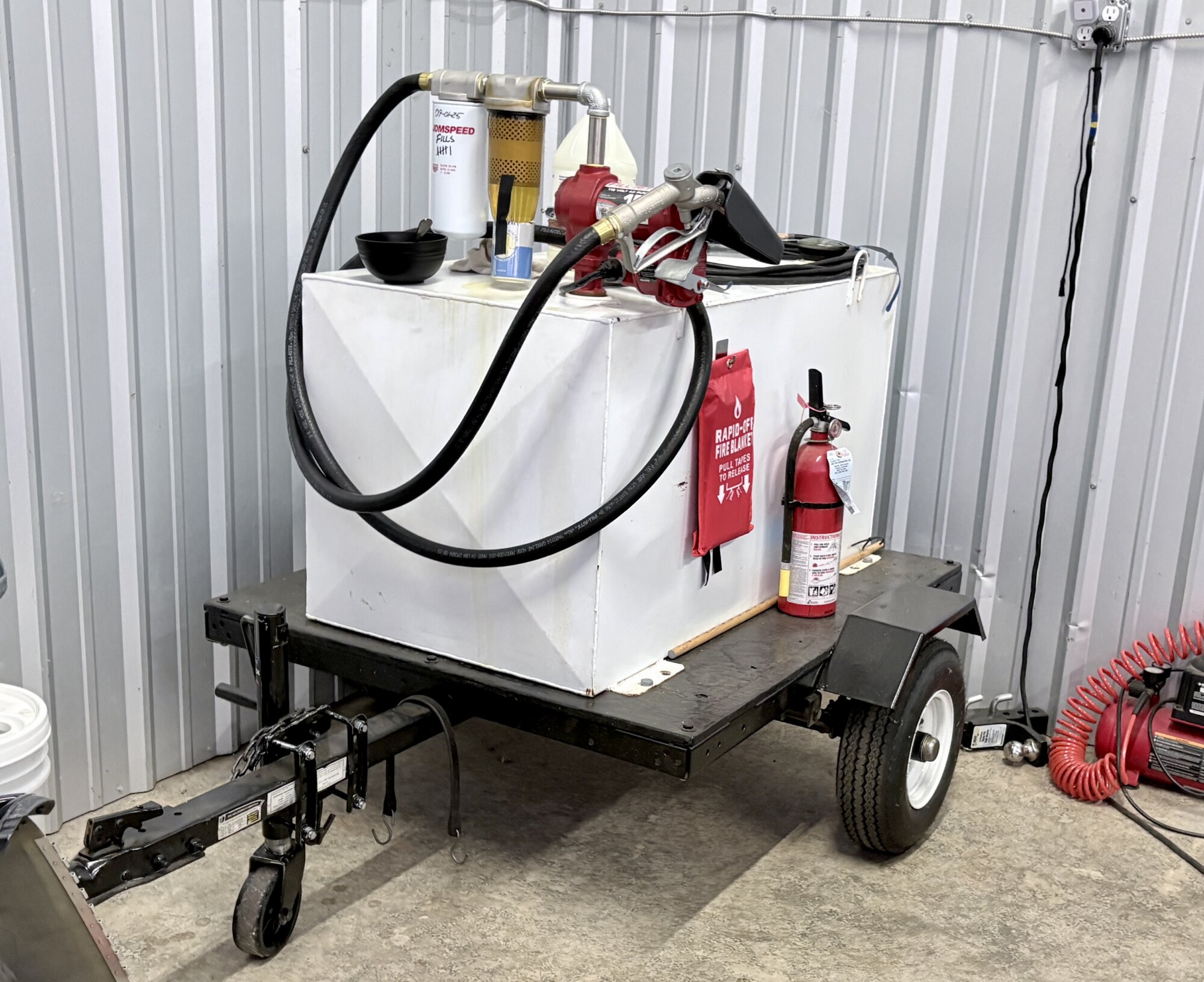
And so it was timely that I came across the smart-looking little fuel farm in the lead photo. Turns out its builder, Scott McElroy, has a background in risk management and is careful as everyone should be about storing fuel for use in his own Van’s RV. My kind of guy. McElroy’s capable setup was quite affordable (we linked to the major components, though there might be plenty of substitute parts when building your own) and has far more control and safeguarding than storing in plastic jugs.
The trailer, a small Harbor Freight folding model, can be sized to the fuel storage cell and his is roughly 3 by 5 feet. The rectangular steel fuel tank is a pretty standard 100-gallon design with a filler cap and a threaded female fitting for the pump. McElroy sourced his on Facebook marketplace for around $400. The pump (with a pickup tube) is a 110-volt Fill Rite that flows 15 gallons per minute. He installed a water/ fuel separator in line after the pump, and then a JDM Speed fuel filter.

McElroy marks the filter each time he fills the tank, and replaces it after eight fills—or 800 gallons. Like us, he sources ethanol-mixed pump fuel and eventually the stuff gums up filters. If you have filters in the aircraft, they’ll eventually gum up and McElroy notices the one in his RV-12 is ready for replacement at around 150-hour intervals.
This setup sure beats lifting a heavy gas can to fill the aircraft’s single fuel tank, with a filler neck located up high on the fuselage. The hose is a standard Fill-Rite pump hose and gas nozzle. You can use a wooden dowel with 10-gallon markings for measuring the fuel quantity, but a simple float fuel cap could also be used.
For shared arrangements where you might want to record fuel use and charge individual members for the fuel they pump, you could also install a Fill-Rite fuel meter inline. The company makes a nice variety of digital and mechanical fuel flow displays to choose from.
If you had an airport pickup truck as many do, you could of course skip the trailer and keep a similar setup in the bed. But McElroy doesn’t need one. “I pull my fuel trailer behind my Benz SUV very easily, but any car with a hitch could pull it for fill-up at the local gas station,” he said.
If you have a fuel storage setup that works for you, let’s hear about it.

Maybe just not visible in the photo, but Id certainly add a grounding wire to this setup.
This setup has grounding, of course. The 110-volt power supply is grounded and you also attach a copper clamp from the pump to the aircraft when filling.
Not sure what your criteria for quite affordable is, but my calculations give me something WELL over $1000 and I didn’t even price all the parts. I would love something similar to this, but my budget isn’t that rich.
Richard, the cost of plastic jugs (Canadian jugs which poor without spillage and have vent caps US$) for 6 gallon jugs is about $20 each. I used 6 for transporting 39 gals which is $120 or so for the cost of jugs. Today, most of them are 5.5 gals or 36 if you over top and use them before the temperature changes.
You can buy a ready made one from JME at $1200 which is consistent with your estimate.
A friend with the same airplane/engine as mine did it differently. He bought a used semitruck fuel tank 100 Gal, freightliner aluminum round tank, built a cradle for it and added a pump and hose. The tank cost him about $200, the pump about $300 more and he got hoses and nozzle from a farm supply house for another $100 about 5 years ago. I’m not sure how he managed to mount the pump to the tank, but he’s in SE Michigan where there is an abundance of machinists and engineers. I am shocked at the price of pumps these days. My first was a TutHill hand cranked pump which I think I got at a farm auction for $25.
What you did is the same as I do – several 5 gal jugs. Of course the current “no spill” jugs cause more spillage than the old fashioned jugs with just a plain pour spout so I usually buy the straight spouts from Amazon and use those.
If you save $2 per gallon, while burning 7 gallons per hour, you’re saving about $1000 in 70 hours of flying.
Also, FYI Vevor has 58 gallons transfer tanks for around $600 (just need a truck bed or trailer) (includes everything but 12v power).
I have a very similar set-up, same trailer, except with two 22 gallon tanks for my mowers and tractor.
We couldn’t understand how we were getting water in the fertilizer pump gas tanks on our tender trailers, we even started storing in a shed. Then I found out an employee was putting 10% ethanol gas in them.
your water came from the hygroscopic ethanol, pulled out of the air. Pretty common among bikers to avoid ethanol because of the crap that will collect in fuel systems.
I will NEVER use ethanol in small engines or my airplane.
I am a farmer with vested interest in ethanol, doesn’t change my experience and opinion.
We have 210 gallons in two tanks on a trailer. Trailer has license plates and lights to make a 3 mile run to fill with 91 octane. The trailer is stored 30 feet from the hanger at the edge of the ramp. The pump is mounted on the principal steel tank, powered by 12 volt battery and charged with a 10 watt solar panel. (The secondary tank is plastic and used to transfer to the primary one.) Both tanks are grounded to each other and the trailer frame. And the planes are grounded for each fueling. The pump on each tank has a filter. And I dipped the tank with water Detection paste applied to the repurposed wood broom handle that is used to check quantity.
FYI, in the U.S., trailering more than 119 gallons requires hazmat permits.
If Ethanol is a problem (and it usually is), there are gas stations that sell ethanol-free gas for an upcharge. There is an App called “puregas” that will help you find where to purchase it.
While you still pay road taxes, you short change the aviation fund by skipping the fuel pumps at the airport. At the price of avgas, I can hardly blame someone for doing this but it becomes a downward spiral.
You make a very valid point, but if you own a Rotax powered aircraft, using 100LL continuously will nearly double your routine maintenance effort and expense. My local airport just installed a completely new fuel system, but despite being in a very “green” state, the airport sponsor (county government) refused to consider adding Pb-free fuel. I suppose the 100LL tank will eventually be converted, but until then we’re stuck. Luckily a gas station <10 min away sells ethanol-free mogas in three octane grades (I’m in farm country, so it’s in demand).
Ever since TN gave FEDEX a fuel tax cap, I could care less if my few pennies worth of aviation fuel tax gets avoided by using gasoline. Apparently they have money to burn and decided to give FEDEX a free pass.
I bought and use one of these. Works well.
https://smartassproducts.net/collections/aviation
Those are very nice units, but wow, are they expensive! They don’t appear to be towable behind a road vehicle; do you refill yours by winching it into the bed of a pickup? Or will it drive itself up a tailgate ramp?
Unfortunately several stations around here explicitly don’t allow filling this type of rig. Maybe a Colorado thing? Check before building one. I just did the math and such a rig’s payback is very quick assuming 100 hrs of flying/yr.
I have been using mogas alcohol free since the mid 1990s in my C182/O470R. It ran fine on Avgas 80, but when 80 disappeared, 100LL created all manner of problems. The engine runs cool, scavengers didn’t work. Every oil change required pulling the bottom plugs and cooking the lead out of them. So, I got the mogas STC and bought the plastic jugs. I also got a graduated cylinder for alcohol testing as some gas stations weren’t too fussy about what they called “ETOH free” fuel. Then the state abandoned labeling altogether. It was still available but you had to know where to get it. Once the switch was made from 100LL to mogas, all of the spark problems went away and the oil at change interval was cleaner, as were the oil filters. The engine at that time had about 300 SFRM.
Fuel Transfer:
Initially 6 plastic jugs of the 1990s style (which you can still get in Canada) worked for years. I never left them full, just topped them at 6.5 gallons each for a total of 39 gallons gallons. This mostly covered my needs then. Since the 87 Octane ETOH-free gas station was on the way, and I was flying 2-3x week it was pretty easy to keep the jugs full and empty them into the airplane.
I moved to a new state in 2008 where mogas was on field, but about the time I signed the hangar lease, it was discontinued with the new FBO on field. A few tanks of 100LL and we were back to mogas ETOH free. Initially with the same jugs that filled the snow toys, boat and chainsaw. But the fuel needs had increased. I added Flint tip tanks increasing my fuel load to 83 gal usable as I was commuting about 6 hours twice a week, making the trip non-stop with mogas at the southern field. So between the toys and the airplane I needed something else.
Tankage & Transport:
Fueling:
Lifting a hose and nozzle to the aircraft up a ladder is a lot more fun than lifting a 6.5 gallon plastic jug weighing 38#, not resting on the wing, and not spilling.
Time to fuel about 10 – 15 minutes. About the same as a self service pump.
So, the total rig then cost about $800, I just checked the meter last week and have pumped over 11000 gallons (about 600 gal/year) adding about 8 cents/gallon to the pump price, exclusive of the truck and the diesel to get to the airport. Mogas 91ETOH free right now is running about $4.00/gallon and reg E10 87 is $3.85. The spread is usually a bit higher with in ordinary times mogas was running $2.75 and E0 91 was running about 3.60. The local FBO base charges about the highest fuel prices in the state at $7.85-$8.25 a gallon and sells very little 100LL to anyone as they can fly 10 miles away and get it for half.
About half of the fuel is bought (mainly mogas or now Swift 94UL) on the road away from base.
I’d say it was worth it in savings in spark plugs and oil changes alone. Oil analysis shows very low Pb in the oil, the engine ran to 2750 hrs SFRM or about 1250 hours past TBO, when it was overhauled due to increased wear metals and a cam lobe wear pattern. It is now 1875 hours SMOH (new limit) with zero problems on probably 75% mogas ops and Electro-Air EIS. The EIS dropped the fuel burn from 11.5 to 10 g/h at 9000-11000 ft and down to 7.8 g/h at 14-16k.
The main mistake I made was not buying the 110 gallon tank. The DoT regs limit this transport to 110 gallons without placarding, but every time I put 51 gallons in and need about 15 more to top the tip tanks, I think I should upgrade.
I have an almost identical setup to the one shown here. I live on an airpark with no fuel source so I pull the trailer about 20 miles to an airport with 100LL and pump in 30 gallons. Then on the way home I stop at a station that sells ethanol free 91 octane gas (for boats, yard equipment, etc.) and top of the tank with about 75 gallons. That gives me a mixture with at least 95 octane, no alcohol and the benefits of the long shelf life of 100LL.
Typically the ethanol will dissipate the water though out the gas and it will never collect at the bottom of the tank but over time the fuel will be come saturated with water. My Airport has a rule that gas can only be stored in the Airplanes tanks so a rig like this is out for me and I don’t fly enough to use the fuel before it goes bad. another thing Ive found is while my engine and fuel system is safe for ethanol the orings in the fuel drains were not and this week Im replacing the seals in the fuel cap cause they have now harden and are leaking.
Often the o-rings and gaskets will swell when exposed to alcohol in fuel. I do not use E10 in any internal combustion engine except the car which is unavoidable. I don’t store gas in anything in the airport except DoT approved tanks. I find it curious that we can store fuel in aircraft tanks, made of rubber, which will probably melt a lower temps than poly cans, or metal which can leak.
Moisture came from the ethanol, which is hygroscopic (LOVES CT River atmosphere) (ie: ethanol is a dessicant). Ethanol is also what makes mogas go stall and what causes vaporlock.
Get rid of the ethanol gas and replace it with pure (zero ethanol) mogas. (BTW, Rotax only “approves” up to 10% ethanol, it defaults to wanting E0 (zero ethanol))
STALE not stall (stupid AI)
>>replace it with pure (zero ethanol) mogas.
Not a widespread option.
I’ve found that a Wurx 20 gallon tank with their battery powered pump (and rechargeable AA batteries) does a pretty good job. I can’t store fuel in the hangar (except in the plane, of course), so I make sure to buy less fuel than the plane’s totalizer says I need and empty the Wurx container each time.
Since 20G of fuel is more than I can lift into the back of the SUV, I put the container in the back when it is empty, fill it at Costco while it is still in the back, back the car up to the plane’s wing and pump from it there, and then put the empty (and much lighter!) container back in the hangar.
No problems in my setup, but when friends do it in their Tesla or Rivian, they get a lot of strange looks from people at the gas station!
I just had a Wurx pump grenade on me last week. It was the plug-in version. I’m lucky I didn’t lose the plane, the truck and the hangar. I got rid of it and am back to using 5 gallon jugs (and looking for a better way). Their battery powered pump is probably safer, but still be careful…
Yikes, that’s scary. Electrical fires and gasoline don’t sound like a good mix. The battery powered pump has been fine.
Most local state fire marshals have pretty strict regulations regarding hauling gasoline on public roads in a tank like this. As one commenter stated, if over 119 gallons, you would need a CDL, placards, and a tank endorsement on your drivers license. If under, you would still need authorization from your local fire marshal. Here in Massachusetts, the fire marshal does an inspection on the tank and puts a decal on it. Many of the transfer tanks sold by Harbor freight, tractor supply, etc. are only certified for combustibles such as diesel or kerosene. Gasoline containers are built to a higher spec. Just make sure you are legal before doing something like this.
Time to move to a better state.
You would need to expand your comment a bit if you want anyone to know what you’re talking about.
Blanket statements like this suck. Not everyone lives in a communist left wing state. My local fire marshal has better things to worry about than some guy and his gas can.
Blanket? You mean like the Federal regulations regarding bulk containers? Or the Federal regulations covering hazardous materials transportation? Fire marshals don’t really have “better things to worry about” than some imbecile hauling around enough gasoline to incinerate you and your entire family in a traffic accident because said gasoline is in a half-assed, do-it-yourself tank trailer that’s not up to standard.
Alcohol is put in fuel at the terminal.
You might find a terminal which will sell you fuel without Ethanol if you bring such a system to them.
In Canada, some airports sell alcohol free Mogas; which they get from the distributor.
Lead is bad for all engines;
Our organisation just had to ream the lead out of valve guides on an engine.
An engine which is known to run better and longer on unleaded, but in an aircraft for which there is no STC available.
People need to push for unleaded availability at decent prices; sans STC!