

From the perspective of flying various mods over the years, we believe that the drag reduction mods give the best bang for the buck—the best odds for the mods to make your airplane faster at a reasonable price (if anything in aviation is priced reasonably).
The good news is that there are a lot of speed mods on the market, so there is probably at least one for your airplane unless it’s a Grumman/Gulfstream Cheetah or Tiger, later model Mooney (the companies where Roy LoPresti did his speed increase magic), or Cirrus as those received a lot of attention to drag reduction while they were still in production—and the attention worked.
The not so good news is that speed increases per mod can’t be stacked. In other words, if one advertises a 4 mph cruise speed increase (and the mod shops always advertise in miles per hour because the numbers are bigger than when stated in knots and no one in the U.S. uses kilometers per hour as those numbers would truly be big), adding another mod that advertises a 3 mph speed increase you aren’t going to go 7 mph faster. It’s going to be somewhat less. Each speed increase advertisement is based on comparison to the stock airplane without any other mods.
For this report, we’ve hand-picked several speed mods that are currently on the market for certified aircraft, identified suppliers, and given our thoughts on their effectiveness.

Wheel Pants and Fairings
Modifications to attack the high drag of fixed landing gear using wheel pants and/or gear strut fairings have historically been the most effective, with speed increases of up to 11 mph over main gear tires and 6 mph over factory landing gear fairings. The fairings and wheel pants have several marketing names including Fancy Pants and Speed Pants. The nosegear is also a high drag area that has been reduced with various combinations of wheel pants and gear strut fairings.
A side benefit of reduced drag on the gear (and elsewhere) is an increased rate of climb. We’ve gotten feedback from owners who installed landing gear wheel pants and strut fairings indicating that their airplane took off in a shorter distance and climbed better, allowing them to go comfortably into strips that had previously provided a certain pucker factor.
Gap Seals, Flap Hinge Fairings
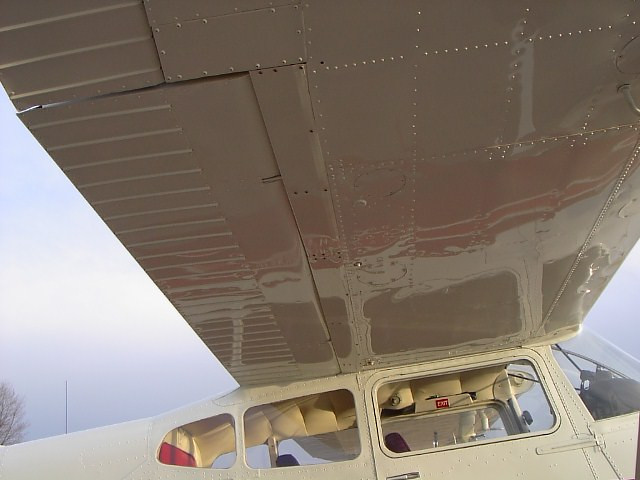
The gap between the trailing edge of the wing and the flaps and ailerons has long been thought to be a high drag area due to the leakage of higher-pressure air under the wing up through the gap. The thought was that lift would increase and the airplane could fly at a slightly lower angle of attack to further reduce drag. There was concern that flap gap seals would interfere with the airflow over the flaps when extended at low speed—thus increasing stall speed.
Put bluntly, what we found over the years was that, in testing, flap gap seals did not adversely affect stall speed. They often increased rate of climb and cruise speed slightly, although the amount varied widely with the type of airplane. We’ve received reports of speed increases from 0 to 3 mph.
Aileron gap seals have one big positive effect: They dramatically increase roll rate and low-speed handling in roll. We think that they are worth it if just for that improvement. Reports we’ve received and claims by mod shops for speed and rate of climb increase range from modest to no effect at all.
We observed prices in the $500 range for flap or aileron gap seals—although installation may require the extra cost and effort of painting. Some suppliers, notably Knots 2U, also offer flap-fuselage and stabilator gap seals for Piper singles. And, Piper singles have their flap hinges hanging out in the breeze. Of course, fairings are offered for them and might give a one to two mph speed increase.
Fuel Tank Fairing and Smoothing
A high drag area on the Piper Cherokee 6, Lance, Saratoga series, and Seneca twin series is around the wing fuel tanks due to exposed rivets and screws. Laminar Flow Systems offers a combination of fairing and smoothing for the area and makes claims of cruise speed increases in the 4 mph for fairing and 15 for smoothing. Kit prices start at $1,025.

Hoerner Wing Tips, Gear Lobe Fairings/Wheel-Well Fairings
Hoerner wingtips have been around for decades for various Cessnas and Pipers and have proven popular for speed increases of 2 to 3 mph. We have not been able to confirm claims of better handling.
Retractable Piper singles and the Seneca still have a turbulent air area aft of the main gear wells when the gear is up. Fairing in the area (it does not affect landing gear operation) reportedly increases cruise speeds by up to 4 mph.
Main Landing Gear Speed Covers
400-series Cessnas have a significant drag area around the main landing gear when it is retracted. Speed covers that look like smooth hubcaps bump cruise speeds by up to 15 mph and rate of climb—we’ve flown them before and after installation and found that the claims were true. For on the order of $3,600 for the kit and an installation time of under two hours (we watched), we think this mod is a no-brainer for the 400-series Cessnas for which it is available. Premiere Aviation (www.premiere-aviation.net) has a video showing before and after performance on its website—it matched what we observed when we flew a 421C before and after.
There’s also the LoPresti Hubba Hub caps for 6-inch wheels. They have an access door with a 1/4-turn fastener for access to the tube’s air valve, and are approved for Bonanzas, Cessnas, Mooney’s, Maule’s, Pipers, and others. We found them at Aircraft Spruce for $279 per pair.

Cessna 177 Cardinal Cowling Cover
The earliest Cessna Cardinals (models 177 and 177A) had a surprisingly high-drag lower cowling. A $550 replacement lower cowling from Maple Leaf Aviation (www.aircraftspeedmods.ca) reduces drag by redirect airflow around the nose and through the engine. Cruise speed increases of up to 12 mph are claimed.
Select Main Supplier List
- Knots 2U: One of the earliest mod shops formed, Knots 2U began by speeding up the already efficient Piper Twin Comanche. It has an impressive list of speed mods primarily directed at Pipers and Cessnas.
- Whelen Aerospace: Long known for its aeronautical lighting equipment, Whelen Aerospace acquired LoPresti Aviation (and in its marketing continues to use the famous name), making a long line of effective speed mods for a number of aircraft types, although it eventually focused on the Piper line. Currently, Whelen offers LoPresti speed mods for a range of Piper fixed and retractable singles.
- Laminar Flow Systems: Proprietor of an air charter operation in the U.S. Virgin Islands in the 1970s, Robin Thomas became increasingly frustrated with the speed of the company’s Piper Seneca I. Retaining an aerodynamicist, Thomas developed speed mods that cranked up cruise speed by more than 8 mph, formed Laminar Flow Systems, and went on to develop more speed mods, including a set that upped the speed of a Cherokee 140 by 20 mph. Targeted at Piper singles and the Seneca, Laminar Flow Systems now offers an eye-wateringly large line of speed mods that have proven popular with users because they work.
- Maple Leaf Aviation: Initially working on ways to make the Cessna Cardinal line faster, Maple Leaf Aviation has branched out to include mods for the Cessna 172 and 182, but the Cardinal series remains its focus.
- Premier Aviation: Providing one product for the Cessna 400 series line, main landing gear speed covers, Premiere Aviation has succeeded in delivering a product that provides a nice performance boost at a reasonable cost that can be installed quickly.
Conclusion
In our opinion, the odds of getting the results you want for a mod are highest with the drag-reduction offerings. If your budget just allows one mod, we think wheel pants give the most speed increase of any of the others offered.

Once upon a time at an aerodrome far, far away someone came up with the idea of selling dimpled tape for the leading edge of propellers to increase prop speed/thrust using the criterion that golf balls with dimples flew farther and straighter than smooth ones… Would this fall under the category of snake oil or just collecting O.P.M?
The best (and cheapest) way to reduce drag is to make sure your wings, stabilizers and flight controls are installed in their most correct and optimal positions, and that everything is rigged perfectly.
I don’t have a single speed mod on my machine and she cruises at the book speed without any mods. That is saying something for a Piper, which has notoriously optimistic published numbers.
I have seen an increase in speed in my C-182Q. I did install gap seals, new wing tips, and an exhaust pipe cover, and I keep it waxed. However, I think the greatest increase in speed, was having my engine mount structure re-aligned. It always seemed to, with wings level, to be slightly ball right. Once that was done, overall I’ve seen about 6-7 knots increase in cruise and slightly better climb performance. True, not a dramatic increase, but it was to the positive.
Yes, reducing drag is a lot less expensive than HP.
I replaced the wing tips on my C175B wiht Hoerner tips, and, along with the flap gap seals, I now use 6.8 gph vs the poh 8.8 gph at 125 mph.
The other performance change is a 10 mph reduction in stall speed, which is now 40 mph with 30 degrees flaps, vs 50 originally.!!
I have most of Maple Leaf’s speed mods on my fixed gear Cardinal. I’m about 5 knots TAS over “book” speeds.
The best speed mod is to have your 50yo plane freshly re-rigged by someone who knows what they are doing. As a certified mechanic, surprising how many planes I see improper cable tensions or other issues.
Fixed properly, pilots are surprised and hear feedback like “Feels like a sports car” or “It’s 5 knots faster.”
I second comments from Dave Coleman & Nordic Dave about rigging. My 172N with O360 cruises at 10,000′ at 130 KTAS at 8.1 gph. No speed mods, just carefully set rigging.
Speed is proportional to cube root of power, thus reducing drag is the most effective way to increase speed (and efficiency).
Speed mods are fine, but secondary – first make sure the rigging is correct. Otherwise you’re dressing a turd.