

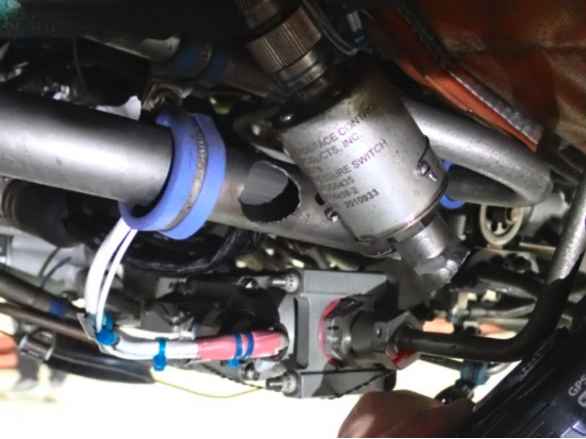
Two NetJets pilot deadsticked a Citation Latitude while there were “two instances of fire flaring up around the airplane” as they made an emergency landing on a highway in Laredo, Texas, three weeks ago according to the NTSB preliminary report. Five of six people on the plane survived the accident, which resulted in the big business jet splitting in two on a freeway about a mile short of the airport. Investigators also found a fuel pressure switch broken off a fuel tube in the right engine and major damage to a starter generator when they inspected the aircraft after the crash. The preliminary report does not draw any conclusions from that physical evidence, but the report also shows the crew received alerts relating to the fuel and electrical system before declaring an emergency and heading for Laredo. The flight was supposed to terminate in Austin after originating in Los Cabos, Mexico.
Trouble with the airplane started with an “unusual vibration” coming from behind the panel. The crew checked with their flight operations duty officer and they all determined it was safe to keep going. A while later the crew alerting system (CAS) told them the fuel boost pump had come on, indicating low fuel pressure and confirmed seconds later by a CAS message. That was followed by a generator failure and an alert that they were low on fuel, and that’s when they decided to head for Laredo. On final both engines quit and surveillance and doorbell camera videos showed the two instances of fire enveloping the plane. The crew asked ATC if there was an open field they could reach but the controller had bad news. “It’s just going to be the main highway, and that’s just about it.”
The crew set down on the northbound lanes of Bob Bullock Loop, sheared off some light poles, and hit a vehicle (injuring the driver), and the plane ended up rolled on its side straddling the edge of an overpass. Passersby eventually got a door open and helped the five survivors get out of the plane, which had a small fire going in the fuselage. One passenger died, the captain was seriously injured, and the first officer and three other passengers were slightly injured.

It seems strange to have such a catastrophic failure on such a reliable system. For the fuel pressure switch to just rip out (vibrate out?) of a fuel line is so random. I’m guessing there are a couple of reasons for this – possibly a bad weld and the lack of or improperly installed pipe clamp that allowed excess vibration. Then there is the problem with missing screws in the starter generator as well. Hard to tell from the pics in the report whether the missing screws were part of the casing or part of a support system. I’m guessing Latitude owners will at least be inspecting these systems now and not waiting for a final report.
Without seeing a close up of the fracture surface, that looks like a fatigue crack at the weld. This reads like the aircrew did everything right, but that mechanical failure dictated the ending. Next question might be, could this be a fleet issue?
Appears that the right generator increasingly ate itself throughout the flight creating the vibrations resulting in the fuel sensor departing from the fuel line. The large hole left in the fuel line would quickly deplete fuel in the right tank and account for the fire(s) observed in flight from the ground. I understand (could be wrong) that the fuel crossfeed on a Latitude connects directly to the opposite side fuel line—not the oppposite side fuel tank. Crossfeeding from the left tank to the gaping hole in the right fuel supply line would quickly deplete the left tank leading to flameout of both engines with little fuel remaining for a post crash fire. Obviously all this needs to be confirmed by the NTSB, and I look forward to hearing if and when left to right crossfeed was applied as a cautionary tale for my own flying.
The fuel crossfeed system feeds fuel to both engines from the same tank (left or right). Normal operation, the left tank feeds the left engine, right tank feeds the right engine. Having the crossfeed engaged (from either tank) would explain the near simultaneous engine flameouts. None of the failures mentioned in the preliminary would have precluded normal operation of the left engine and systems, had the fuel crossfeed not been engaged.
You can bet the FlightSafety sim instructors will use this situation as a training and checking item. The instructors at CAE trained the fuel loss/leak situation in the Hawker for the initial and all the recurrents I attended.
I still remember our Flight Safety instructor reminding us that cross feed on a Hawker “SUCKS.” In other words it is a vacuum from the receiving side rather than pressure pushing from the supply side. But that was a few years back.
Monday morning quarterbacks tend to aggravate me. However, seems to me if I’m concerned about lack of fuel and I’m over an airport at 21,000 feet, I’m not going to let a controller take me completely out of range from safely making it down to the airport that was directly under me.
“Trouble with the airplane started with an “unusual vibration” coming from behind the panel. The crew checked with their flight operations duty officer and they all determined it was safe to keep going. “
Perhaps this is that armchair piloting mentioned before, but….you are flying along in a vibration free jet. The next moment a vibration is felt. an “unusual” one which would indicate maybe a not so small one.
Color me cautious, but would that not constituent at least a PAN PAN and a divert to investigate while on the ground, not at some height above it? I know it is not quite apples to apples but if I am driving down a highway and from one moment to the next my engine starts to run rough, I’d seriously consider taking he next exit to see what may be wrong then driving on till it blows up.
Still, Cudo’s to the pilots for doing what they could and dead-sticking into a difficult spot to try and save everyone.
Sure glad it wasn’t a fly-by-wire airplane. Although they probably would have had enough battery left to operate FBWire flight controls for the short amount of time they lost power. Manual flight controls are still the best.