

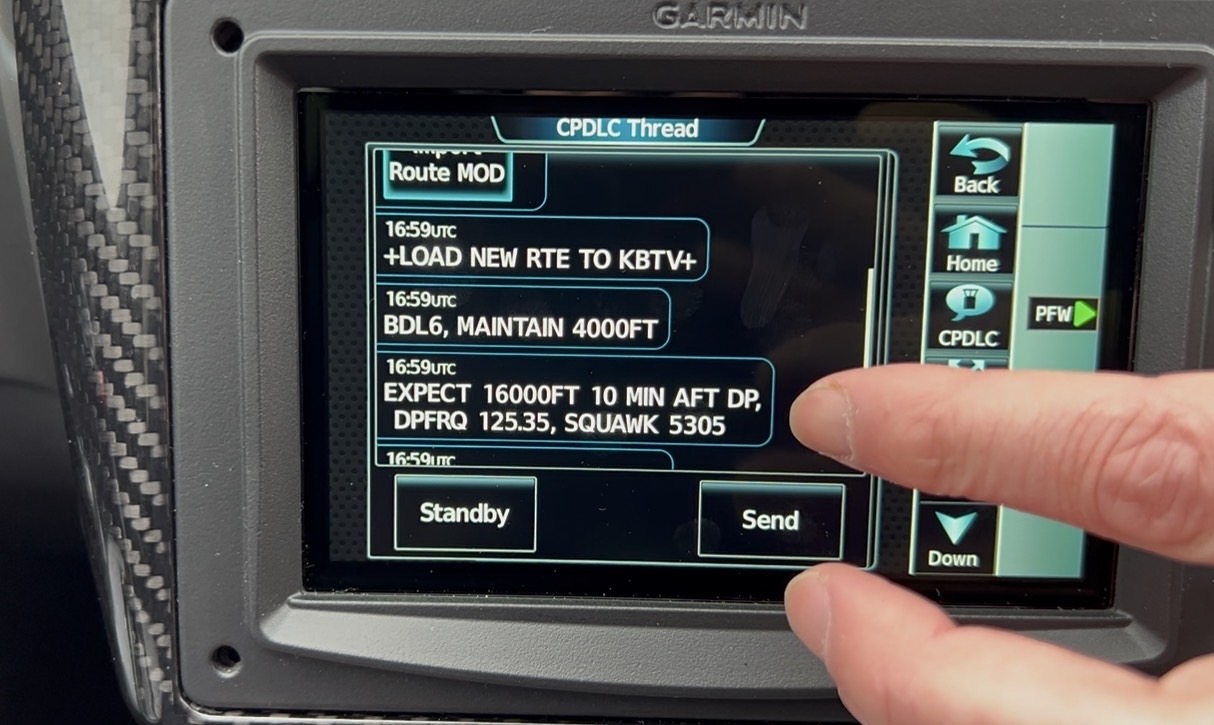
There are two issues involved in departure procedures: obstacle clearance and Air Traffic Control (ATC) coordination. Last time we talked about obstacle clearance provided by compliance with standard takeoff/climb-out procedures, or when published, nonstandard takeoff minimums and/or Obstacle Departure Procedures (ODPs). The other half of the problem that we’ll discuss today is ATC-directed departure routing/climb clearances, which can be very long and complicated. The use of Standard Instrument Departures (SIDs) reduces the amount of clearance delivery bandwidth needed to communicate the routing to the pilot.
Unlike the ODP, which is published primarily for terrain/obstacle clearance reasons, the SID is used to save a lot of time, talking, and confusion with ATC. It is published solely to allow controllers to say “LINDZ ONE SID” rather than to read a long description of the route, initial climb-out instructions, frequencies, and altitude assignment instructions. Let’s say you’re departing Aspen (ASE) for Denver (DEN) and have filed via Kremmling (RLG) V8 Mile High (DVV) at 17000. The controller could read the following:
“Grumman two two romeo lima is cleared to Denver via heading 343° to nine thousand one hundred, then climbing left turn to sixteen thousand on heading 273° to intercept I-PKN northwest course outbound to LINDZ then V591 Kremmling as filed. Maintain sixteen thousand, expect seventeen thousand ten minutes after departure. Departure frequency one two three point eight, squawk four three two one”, which is a total of 63 words that took me 45 seconds to say. Or, using a SID, the clearance could be simply, “Grumman two two romeo lima is cleared to Denver via the LINDZ ONE, as filed, squawk four three two one,” which is 20 words taking 9 seconds. Which would you find easier to copy, and which takes up less time on the clearance delivery frequency when four other aircraft are waiting for their clearances?
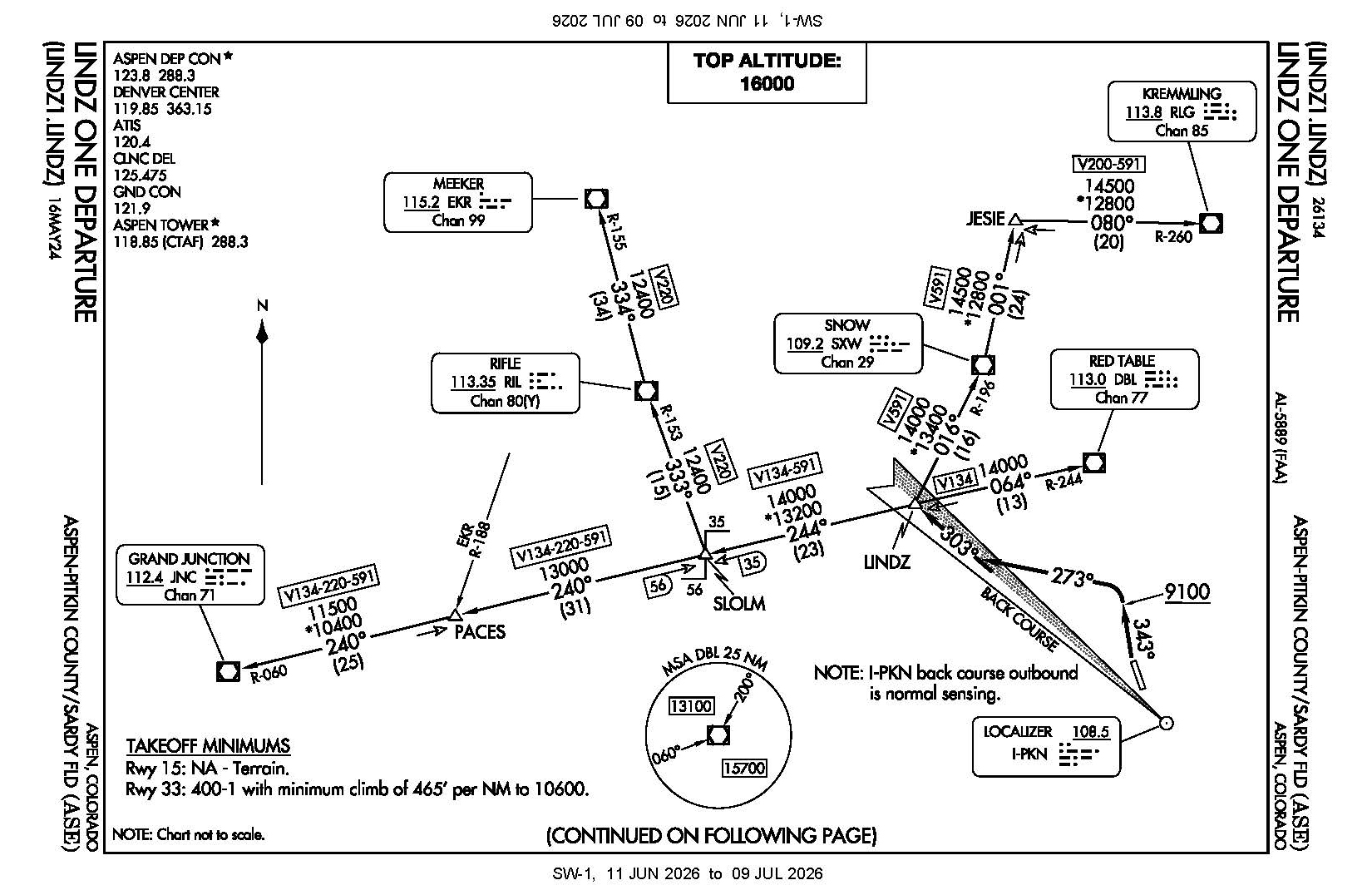
In referring to the chart we see that it includes the initial climb-out, the routing, and the initial and expected altitudes as well as the departure frequency—all without clogging up clearance delivery. This “pilot nav” SID (i.e., one which you fly on your own navigation rather than following ATC radar vectors) includes everything you need to fly the route.
Vector SIDs
The other type of SID is a “vector SID.” These involve locations where there is no preplanned departure route as with the LINDZ ONE, but they would like to reduce the repetition of departure instructions on the clearance frequency. A good example is the PITTSBURGH FIVE at Pittsburgh International (PIT).

Imagine if you filed from PIT to Wilmington, Delaware (ILG) via direct Johnstown (JST) and then via Victor airways. The controller can give you “Cleared to Wilmington via Pittsburgh Three Johnstown, as filed, squawk 2345”—and that’s it! The SID includes the initial heading on takeoff (depending on the runway you are assigned), the expectation of radar vectors to your filed route entry point, the altitude instructions, the departure control frequency, the tower frequency, and even ground control frequency depending on where you’re parked.
RNAV SID
The last type of SID is relatively new (the last 30 years or so compared to more than 50 for VOR-based SIDs), the RNAV SID. These are generally developed only for high-volume airports with a lot of jet traffic, and in many cases are limited to use by turbojet aircraft cruising at FL 180 or higher.
In the case of the TERPZ EIGHT departure from Baltimore (KBWI), the “maintain 250 knots” note is a giveaway that they aren’t going to expect most pistons to fly it. They are only for use by aircraft with GPS, FMS, or other RNAV equipment that satisfies the criteria in Advisory Circular 90-100A. Generally speaking, all modern GPS systems, even the legacy Garmin GNS 430/530, meet these criteria, and their databases include these SIDs. Check your Approved Flight Manual Supplement and other product documentation.
Another feature of the TERPZ EIGHT is the inclusion of specific altitudes to meet as you climb. These are the “hard-line” altitudes you see with an underline (showing minimum altitude), (maximum altitude), or (hard altitude). If the controller tells you to “climb via the SID” rather than including a specific altitude(s) on departure (“maintain four thousand”), you must meet all the “hard-line” altitudes on the SID and stop at the Top Altitude.

In this case, if you are departing on Rwy 15R with the TERPZ EIGHT SID assigned, you would have to meet the following requirements:
- Minimum climb gradient of 780 ft/nm up to 644 MSL
- Climb to at least 4000 before crossing BOBYJ
- Fly 230 KIAS or less until past BOBYJ
- Maintain at or below 9000 until FLACO
- Cross TERPZ at or above 11000
- Cross LITME at or above 14000.
- Stop climb at the Top Altitude of 17000 until ATC clears you higher
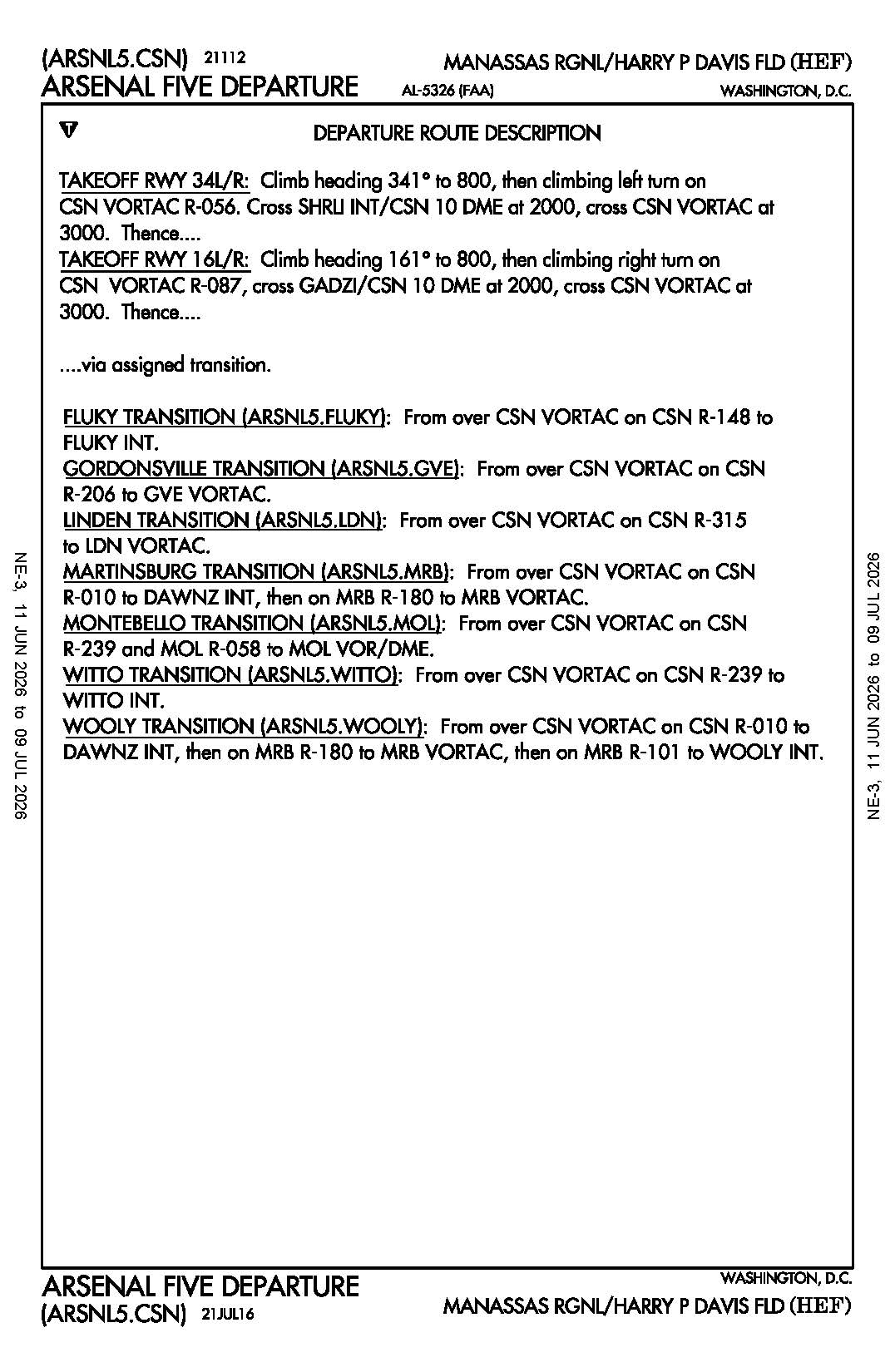
“Climb via” can also be applied on a non-GPS pilot nav SID such as the ARSENAL SID out of Manassas, Virginia (HEF) where you must maintain runway heading until leaving 800, reach 2000 before SHRLI and maintain it until passing SHRLI, and then reach 3000 before Casanova VOR (CSN) and hold it as your Top Altitude until authorized higher by ATC.
That said, do note the MEAs on the legs beyond CSN, as you would be required and expected to climb to them after CSN if you were lose comm before being given higher (the “highest of the three” rule in 91.185(c)(2)). Also, since there is nothing about an expected altitude in this SID, ATC would be required to give you one as part of your clearance, e.g., “Climb via the SID, expect 7000 ten minutes after departure.”
(By the way—yes, FLACO is the former Baltimore Ravens quarterback Joe Flacco, whom, if you’re a Baltimorean, you may remember won Super Bowl XLVII. Others on that SID include former Washington Wizards (later Houston Rockets and LA Clippers) guard John Wall, and former Baltimore/Capitol/Washington Bullets (now the Washington Wizards) center Wes Unseld—the FAA seems to love local sports figures, although it seems they haven’t seemed to work out what to do when they’re traded.)
From the Beginning
One misconception about SIDs (and STARs) is that you can avoid the often-complex routing of these procedures and obtain direct routing or radar vectors by putting “NO SID/NO STAR” in the Remarks block of your flight plan. This old wives’ tale is rooted in the beginning of SIDs and STARs in the 1970s. As mentioned above, the purpose of SIDs and STARs was (and is) to reduce the amount of words a controller must read to the crew to describe the departure or arrival clearance. In those early days of SIDs and STARs, very few of these procedures existed, primarily at bigger airports with mostly air carrier traffic where the clearance delivery frequency could become a bottleneck to departures. In fact, there were so few that instead of incorporating them into the old Approach Procedures books, they were placed in two separate SID/STAR volumes—one each for east and west of the Mississippi.
Each of the two volumes was only about half an inch thick, but they cost extra, which is why most light GA pilots who never flew into airports like ATL, ORD, and JFK didn’t bother purchasing them. The problem was that occasionally they would fly to an airport with SIDs/STARs, and then there would come a communication breakdown and delays on the frequency when the controller tried to assign one for which the pilot didn’t have the printed procedure. To avoid confusion, pilots who did not have the SID/STAR volume would put “NO SID/STAR” in the flight plan to alert the controller that the pilot didn’t have the book so the controller would have to read the procedure to the pilot in its entirety.
Over the years, as the volume of SID/STAR procedures grew the FAA eliminated the separate SID/STAR books and incorporated them along with the approach procedures into what became the Terminal Procedures books. However, sometime in the last half-century, the false idea developed that if the pilot included this phrase in the flight plan, the controller would be required to provide a shorter, simpler routing. What it actually does is create delays and eat bandwidth on the frequency because the controller cannot shortcut the flows into or out of these airports. The most likely result is that instead of going to the head of the line, you’ll be sent to the penalty box until the controller has the time to read the entire procedure to you.
Preparedness Is Key
In all these cases, preflight study is critical. You should check to see what procedures exist (ODP, SID, or nothing), determine their applicability to your aircraft and your flight, and become sufficiently familiar with them that you know what to expect as it comes along. If there are no published IFR procedures, you will have either “roll your own” or wait for good enough weather to depart visually up to the MEA. Either way, a current sectional chart is essential for effective planning, even if it is not explicitly required by regulation for IFR flights.

“Either way, a current sectional chart is essential for effective planning, even if it is not explicitly required by regulation for IFR flights.”
I never flew IFR without a VFR chart showing the route as well, and I was flying before STARs and SIDs. Aviators need to understand the separation of terrain both laterally and vertically in the IFR environment as to how airways and approaches are setup. (TERPS) By the way my first aircraft was a pterodactyl.
Approaches and departures are setup
Aahahh – was that you in Avatar?
Another helpful tip to make clearance read backs easier, is to look up your tail number/flight on FlightAware. Select your flight from the list, select the “More Details” button at the bottom, and probably 98% of the time the routing shown will be what ATC will give you. (You can also load the route into ForeFlight from there) Just write it down and you’re ahead of the game when you call for clearance. This is especially handy when requesting a PDC and it returns nothing, which is an excellent clue there’s a substantial re-route coming your way. You then check FlightAware, see that the routing shown is indeed different than what you filed, and you then write down that changed routing. When the controller says, “I have a full route clearance, advise ready to copy,” you just smile and say “go ahead”. After the long re-route, which you already have written down, you immediately read it back and look like a rock star. This works fantastically, unless someone has blocked the tail number, in which case you’re on your own.