

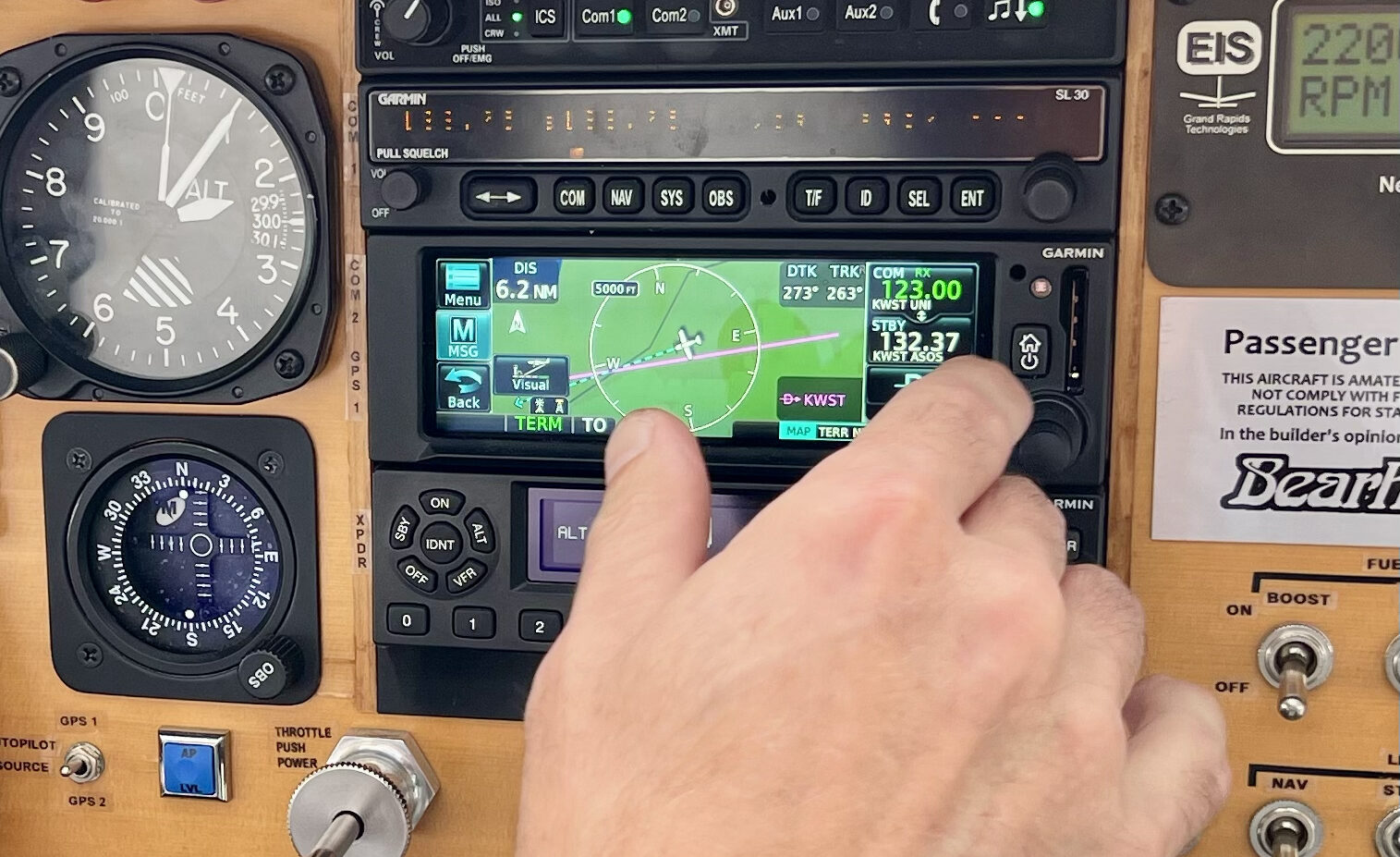
One topic guaranteed to start a good debate in the pilot’s lounge is lost communication under IFR. Some folks will bring out the FARs, others the controller’s handbook, some reference articles in various aviation magazines that might include contradictory viewpoints from pilots, controllers, and FAA personnel. The debate will likely be spirited and likely not result in agreement. All should agree that safety hangs in the balance and that means having a solid plan for when the radios go silent at the worst time.
Is It an Emergency, Really?
The regulation itself says you must follow these procedures for lost comm under IFR. Referencing 14 CFR 91.3, while the PIC has emergency authority to deviate from any Part 91 rule to ensure a safe outcome, Flight Standards has written:
Granted in an emergency situation [emphasis added], § 91.3(b) does permit a pilot to deviate from any rule in part 91 to the extent required to meet the emergency. However, a loss of communication is not automatically an emergency. Under a loss of communications, ATC would expect the pilot to comply with § 91.185, unless there is an emergency. (Coordinated statement from AFS-420/810, June 3, 2009.)
That said, loss of communications in instrument conditions would definitely make me “concerned about safety,” and the Pilot/Controller Glossary says that is an “urgency” condition which by definition is an “emergency.” While that could justify deviation from 91.185, I think Flight Standards is saying that with lost comm, unless you have some additional issue requiring deviation from those rules, they really want you to follow the 91.185 procedures.
Next, note that this regulation covers “two-way radio communications failure,” not “two-way voice communications failure.” There are a number of ways to communicate with controllers other than standard VHF radio, such as:
- Receiving over a VOR station and responding via transponder or turns.
- Using of a cellphone (don’t call 911—find a clearance delivery phone number in the A/FD entry for a nearby airport).
- Other communication systems like SATCOM, ACARS, or SELCAL.
Always troubleshoot the problem as best you can before reverting to 91.185. First, check/switch your headset/microphone/radio/audio panel switchology. Try a few other frequencies from the A/FD or your charts, or even 121.5. My experience suggests these steps will solve the vast majority of lost comm situations without reverting to 91.185.
Where Do You Go?
Paragraph (b) is clear and unambiguous: If you’re in VMC when you lose comm, or encounter VMC after losing comm, and can land “as soon as practicable” in VMC, you must do so. The fact that an airport is inconvenient or doesn’t have a radio shop will not satisfy the FAA if you pass up some airport in central Pennsylvania and fly through the New York metro area to land at your planned destination on Long Island. Better to land at the small airport, phone ATC to tell them you’re all right, and then make whatever arrangements are necessary for a no-radio arrival at that desired destination airport in Class B/C/D airspace. The FAA has been unforgiving (think emergency revocation) in cases where a pilot blasted into a busy terminal area in clear conditions after losing comm. Only if you aren’t in conditions allowing visual flight to a suitable airport do you go to paragraph (c), which starts with the route. The popular acronym for this is “AVEnue F” (AVE-F), for Assigned, Vectored, Expected, Filed. Let’s look at each.
Assigned: If you’re on an ATC-assigned route, just stay on it until you reach your clearance limit. That could be your original flight plan route if “cleared as filed,” or your route as most recently amended by ATC.
Vectored: If you’re on a vector from ATC, and it’s taking you where you’re supposed to go, just stay on it until you get there. For example, if given a vector to join an airway, stay on that heading until reach the airway, then join it. If given a vector then “direct when able” to a fix, stay on the heading until you can navigate to the fix (e.g., when you begin receiving a navaid) then proceed direct. On the other hand, if vectored off your assigned route for traffic, turn to rejoin your route as soon as you realize you’re lost comm.
Expected: If you’ve been given a clearance limit short of your destination that is not on your original route, ATC must give you expected routing past that limit (and if they don’t, demand it). If you lose comm before that clearance limit, hold there until your EFC, then follow the expected route to your destination.
Filed: If you’ve been given a clearance limit that is short of your destination but is on your filed route, absent a different expected route from ATC, just follow that filed route to your destination.
Too Quiet, Too Soon
Imagine you’re on your way from Wilmington, Delaware (ILG) to Atlantic City, New Jersey (ACY) on the standard clearance of “Radar vectors to Woodstown (OOD), V184 Cedar Lake (VCN), direct.” Assume Tower clears you for takeoff on Runway 27 with “turn left heading 180” and you lose comm shortly after you complete that turn. Here, you’re in the “Vectored” case. Since the 180 heading isn’t taking you toward OOD, you’d immediately turn further left direct to OOD, rejoining your assigned route, and then follow that all the way to VCN and from there to the airport (more on that last part in a bit).

Now, imagine as you approach VCN, Philadelphia says, “N12345, Atlantic City isn’t taking the handoff. You’re cleared to Cedar Lake, hold southwest of Cedar Lake as published, expect further clearance at 1600Z, time now 1530Z.” This one’s pretty straightforward—continue on V184 to VCN, then enter the published hold on the VCN 226 radial and wait until 1600Z to depart VCN.
On the other hand, imagine as you approach Woodstown, ATC amends your route saying, “Cleared to BRIEF intersection via Woodstown V166, hold northwest of BRIEF on V166, expect further clearance at 1600Z, time now 1530Z.” Just short of OOD, you lose comm. Initially, it’s easy—when you reach OOD, turn right and follow the OOD 154 radial to BRIEF. But there’s no hold at BRIEF as there was at VCN, so how do you hold? The AIM says that when you reach a fix where you must hold without either a published hold or complete holding instructions, you should enter a standard hold (right turns, one-minute legs up to 14,000 or 1-1/2 minute legs above 14,000) on your arrival course, and in this case it’s 154 degrees inbound to BRIEF.
The problem now is that you have no expected routing from BRIEF and BRIEF isn’t on your original or filed route, so you have nowhere to go when your EFC time arrives. This is why you should never file or accept a route you can’t fly with only the equipment aboard your aircraft. When the controller gave you that clearance to BRIEF without expected routing beyond it (such as “After BRIEF, expect V16 Cedar Lake, as filed,” which would rejoin your filed and previously cleared route as well as being an IAF for ACY), you should have refused to accept that clearance until the controller provided expected routing. Be firm (but polite) in making this point with ATC. The one time a controller gave me an amended clearance to somewhere not on my filed or previously assigned route and absolutely refused to provide expected further routing, I advised the controller where I was going to go in event of lost comm, just so it was on the tape in case there was a problem later.
What Altitude?
The next subparagraph covers altitude to be flown. I teach the mnemonic “MEA” where you fly at the highest of:
- Minimum altitude, either the MEA for an airway or, if off airways, the Off-Route Obstruction Clearance Altitude (OROCA) on your enroute chart (the big brown numbers that look like the MEFs on sectionals)
- Expected altitude (at/after the point/time you were told to expect it)
- Assigned altitude (last ATC-assigned altitude)
So, if our original clearance to ACY was “Maintain 2,000, expect 3,000 ten minutes after departure,” and we lose comm just as we turn south to 180 climbing to 2,000 … - Initially, you are not yet on a published route, so you have no MEA, but you do have an OROCA of 2,700. Your last assigned was 2,000, and you’re not yet to 10 minutes for the 3,000 expected to kick in. The highest of the remaining two is 2,700, so you’d climb to 2,700 as you turn direct to OOD.
- Assume you reach OOD before 10 minutes has elapsed (it’s only 14 miles). When you join V184 at OOD, the MEA for the next leg is 1,900, the last assigned is 2,000, and the expected 3,000 isn’t yet expected. The highest of the available altitude is 2,000 so you’d descend from 2,700 to 2,000.
- When 10 minutes has elapsed, your assigned is still 2,000, the MEA is still 1,900, but the expected is now 3,000 so you’d leave 2,000 and climb to 3,000.
- Since the MEA doesn’t change again before you reach the point where you commence the approach, and the last assigned won’t ever change after you lose comm, 3,000 is where you stay until the IAF.
Now, when will you leave cruising altitude? To a certain extent, that depends on how you chose your routing. Flight Standards guidance says:
It is important for the pilot to accurately and completely describe the planned flight route in the route section of the flight plan. In order to simplify the proposed flight route for ATC, pilots should file the routing via airways or jet routes established for use at the altitude or flight level planned. One of the reasons for a flight plan is to give ATC the pilot’s intentions in the case of lost communications. It is always recommended that pilots file flight plans assuming that their aircraft will encounter a loss of communications. Except when a pilot is being radar vectored, an instrument approach begins at an initial approach fix (IAF). Therefore, the IAF should always be listed in the route section of the flight plan. [Emphasis added.] In a non-radar environment, a pilot should not accept a clearance unless the aircraft has the navigation equipment to fly to that clearance fix/location. We realize that in many of today’s modern aircraft, most are equipped with global positioning systems that allows a pilot to fly direct to a location regardless of whether the airport has a ground‑based navigation radio aid.
In our case, we did file our route through VCN, which is an IAF to ACY’s RWY 13 approaches. If weather suggested we’d be using 31, I would have filed OOD V184 ACY as my route rather than V184 to VCN because ACY is a feeder fix for the RWY 31 approaches. Either way, I’d arrive at an IAF from which I could fly an approach.
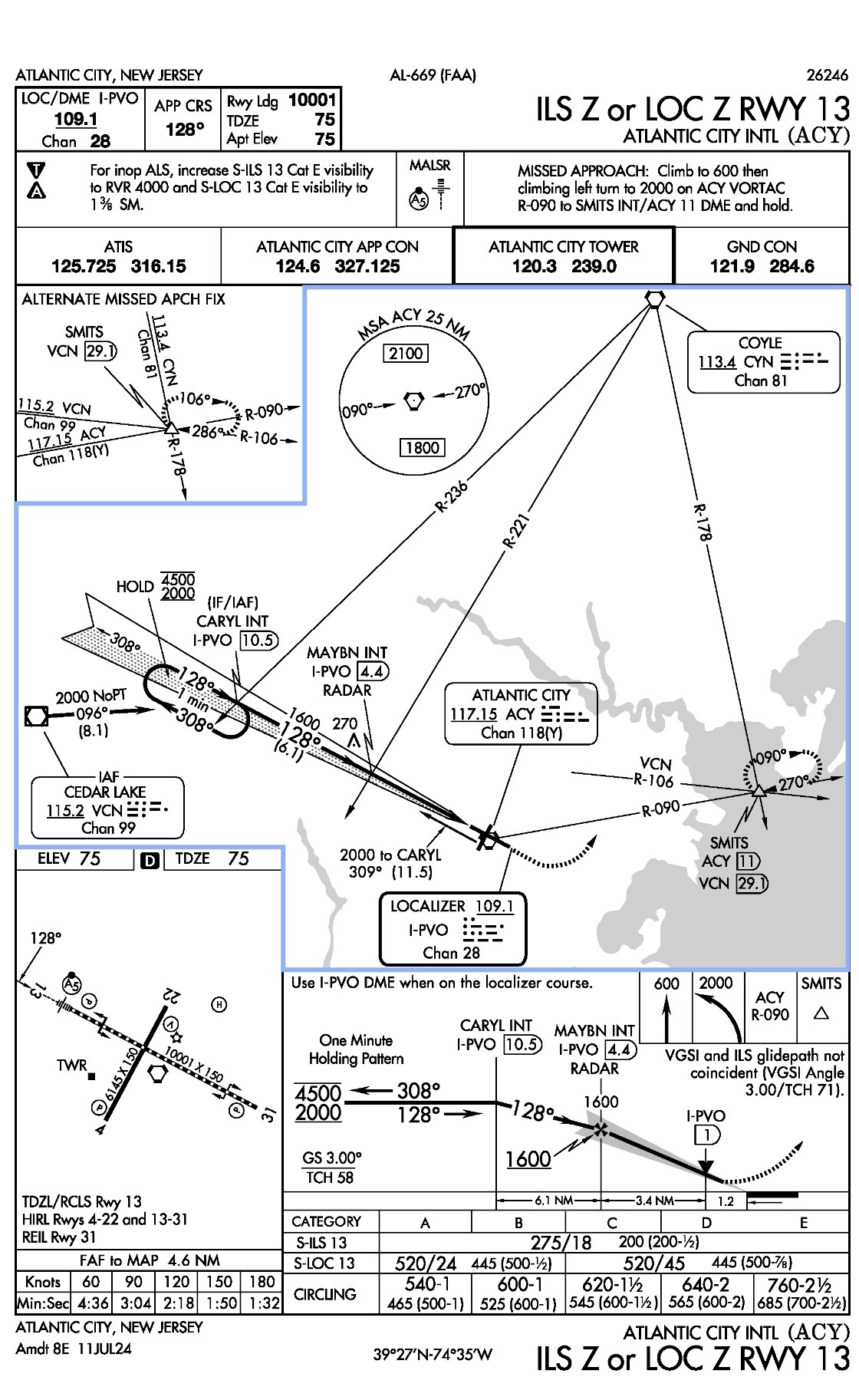
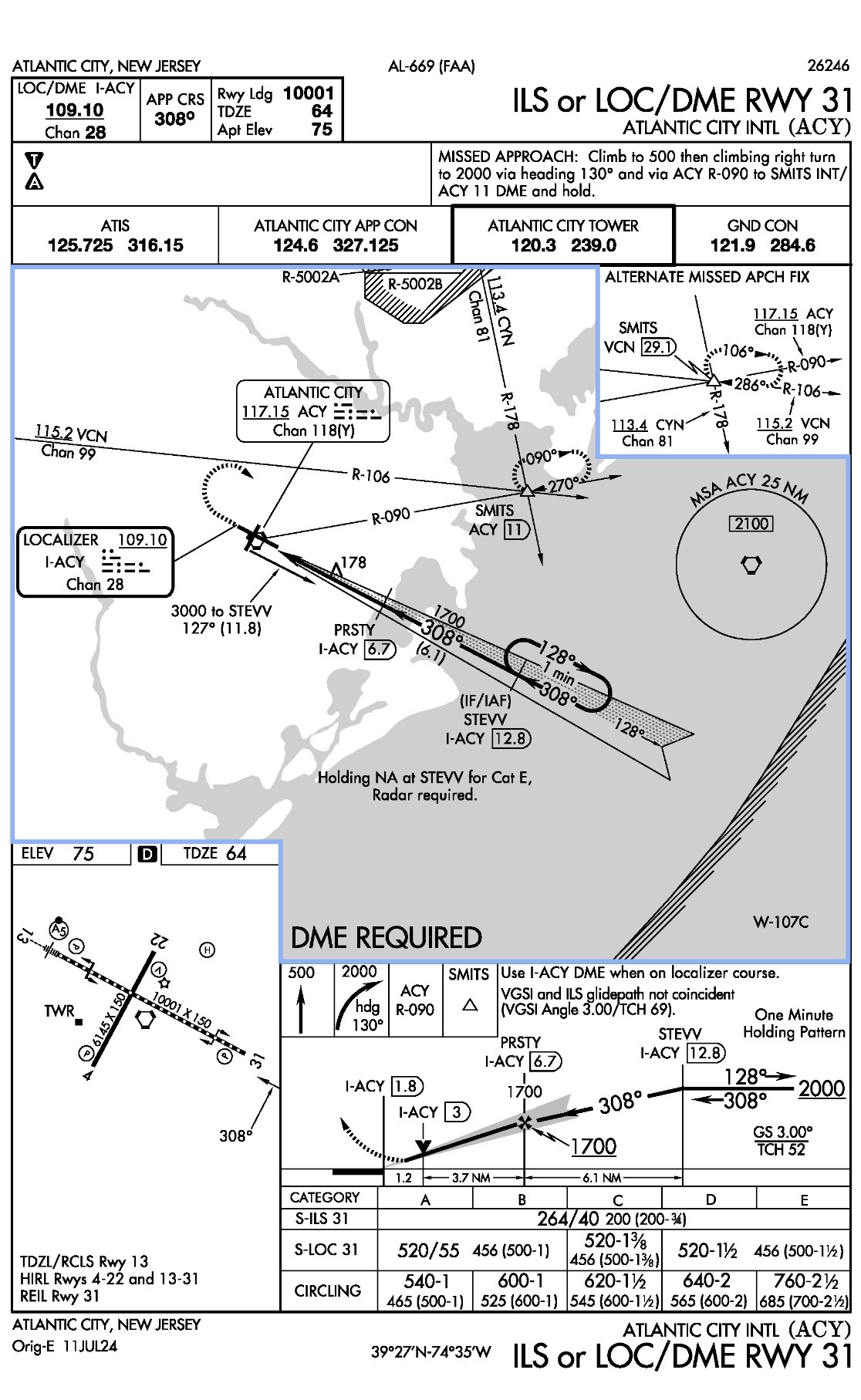
But what if you don’t follow that recommendation, or ATC is vectoring you beyond the last point in your filed route of flight? Here’s Flight Standards’ advice:
If unable to navigate to the clearance limit (such as in the case of where the aircraft is being radar vectored to a destination airport that does not have a ground‑based navigation aid), the pilot is expected to proceed to the IAF for the approach to the runway of intended landing via the routing and altitude as described in [AIM] paragraph 6‑4‑1 c. 3(a) and (b). The pilot should then depart the IAF from where the approach begins, commence descent or descent and approach as close as possible to the expect further clearance time if one has been received, or if one has not been received, as close as possible to the Estimated Time of Arrival (ETA) as calculated from the filed or amended (with ATC) Estimated Time En Route (ETE).
Assuming you’ve done what the FAA suggests, and put an IAF in your route of flight, you’ll continue to that IAF at cruise altitude. Upon reaching that IAF, if your ETE has expired, commence your descent/approach. If you’re early, enter holding there either as published (if there is one), or “standard,” using your arrival course as the holding course. If you’re too high to get down, begin descending in that hold at expiration of your ETE and leave the hold when you’re low enough to fly the approach from there.
What happens if there’s no IAF on your filed/cleared route of flight? You’ll have to navigate from the last point in your route of flight to an IAF. That’s easy with a GPS or equivalent, but could be tricky if all you have is VORs. Either way, you’ll do the same there as for an IAF on your route—check the time at arrival, and either descend/commence if your ETE has expired or hold until it does.
Controllers’ Guidance
All the above is reasonably straightforward, but may still not be what you want to do, or what you think ATC wants you to do. Here’s what the FAA tells its controllers in FAA Order 7110.65:
When an IFR aircraft experiences two-way radio communications failure, air traffic control is based on anticipated pilot actions. Pilot procedures and recommended practices are set forth in the AIM, CFRs, and pertinent military regulations.
Of course, controllers may still be hoping you’ll land sooner, even if that means violating 91.185(c), but that is a double-edged sword. It has the advantage of getting you out of their system and allowing them to return to normal operations more quickly, but it’s also a departure from the FARs for which you alone may be held accountable. While you may be able to make a 91.3(b) case for an emergency deviation from the Part 91 rules (especially if both your nav/comms have stopped “comming,” and you don’t have great confidence that they won’t stop “naving,” too), keep in mind Flight Standards’ stated position that lost comm is not in and of itself an emergency situation. If a loss of separation occurs, it must be reported, and you’re the one who deviated from the rules.
While most pilots seem to assume ATC will clear all traffic below, that is not a specific direction in 7110.65, so you can’t be completely sure they’ll do that, especially if you deviate from your route, as ATC may not have you on radar (either by transponder/ADS-B-out with your altitude, or as a primary return without) to discern your non-standard intentions. On the other hand, if ATC can keep everyone else out of the way, they’re unlikely to report the situation to the FSDO, so if both you and ATC are happy with the outcome, even if it includes a deviation from 91.185(c), to quote the Bard of Avon, “all’s well that ends well.”
One thing in your favor if you lose comm on departure and want to discontinue the flight before more trouble develops is that 7110.65 requires ATC to shut down the airspace around your departure airport to IFR traffic for 30 minutes following the release time given to tower or the void time at a nontowered airport. Those 30 minutes should be enough to return (including flying an instrument approach).
Because of 9/11
Finally, after 9/11, the FAA added the following to the ATC Handbook regarding lost comm:
If radio communications have not been (re)established with the aircraft after five minutes, consider the aircraft’s activity to be possibly suspicious and handle the flight per FAA JO 7610.4, Chapter 7, Hijacked/Suspicious Aircraft Reporting and Procedures.
So don’t be too surprised if you’re intercepted, or there are folks waiting when you land, especially near the Washington, D.C. area or a security TFR.

The DRS, what you refer to as “Flight Standards guidance”, does not say what you say it says. A quick search of the statement “the IAF should always be listed in the route section of the flight plan” yields a verbatim hit from 2009 where one Ron Levy made the same statement with no official reference to back it up. Later in this article you say the “the FAA suggests”, so a “should” is reinforced but that doesn’t turn it into a “must”.
My suggestion is you get to your destination airport, and start your approach as close to the time you filed for — it’s very possible you’ll be late, as often happens even in the best laid plans. At that moment, squawk 7700 and focus on getting on the ground in one piece. Sort the details out with the authorities after a safe arrival, letting your lawyer argue that you made the safest decision in light of the circumstances.
You are correct that the DRS doesn’t say that, but I did not say it did. I did not clearly cite the source for the statement about filing to an IAF, which was the same “Coordinated statement from AFS-420/810” (which is not in the DRS), cited elsewhere in the story, not an AGC-200 legal interpretation. And perhaps made the same omission 17 years ago when I first shared that written statement from Flight Standards. But regardless, after further review, I did not use the word “must” in that context, only that it was “Flight Standards’ advice” and I agree that it isn’t a regulatory requirement, just a good practice.
As for squawking 7700, the FAA’s guidance in the AIM is to squawk 7600 for lost comm, which you should already be doing long before you start your approach. 7700 should be used only if an additional problem that threatens safety has developed, and that should be done as soon as that condition arises, without waiting until you start the approach.
Thank you for this article! I’m not a pilot yet, but I do ATC as an occupation and nerd out on aviation stuff like this article.
Towards the end of your article, you said, “…7110.65 requires ATC to shut down the airspace around your departure airport to IFR traffic for 30 minutes following the release time given to tower…”.
For towered airport departures, it should be assumed you are radar identified even if you lose comms before checking in with the departure controller. This is because when departing a towered airport, communications are not necessarily needed to establish radar contact in areas with good radar coverage. So the airport would not be shutdown for 30 minutes to IFR aircraft in those situations as you can see below from chapter 10 of the .65:
“IFR traffic which could be affected by an overdue or unreported aircraft must be restricted or suspended unless radar separation is used.”
This honestly shouldn’t matter in the decision making process though, because if the tower and/or departure controller see the NORDO returning to the airport, a hole will be made for the NORDO. My personal suggestion if the NORDO pilot knows the tower is busy, it would be best to make very obvious and slightly wider than normal pattern legs so your intentions can be interpreted correctly and a little extra time to get planes out of the way. There’s no need to crank it in tight of the only issue is lost comms.
You make a very good point. But whether or not ATC has a lock on the NORDO aircraft, the pilot can still safely assume that as long as they’re back on the ground within 30 minutes, they can do whatever it takes to safely return to the departure airport. It’s ATC which primarily benefits from that “radar contact” exception.
As for returning to a tower-controlled airport pattern in VFR conditions as directed by 91.185(b), I agree that the pilot should try to fit into the flow of traffic and follow the AIM 6-4-1c.(2) procedures for VFR NORDO arrival at a tower-controlled airport, including joining the pattern and looking for signal lights from the tower. I just hope we all remember that there are signals other than a steady green which may be given in that situation, and what they all mean (or have them readily available in the cockpit).
Per the following: “Either way, you’ll do the same there as for an IAF on your route—check the time at arrival, and either descend/commence if your ETE has expired or hold until it does.”
I once discussed this with a friend who is an approach and tower controller and he said that ATC wants you down and out of the way as soon as possible. As such, skip the hold if you find yourself arriving early and just start the approach.
Thoughts?
Having discussed this with several TRACON supervisors, I know they agree, even though it’s contrary to AGC-200’s interpretation of the regs. It’s certainly what I’d do. Remember that the lawyers don’t get involved unless ATC is upset.
Ron, can you check and then elaborate on your comments about using the OROCA for altitude when not on an airway in a lost comm situation? The OROCA may be a reasonable way to select an off-airway altitude in the flatlands. But in the mountain west where I live it is not uncommon for the OROCA to be nearly in the flight levels for a particular grid square where a portion of the quadrant is in mountainous terrain, but where it is entirely appropriate to fly much lower over a large portion of that quadrant. For example, departing KGXY eastbound, the OROCA for this quadrant is 16,600′, but the airport elevation is 4697′ and the terrain only gets lower to the east. As I understand it, the regulatory requirement for off-airway altitudes is not the OROCA at all, but rather requires the pilot to determine the highest obstacle within 4nm of the intended route, and fly at least 1000′ (non-mountainous) or 2000′ (mountainous) above that. Meeting this requirement in practice requires a lot of analysis that was difficult to do in the days before terrain maps on panel-mounted GPS, so I can see how the OROCA became a proxy for the required altitude. But I don’t think the regulations require using it, and I suspect guidance to do so just implicitly assumes doing so is “reasonable” in most cases. That’s fine, until it isn’t. I’d like to get your take on it.
I think you have a very good point. I don’t think the terrain display on the average GPS is all that well suited for this task (especially in mountainous terrain since it only shows 100/1000 clearance), but the profile display in Foreflight allows you to set an 8nm corridor width (4nm either side) and see the actual elevation of the highest obstruction and the clearance amount.
Thanks Ron.