

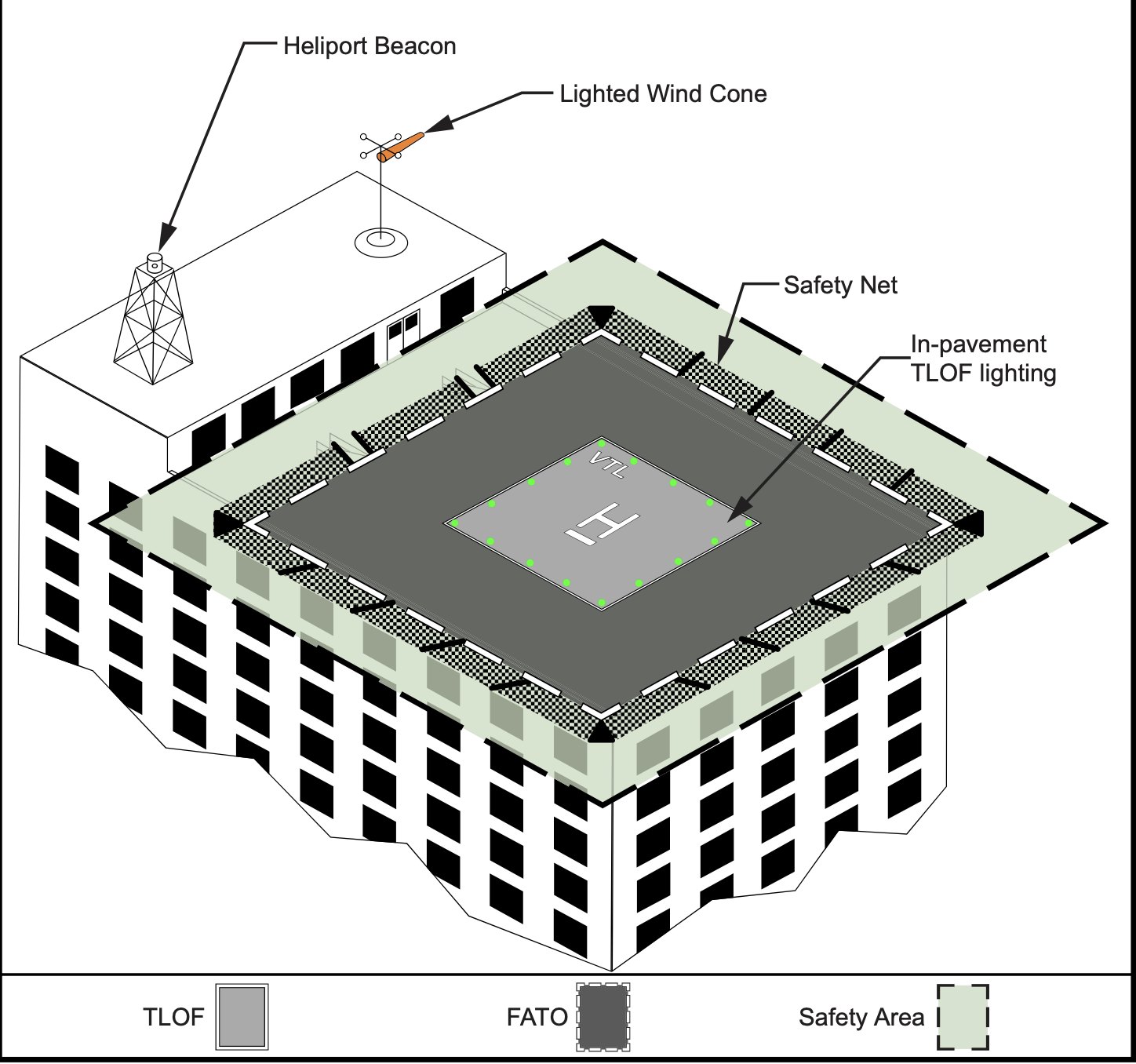
While most of the attention on advanced air mobility has naturally centered on the aircraft involved, the FAA has set proposed design standards for the ground facilities that will serve them through a new advisory circular (AC). The agency announced the proposed rules last Friday, a few weeks in advance of an online industry day Nov. 10 (register here) in which they will be presented to stakeholders. The package is enormously detailed and covers hundreds of pages with diagrams for everything from downwash protection areas to ramp markings. The new standards will supersede those for existing heliports.
“Based on FAA research into the performance of various vertical flight aircraft, the draft AC advances performance-based guidance for facilities serving helicopters and powered-lift aircraft,” the letter to stakeholders says. The document is seen as a major milestone toward integration of new vertically capable aircraft into the National Airspace System (NAS). Comments will be accepted until Jan. 11, 2027, at vertiports@faa.gov.

Russ, in your illustration, the symbol for the vertiport does not seem to match that in the draft AC, which uses the traditional H instead of the proposed and rejected broken wheel alternative symbol (see Figure 4-22 in the draft AC 150/5390-4).
See also Johnson C, Morfitt G, Thompson L. A Comparison of Proposed Concepts for Vertiport Markings and Symbology. In: Proceedings of the Vertical Flight Society 80th Annual Forum. Montreal, Canada: The Vertical Flight Society; 2024. p. 1–29. Available from: “https://proceedings.vtol.org/80/operations/a-comparison-of-proposed-concepts-for-vertiport-markings-and-symbology” doi:10.4050/F-0080-2024-1275
So… basically…
Helipads for electric helicopters.
This is supposed to be somehow cheaper than operating a Jet Ranger or R66?
Where is it suggested that it will be cheaper?
First, yes, many of these will be cheaper to operate than a Jet Ranger. Second, eVTOL is an entirely new category of aircraft. They are neither a rotorcraft nor an airplane. The main thing that differentiates an eVTOL from a helicopter is that they cannot rely on a rotor for forward flight. This is the definition: Powered-lift is defined in part 1 as a heavier-than-air aircraft capable of vertical takeoff, vertical landing, and low speed flight that depends principally on engine-driven lift devices or engine thrust for lift during these flight regimes and on nonrotating airfoil(s) for lift during horizontal flight. Powered-lift have characteristics of both an airplane and a rotorcraft.
The problem is ultralight and light sport aircraft (LSA) eVTOLs are the same size as an auto or a truck. Meaning a driveway is large enough to come and go from. Or in short, where ever an auto can go an ultralight or LSA eVTOL can go and up and down. And since in most US states, the private property owner owns their air rights to the base of navigable airspace, coming and going from one’s driveway is a Bill of Rights right, not abridgeable. And so far, the FAA has not acknowledged this. So flying above: streets, alleys, boulevards and highways is a given: public thoroughfares. The only thing left is getting the FAA on board on this and should be common sense! Unfortunately, proving again common sense is not all that common! To the flying public’s consternation in this case! Stopping the American government, FAA in this case, from competing with the French bureaucrats creating huge distractions and huge delays is a never ending battle. Obstructing commerce is a crime. I assume some one will eventually sue the FAA for obstruction of commerce. When? Hard to say!
There are plenty of laws (some civil) that impact you and your car in your driveway right now, not the least of which is that you cannot pose a danger to your neighbors. You also cannot make above a certain amount of noise. You cannot produce noxious fumes. You cannot deny access to your neighbors’ property. You cannot look into their private yards or windows. These apply whether you’re on the ground or 10 feet in the air.
I’m not really sure where French bureaucrats come into your arguments. In general, the French enjoy the ability to land their helicopter on any private property (as long as it’s not in a dense city and fewer than 200 times per year). We in the US generally do not have these rights. Worse, the laws in the US overlap with dozens of possible layers that prohibit what we do (HOA, city, county, state, federal, not to mention national & state forests vs parks vs monuments vs BLM land vs public land). Asking “can I land here” requires potentially days of research of all applicable laws and even then you’re not sure you caught them all.
Still, I’m with you on expanding places that are safe and reasonable to land.
False assumptions are slander. Of course no one can pose a threat from their driveway. Current ultralight eVTOLs are the size of autos and much, much safer because they have 3 separate softwares that continually talk to each other to maintain aircraft stability, LIDAR or equal to avoid obstacles, and a parachute in case the solid state devices fail. Jet fighters do not have this safety equipment; much less fixed wing aviation. So, if you are trying to make a point, the facts do not support what ever it is you are trying to say. And noise, relatively speaking does not exist for anything running on electric motors. The US has the Bill of Rights, property rights in this instance where the air rights can not be abridged. So, your writing is fiction making it extremely annoying and slanderous. The good news for you is most people have no clue about the safety on ultralight and light sport aircraft (LSA) eVTOLs. So, I will be here pointing out these safety features to get people like you to know what is actually going on. All the best! And please stay out of the way, since your knowledge is very insufficient! Safe and reasonable landing locations for ultralight eVTOLs are any auto parking locations that have no wires above it; not only driveways. And with 8 each electric motors and propellers in groups of two, one can be lost and the aircraft still flies. Skytech has shown with two motors off the aircraft still flies. With all this redundancy, safety problems with these eVTOLs do not exist.