

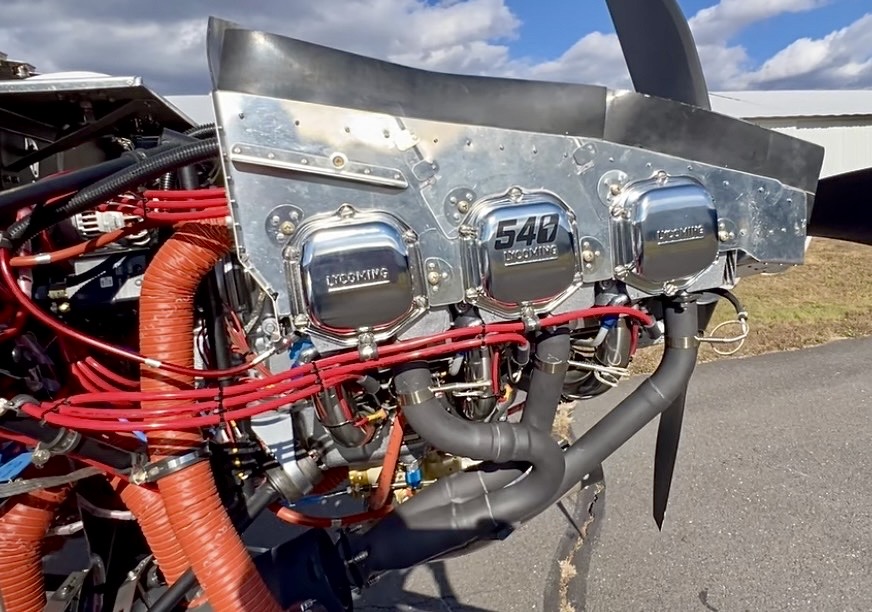
The FAA adopted an airworthiness directive (AD number 2026-17-10) for certain Lycoming Model O-235, O-540, and IO-540 engines with a particular piston pin installed. This AD comes after several reports of hard piston pin failure and also engine failure. The AD says, in part, that it received reports from Lycoming of metal particulates found in the engine oil during oil change and two non-detectable engine failures on Lycoming Model O-235, O-540, and IO-540 engines.
Lycoming’s investigation revealed that certain thin-wall piston pins were manufactured with microcracks and inclusions in the base metal due to honing and tooling process changes from the piston pin supplier, making the pins more susceptible to failure. One thing leads to another—piston pin failure can obviously dump debris that circulates throughout the engine, trashing bearings and other cylinders, plus block oil passages and lead to eventual oil starvation.

The AD hits a wide range of engines and requires replacement of the affected piston pin with a part deemed eligible for installation and, for certain engines, oil change and visual inspection of the engine oil filter, oil pressure screen, and oil suction screen for metal particulates. The AD chases Lycoming’s Mandatory Service Bulletin No. 667A (it supersedes Service Bulletin No. 667) and applies to all Lycoming engines or cylinder kits using LW-13445 Pins, or Spare LW-13445 Pins with an FAA 8130-3 dated between Jan. 7, 2021, and Dec. 15, 2025.
Depending on the engine serial number and production run, compliance is required within the next 25 hours of operation, not to exceed 150 hours’ time in service. If greater than 150 hours’ time in service, the Bulletin calls for an oil sample evaluation before the next flight. The Lycoming Bulletin spells it all out and also lists instructions for warranty claims.

Lycoming Saved a lot of money again with that lowest bidder making their Piston Pins.
Mechanics like to advise owners to get a “Factory Engine” and then they do this again…. How many Piston Pin, Connecting Rod Bushing and Crankshaft A.D.s in the past thirty years?
Every time they get sued Lycoming just increases the price of their mistakes onto the customer. Not a problem when you have a captured customer.
“Every time they get sued Lycoming just increases the price of their mistakes onto the customer. Not a problem when you have a captured customer.”
That’s pretty much true of any “for profit” company, otherwise they go out of business.
Federal Registry count: 4ea piston pin, 2ea connecting rod, 11ea crankshaft ADs since 1960.
IMHO – if this were a car, a recall would’ve been required by NHTSA, at NO COST to the end user. Why is it that Lycoming can have all of these AD’s, obviously due to poor decisions in quality control, or vendor oversight, and the end user gets stuck with the bills? Not trying to put Lycoming out of business (or should I say Textron, their parent), but there has to be some accountability.
In the case of my airplane, fortunately I dodged the bullet due to my build date on the connecting rod bushing AD. Not everyone was so lucky.
That all said, I believe that if you’re using Lycoming parts, or have a Lycoming rebuilt / new engine and these ADs come out, Lycoming should be on the hook. Not the guy who in good faith buys the engine
Not just Lycoming that bills the customer/owner for “recalls (ADs, SBs, etc.) — they all do it (in the Aviation business — parts, accessories, airframes).
Aside from the liability and reliability issue, the logic of this AD is puzzling to me.
Oil analysis to detect piston pin failure??
By the time you read “piston pin in oil”, your piston pin is broken! Parts of the piston pin can only escape into the oil from the small gap between the rod and the piston bosses. That is also the area of maximum stress. Once broken, I would expect the piston movement to exercise the fracture putting debris into the oil. The fracture would result in slightly lower compression on that cylinder causing a change in vibration. I cannot see how wrist pin material can get into the oil without an actual fracture.
I have seen this once where the pilot noticed an increase in vibration and a slight power loss, otherwise no change. He continued on for almost 30 min when he arrived at his destination. The wrist pin was broken in half, there was no metal noticed in the oil or filter. The root cause was a failure of one electronic ignition operating with too much advance. (the light weight piston and pin was not made by Lycoming or Continental)
Ignition timing matters when it comes to engine stress and it must be checked with a strobe light while the engine is running. Unless you have a readout of it in the cockpit.
“Lycoming’s investigation revealed that certain thin-wall piston pins were manufactured with microcracks and inclusions in the base metal due to honing and tooling process changes from the piston pin supplier, making the pins more susceptible to failure.”
A total of 957 engines between the O-235 and 0-540/I0-540 were built under the current piston pin AD. Most are of the 540 series and few 0-235’s since no OEM is building an 0-235 powered airplane to my knowledge. Brand new zero time 0-235’s would be few if any. However, with the flight training demands, it seems to me the number of factory reman 0-235’s would be less than 540 series but still more than just a handful. Both Lycoming and Continental do not provide the number of each type of engines they produce, whether it be zero time brand new factory assembly line engines, factory remans/rebuilt, or factory overhauled. The 0-235 was first FAA certified in 1942. The 540 series officially had its Type Certificate approval 10/31/1957. The 0-235 normally has a 2400 TBO with 540 series at 2000 hours with a 2600 hour TBO extension on factory new and factory rebuilt engines.
This begs the question of why would you ask for and approve ” honing and tooling process changes from the piston pin supplier, making the pins more susceptible to failure”…on two of your most durable engines with 2400/2600 TBO’s with a build history spanning 84/69 years? Or, are we to believe the piston pin supplier just decided one day to change the tooling and subsequent machining specs on their own? Especially on the single most stressed component of a four stroke engine?
Interestingly, just prior to the 9/14/26 effective date of this AD, Textron’s CEO Ron Draper retired as of 8/31/26 staying on through the end of the year in an advisory role to aid the transition of duties to new new CEO Brian Rohloff. Talk about being thrown into the deep end of the corporate pool performing damage control for this AD. Welcome Brian, to the “buck stops here” position.
As with most, if not all engine AD’s, there is no alternative method of compliance. That means pay the going Lycoming rate on replacement Lycoming piston pins or hope your engine falls under some sort of warranty. Then the elephant in the room problem for both out of pocket customers and those under warranty, has to be dealt with. Who makes the new pins, where are they going to be manufactured, and when the replacement pins become available? And the question of what tooling and honing methods will solve this problem still remains. Add to this mess that how many other internal parts such as bearings, rods, cylinders, accessory gears, pistons, etc need to be replaced due to metal pumped throughout the engine. And who will supply those replacement parts, and when will those parts be available? I doubt very much Lycoming will simply replace these engines with new because of cost and availability. So cranks and rods will have to be polished, maybe resized, and balanced for example, if enough metal has circulated through out the engine. And the only way to find out will be a teardown.
GM has an almost 1 million vehicle recall on the once bulletproof 6.2 V8’s that are grenading because of tooling/honing tolerance changes during OEM manufacturing process with dealer noise diagnosis followed with an oil viscosity change. If that bandaid oil viscosity change results in lower end of the engine still making bearing noise and soon after tossing a rod or two out of the block, the final solution is, so far, replacing the engine with another machined the same way. How will doing the same thing over again solve this problem? Plus, the wait time for an identical engine can vary from weeks, to months, or longer because of the all the supply chain issues that plagues most US assemblers. Most US OEM manufacturers have morphed into US assemblers depending on overseas companies who manufacture for the assemblers to the assemblers specs. Lycoming has the same problem because they assemble what someone else manufactures. 957 is certainly far less than a million, but 957 in the small GA airplane market is still significant. And that is assuming, Lycoming knows accurately, the number of engines subjected to the piston pin AD. Concerning car/truck recalls, the initial number is usually relatively low compared to what eventually becomes self evident when more failures occur. Often the date range of manufacturing…ahem… assembling, expands.
There part that baffles me is where if you don’t have an 8130, then you’re guilty.
Yeah, that one is the worst part. Comment Period is open on this AD through October 13th. Probably worth commenting on that point alone as that will require thousands of engines to come out of service that were built prior to 2021 and haven’t had cylinder work done since then either.
https://www.regulations.gov/document/FAA-2026-8789-0001/comment