

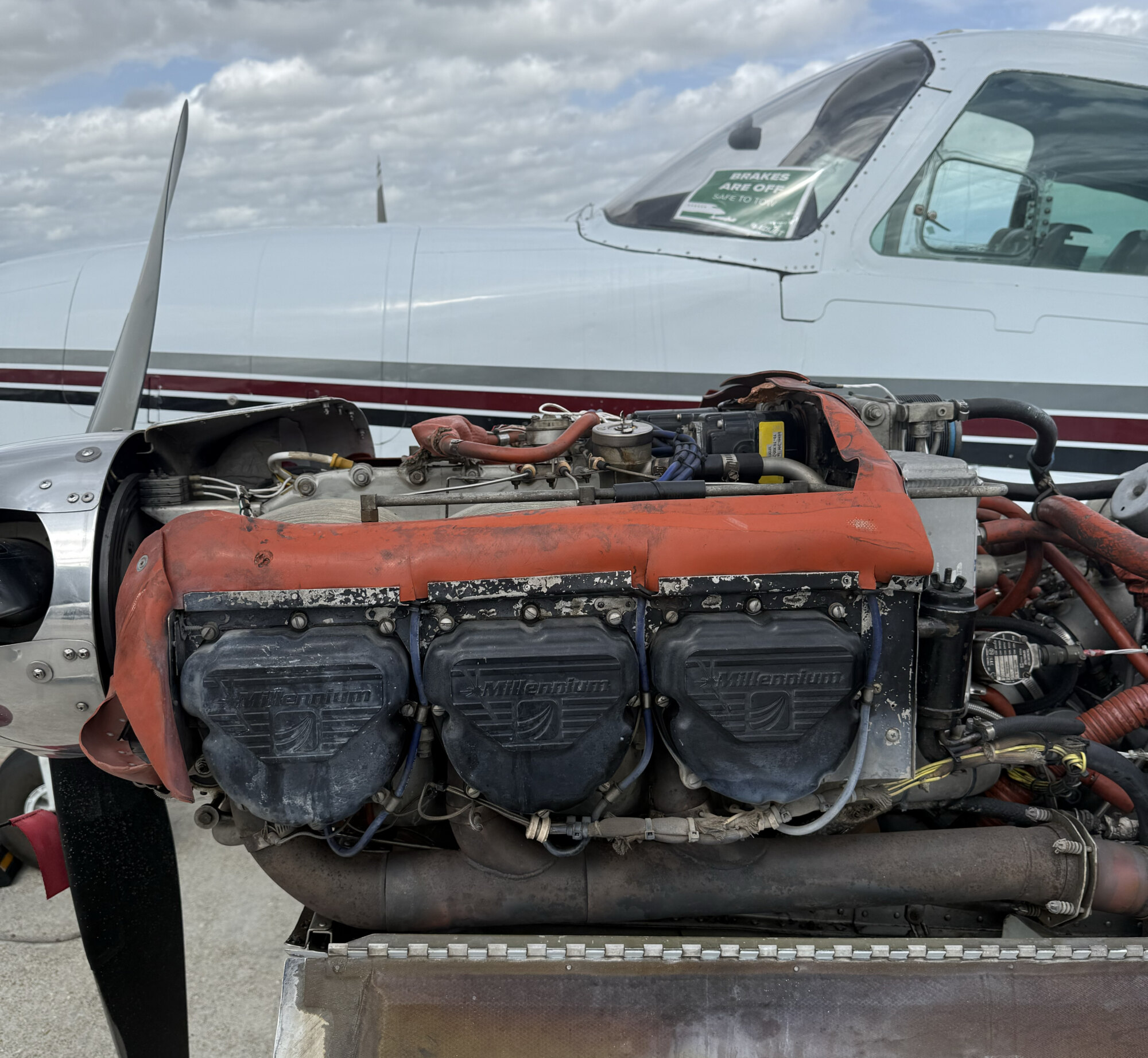
I recently got a call from a reader relatively new to aircraft ownership and she was rattled after sitting through an FAA safety seminar. Apparently the presenting FAA inspector made a blanket statement that insurance companies won’t cover a claim if the aircraft is damaged during a forced landing if the crash was caused by a failed engine that is past TBO. Huh? I’d expect that aircraft insurance policies should generally cover airworthy aircraft, and operating an engine after TBO certainly doesn’t make the plane unairworthy.
The Lycoming O-360 series in this owner’s Piper has around 2,300 hours after working hard at a local flight school the past 12 years. With a few hundred hours over the TBO and calendar time running short, it’s flown several hundred hours per year, which could be why cylinder compressions (they’re Lycoming cylinders) still test good, oil consumption and metal analysis is normal, and runs strong. Worth mentioning is that Lycoming has extended its TBO recommendation to 2,600 hours with high usage on some engine models.
For many, operating beyond TBO is much about confidence while recognizing that engine maintenance and other factors play at least some role in following manufacturer TBO recommendations. Plenty of engines regardless of how you run them and maintain them, or how long the engine makers say they might last, might not come close to the TBO. I worked on a couple of old Beech Queen Airs used for high-time charter and remember their geared IGSO-series engines barely ever making it to 1,000 hours. But of course we’ve all seen Lycoming 360s and plenty of others chug along way beyond TBO.
The owner’s confidence in this four-cylinder Lycoming, influenced mostly by her flight instructor and a mechanic who have flown and maintained the aircraft at the flight school where it was based, has her continuing to train for her private pilot’s certificate in the plane and so far she’s not uncomfortable enough to spring for an overhaul. But would her insurance company actually refuse a claim simply because the engine was flown over Lycoming’s TBO recommendation? We asked a few brokers who took the high road on record saying that each claim is evaluated individually. We call nonsense, and suggest it’s a question every policy holder should ask of an underwriter.
Where’d Those Numbers Come From?
Many owners wonder just how a manufacturer comes up with the TBO. The FAA says engine makers must publish them, but that doesn’t mean the FAA requires anyone operating under Part 91 to scrap an airworthy engine at any predetermined time. The age-old discussion will never go away. Years ago, we asked engine manufacturers that very question and got the standard answer that it’s made after assessing many engines sent in for overhaul after thousands of operating hours, and the sampling considers how they held up under many different conditions. Various components are evaluated for wear and tear and in the end, TBO is based on how safe the maker determines an engine might be at the end of so many operating hours. There’s some legal speak involved. However, it’s natural to look beyond liability. Hours of operation aside, how much does calendar time matter?

Using the common 12 calendar months time limit for example, engine makers make their argument supporting time in service irrespective of engine hours, concluding that infrequent operation, abnormally harsh operating conditions, and even the use of non-PMA parts and non-compliance with service bulletins could make reaching TBO wishful thinking.
What Should Matter
Should engine trend monitoring matter? We think so, and maybe insurers should, too. In the bad old days, we operated finicky high-output turbocharged engines without graphic engine monitors and relied on mechanical instruments and limited engine sensors to safeguard engines from pilot destruction. Now, our eyeballs are glued to digital engine monitors and we closely analyze their collected data logs while safety and budget money hang in the balance. One mechanic remarked that engines might be failing less frequently now than before the days of engine monitors and trend analysis. I’d say at the least we have more advanced warning before the engine actually tanks, thanks to monitors.
Since we obsess about our engines as much as the next owner, we got talking about this topic around the editorial office and partly concluded that in some cases it could actually be safer to operate a particular engine beyond TBO, and for the typical Part 91 operator, the TBO could offer limited practical purposes. We certainly don’t ignore it, but it’s more an indicator that should be tracked alongside of especially good regular maintenance, engine monitor trend data, oil sample analysis, plus storage conditions and frequent operation. These are all more telling than TBO recommendation alone, and every insurance underwriter should understand why.

Closely related: I could not finance an aircraft with an engine beyond TBO unless I signed a document attesting that the engine would be overhauled immediately after purchase.
Ummm…. Twelve years time in service.
Like everything else in aviation, “it depends.” Compressions no longer tell the whole story as to engine health and to a degree that once immutable number has gained somewhat less significance with the advent of oil analysis, borescope review, etc. Modern monitoring techniques have created an era where engines no longer need to be prematurely euthanized because of an arbitrary number set by the manufacturer. 7 years ago, I finally replaced at my Continental IO520 at 2400 hours because the all factors pointed to “its time.” My insurance carrier never penalized me for flying 700 hours past its recommended TBO nor did they ever raise the issue.
I have a Lycoming O-360A4A that is now at about 2,100 hours (and over 12 years in service). I am following Mike Busch’s IRAN approach. He says that he is not aware of insurance companies denying claims due to failure of an over-TBO engine that was in a plane signed-off as airworthy. It is foolish to do it blind, however. Periodically, I send my engine monitor data into Savvy for analysis, and likewise borescope shots at every annual. Between every flight, I closely monitor oil consumption and send a sample in for analysis at every oil change (25-30 hours). Also, it’s a bit like the 20-year axe; I’ve replaced the head twice and the handle three times. Over the last 800-900 hours, all four cylinder assemblies either have been replaced or reconditioned, and the bottom end was inspected with bearings replaced due to a prop-strike about 700 hours ago.
Would you purchase insurance from a company that rated its premiums based on engine time relative to recommended TBO? What if they treat TBO like pilot age?
Last time I checked, the FAA does not underwrite or sell insurance, so they would not be the proper authority. Talk to your insurance broker and/or read your policy. I know many policies do not address TBO. That said, the concept of “betterment” applies and if your engine is run out, don’t expect the insurance company to buy you a new one. They will replace it with like kind and quality.
On every renewal of my insurance with Avemco, they ask the TTSN and TSMOH, and I assume other companies do too. If they know the time in service of the engine, and agree to coverage with a premium offer, I don’t see how they could decline to cover airframe damage related to an engine failure.
An FAA inspector has no expertise whatsoever on insurance practices. Zero. Insurers don’t get to just make up rules as they go along. The conditions of coverage, and exclusions, must be pre-written into the policy’s coverage forms. While I’ve never heard of a carrier drafting an exclusion of coverage based on engine TBO status, it’s important to always read through your policy forms page by page every year. In theory it is possible to have such an exclusion, though it seems like a dumb business idea to me. But carriers get to decide what they want to cover or not cover, and you get to decide whether you want to buy it or not. Read those forms.
It’s important to define terms accurately. The TBO referred to in the article is the manufacturer’s “recommended time between overhauls”. Time is typically further defined as flight hours. Flight time is logged in the aircraft records. This is distinct from block time recorded in your pilot records.
Emphasis (for Part 91 operators) is on recommended. The typical insurance policy’s requirement for legal operation is not violated by operation beyond recommendations.
If you review your aircraft documentation, you will find that these recommendations are universally contained in manufacturers Service Bulletins, NOT in the FAA-approved airworthiness limitations which all operators must comply with. See chapter 4 of the engine and airframe Maintenance Manuals or chapter 2 of the Aircraft Flight Manual.
As mentioned in the article, manufacturer’s service bulletins are not mandatory for Part 91 operators. They are required for commercial operators.