

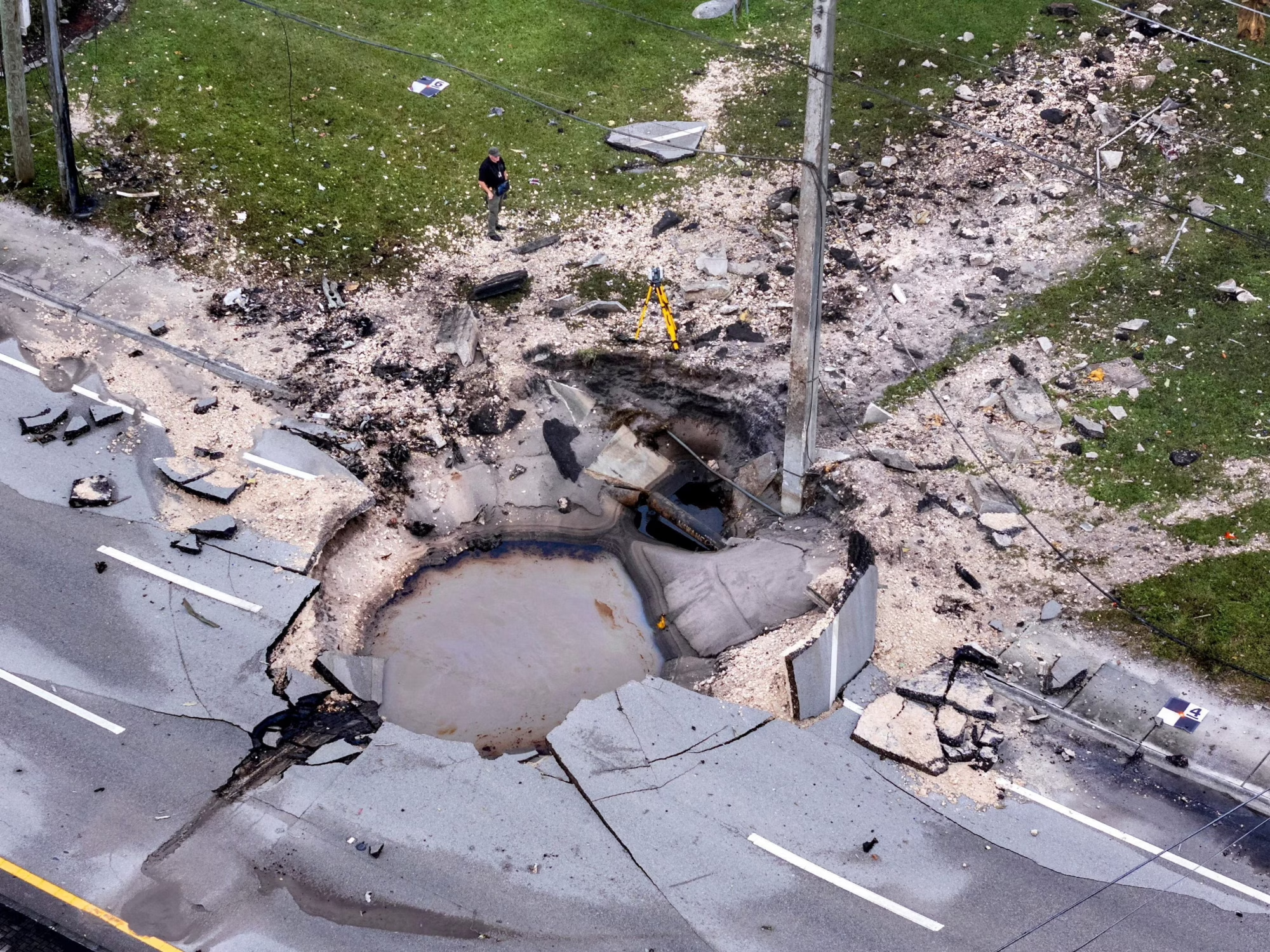
Pieces of the left elevator from a Learjet 60 that crashed near Palm Beach, Florida, were found as far as 3.8 miles from the crash site, the NTSB told reporters on Tuesday, in their second news conference on the accident that occurred Sunday in a residential area of Greenacres in Palm Beach County. Board member Tom Chapman said the elevator was in three pieces and it would have been impossible to control the plane, which dove almost vertically at very high speed into a roadside in the community. Chapman said “knowing that it was lost is a very important piece of evidence in terms of pointing us towards other things to investigate.” Facebook posts reporting the location of elevator pieces were posted late Monday.
The aircraft was on its way from Austin, Texas, to the Bahamas with two crew and seven passengers onboard. The crew threaded through a line of thunderstorms over South Florida before passing over the core of a cell just south of Palm Beach. The first officer, who was the pilot monitoring, told ATC that they were picking up ice and asked to climb from 35,000 to 37,000 feet. Seconds later she told ATC the aircraft was descending rapidly. The plane was calculated to have reached a descent rate of more than 30,000 feet per minute.

I have suspected from the outset that the issue likely was a tail stall due to ice accumulation. This likely caused the rapid pitch down and acceleration to a speed that likely caused the tail to flutter given the ice on it. The flutter than caused rapid structural failure of the horizontal stabilizer leaving the crew powerless. Very, very sad situation and a poignant reminder that avoiding thunderstorms by at least the recommended 20 miles isn’t optional.
Alternatively, a wing stall due to ice on the wing, starting a climb, and being tight in the coffin corner at high altitude and high gross weight. At the stall, the plane noses down and is quickly oversped. Then either flutter or perhaps over control caused the elevator to fail.
I agree that is a plausible explanation also. I lean towards tail stall mainly due to the apparent relative roll stability of the jet after the upset. It appears to have slowly increased bank which suggests the ailerons were still largely effective. A wing stall generally makes the ailerons less effective or even reverse acting and the airplane tends to be relatively unstable in roll with rapid bank changes and often spin entry. Since there is no evidence yet as to significant roll instability, I lean towards tail stall and then tail failure, but I certainly don’t rule out wing stall or simple gust induced structural failure as all are plausible explanations.
I have picked up ice several times when it was (1) not in the forecast or (2) I was clear of clouds. Spooky stuff…
I think the two possible scenarios leading to the loss of control is either the tail was damaged/separated by turbulence or icing on the T-tail caused it to stall producing a rapid and deep pitch down which resulted in an overspeed and the separation of the horizontal stab/elevator.
Agree. Your two scenarios presented sound plausible. As a Lear pilot with more than 3,000 hrs spread across 4 different models, the other thing I wish to point out for those who have never flown an aircraft with anti/deicing equipment is the difference between the two systems. Anti icing systems need to be on BEFORE entering the conditions. In all the jets I’ve flown, the manuals state a two minute minimum prior, to allow time for the collecting surface you are trying to protect to heat up adequately to counter ice accumulation.
I think this is a very important point. The F.O. reported clear ice before they entered the storm cell. If they entered the cell not knowing their deice didn’t have time to remove the ice, or was not capable of clearing already formed clear ice, then this answers a few questions for me. Although I’m still unsure why they flew into that cell in the first place.
Interesting questions:
* Using the start of the flight path divergence as a reference point, not the impact crater, where were the three pieces of the elevator found?
* One piece came through the roof of a house, so it was presumably relatively small and heavy. Considering winds aloft at all altitudes, where might this piece have separated from the aircraft?
* Similarly, one piece that was shown on the web appeared to be relatively light. Where does its location, winds aloft, and flight path suggest that it might have separated from the aircraft?
why didn’t they divert around the cell? we were always taught to NEVER mess around with a Monster storm !
We may never know for sure, but radar attenuation seems the most likely explanation. Attenuation can make severe weather essentially disappear from the scope.
I hypothesise that the young, female copilot was too timid to insist they stay further away from the storm. Resignation, the fifth of the hazardous attitudes might better be thought of as not being a sufficiently loud, prickly stickler for safety. If any of you have daughters going into aviation, I suggest you tell them this, and that you will support them if being a loud, prickly stickler gets them sacked.