

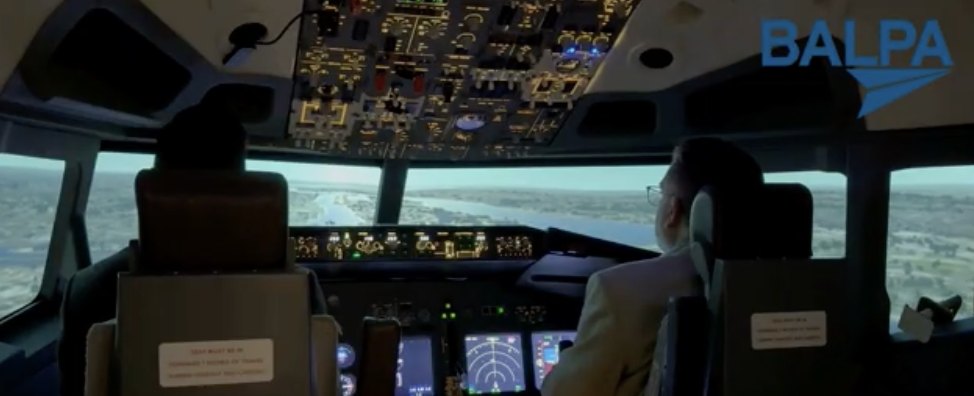
Becoming an airline pilot is supposed to be difficult. The standards are high for a reason. But long before an aspiring pilot reaches an airline interview or builds the experience needed for the flight deck, another test can determine whether the career goes any further: finding enough money to pay for training.
That problem is hardly unique to the United States.
Zohra Francis, acting general secretary of the British Airline Pilots’ Association (BALPA), says the cost of learning to fly risks excluding capable candidates before their aptitude has had a chance to determine how far they can go.
“Becoming a pilot should be demanding, exacting and competitive, because the standards have to be exceptionally high,” Francis told AvBrief. “What should not determine someone’s chances is their ability to pay for training.”
“Financial means are not an indication of talent, aptitude or potential. Our aim is simply to remove that single barrier so that aspiring pilots are judged on the qualities that actually matter.”
Francis was speaking about the British training system, where she says aspiring pilots can face bills of around £100,000 ($135,000). But the numbers facing an American student make her argument immediately recognizable on this side of the Atlantic.
A Six-Figure Decision Before the Career Begins
ATP Flight School currently prices its Airline Career Pilot Program at $123,995 for a student starting with no previous flight experience. That takes a student through commercial pilot training and flight instructor certificates, but ATP says approximately another $12,000 should be allowed for FAA examiner and knowledge-test fees.
The American Airlines Cadet Academy tells a similar story. Current prices among its partner schools range from $99,500 at CAE in Phoenix to $116,000 at an ATP location in Concord, North Carolina.
Those figures do not mean every pilot going through training in the U.S. must spend $100,000. Flight training can be completed through different routes, and costs vary considerably with the school, aircraft, location, pace of training, and experience a student already has.
But six-figure professional training programs are no longer exceptional.
The FAA has itself acknowledged the problem. In its efforts examining the aviation workforce pipeline, the agency identified education and training costs as a significant barrier to aviation careers, particularly for people from lower-income and underrepresented backgrounds.
That makes Francis’ question relevant well beyond Britain.
“Pilot training has fallen into a gap,” she said. “It’s a highly skilled profession, but because training sits outside the traditional university funding model, aspiring pilots can face insurmountable barriers through bills of around £100,000.”
Financing Gets Students In, But the Bill Remains
U.S. students have options that are not necessarily available in the same form in Britain.
American Airlines’ Cadet Academy, for example, has partnered with American Airlines Federal Credit Union to offer training loans. Payments can be deferred while a cadet remains enrolled and makes satisfactory progress. But American is explicit that the student remains responsible for repaying the principal and interest.
United’s Aviate program is free to join, but United similarly states that participants remain responsible for the cost of their flight training, although scholarships may be available through partner universities and flight schools.
The distinction matters.
Access to credit is not the same as reducing the underlying cost of becoming a professional pilot. It changes when the student has to find the money and, for those who qualify, makes training possible. It can also mean beginning a flying career carrying substantial debt.
The U.S. route adds another complication. Completing commercial and instructor training is not the end of the journey to an airline flight deck.
A pilot generally needs 1,500 hours before becoming eligible for an unrestricted airline transport pilot (ATP) certificate, subject to lower-hour restricted ATP pathways for qualifying military pilots and graduates of approved aviation programs. Many young commercial pilots build those hours by working as flight instructors.
American Airlines’ own Cadet Academy describes precisely that progression: initial training through commercial and instructor certificates, followed by experience building, with many cadets instructing until they have accumulated the hours needed to move toward a regional airline.
So the financial calculation made at the beginning of training can follow a pilot well into the early stages of the career.
UK Aviation Growth Collides with a Tightening Pipeline
The workforce question is becoming harder to separate from Britain’s wider aviation ambitions.
Government figures show that 1,315 U.K. commercial pilots who were aged between 60 and 64 in March are expected to reach the mandatory retirement age of 65 within the next five years.
Francis stopped short of forecasting an imminent structural shortage, saying the government’s planned aviation skills gap analysis should provide a clearer picture of future demand. But she said the pressure is evident.
“The Government supports airport expansion, so the industry will need a larger workforce to support that, including more pilots,” she said. “At the same time, a significant number of pilots are due to retire over the coming years.
“The direction of travel is already clear,” she concluded. “We need more routes into the profession if aviation is to continue supporting growth, connectivity and economic opportunity across the U.K.”
No Shortage of People Who Want to Fly
The U.S. pipeline is not standing still, however.
FAA figures show 848,770 active pilots at the end of 2024. Commercial pilot certificates reached 109,727, up 2.8% from the previous year, while ATP certificate holders increased 2.9% to 179,194.
The federal government is also putting money into aviation workforce development. Earlier this year, the FAA announced $26 million for programs covering pilots and maintenance technicians, including aviation training, apprenticeships, internships, and recruitment initiatives.
But workforce-development grants and airline pathways do not eliminate the financial decision confronting an individual student.
Francis argues that widening access need not mean making pilot training easier. That distinction may be the most important part of the debate.
No one benefits from lowering the standards required to become a professional pilot. Selection, medical requirements, checkrides, and recurrent training exist because aviation cannot tolerate weak standards.
The question is what happens before those standards get the opportunity to do the selecting.
“There is no shortage of policy options,” Francis said. “Whether through apprenticeships, student finance or lending support, the key challenge is helping aspiring pilots access the funding they need for training.”
Her proposed solutions are aimed at Britain. The financing structures in the United States are different.
The underlying problem appears remarkably similar.
A young American looking at a professional flight program costing $100,000 or more and a young Briton confronting a £100,000 training bill are making the same calculation before either has an airline seniority number or even knows whether the career will work out.
And that leaves aviation with a question worth asking on both sides of the Atlantic: If the industry wants the best people on its flight decks, how many potentially good pilots never get far enough to prove they belong there?
BALPA believes the U.K. Parliament’s position has shifted over the past year, from regarding pilot training primarily as an issue for the private sector toward accepting that government has a role in tackling barriers to entry.
Francis now wants that recognition translated into policy and hopes the Civil Aviation Bill currently before Parliament will not become a missed opportunity.
“The challenge now is turning that recognition into practical reforms that give aspiring pilots from every background a fair chance to compete for a training place,” she said.
Women Pilots Still Fight for Workplace Basics
Opening the profession also means making it a viable career for more women.
Women remain heavily underrepresented on commercial flight decks, and Francis said some barriers are more basic than recruitment campaigns might suggest.
“BALPA reps across numerous airlines have had to fight hard for the basics, such as access to toilets and sanitary bins on flights, or pilot shirts that are designed to fit women,” she said.
She pointed to BALPA representatives at DHL securing measures earlier this year that included increased maternity leave, surrogate rights, and time off for IVF.
“There is still a lot of work to do to make the flight deck a more welcoming environment for women, but changes like these make a big difference,” Francis said.
Now for BALPA, one of the biggest obstacles lies before an aspiring pilot ever reaches an airline cockpit. As Francis concluded: “Being a pilot is a fantastic career for any young person to aspire to—let’s open it up to applicants of all backgrounds.”

So, how is the cost of acquiring a flying certificates through ATP any different than the cost of getting a four year under graduate college degree? Are we expecting this to somehow also to be free?
Here’s how it’s different, Tommy. For many years now in the US, and depending on the state and the particular “bachelor’s” (undergraduate) or higher-degree institution, there have been many kinds of student tuition “scholarships” — not loans. Some institutions have even been able to provide most of the costs for such undergraduates throughout the four year curriculum (think student athletes, for example). The ATP may be more likened to an advanced graduate degree, like an MD in this coutnry, if you will. In Great Britain, I believe, a medical practitioner receives an undergraduate (Bachelor of Medicine) degree. For all intents and purposes, it’s an undergraduate degree! Furthermore, currently, at this time in the US, there are several medical schools (that’s post-college) that offer totally free (yes, free!) tuition, enabling medical students to obtain their MD degrees without exorbitant tuition loans.
The US Air Force was a fine way to get the best flight training (IMO) in the world. Do you have the aptitude? A dozen or so hours in the T-41 (a souped up Cessna 172) will determine that. If you have the aptitude, you’ll learn to fly in some of the highest performance training aircraft and, after a year of intense, immersive training, you’ll graduate with a military pilot rating.
Take the FAA Military Competency written test and be awarded with a Commercial pilot’s license with Airplane, Single Engine (or multi-engine depending on career path) Land and Instrument – Airplane license. AND you get paid as an Air Force officer rather than pay for the training.
Yes, you’ll have a four-year commitment but, during those four years you’ll have the best flying experiences of your life and be a much more seasoned pilot. Depending on the aircraft you fly, you’ll likely have enough flight experience to get your ATP. You can then leave the service and hire on with an airline if that’s your goal. AND you’ll have done a service for your country.
The above is how it was in the 70s when I had the experience. These days, aircraft performance is so much better!
You are correct, the Air Force offers an excellent training and experience path for pilots. However, the commitment after training is 10 years, and the training takes about a year and a half. But not everyone is interested in a military career or training, and the services challenge applicants as well, weeding out many.
Thanks for the update. My training was in 1973. A lot has changed since then!
First; eliminate the specious retirement age of 65.
ICAO did studies years ago which found no valid reason for a fixed retirement age.
Certain ICAO members pushed for a retirement age to fit their national policies for political reasons.
Also; eliminate the equally specious requirement for 1500 hours for an ATPL in the US.
The quality of hours matters; not the number of hours.
Some airlines operate their own training systems; pilots go on the line successfully with a fraction of the hours required in the US; the resulting safety standard is arguably higher than that in the US.
Two colleges in my country produce graduates at 250 hours who are perfectly qualified to go on the line.
My country has no age limit either; a better safety record than countries with an age limit.
Decades in the industry at the highest level;
Training Captain.