

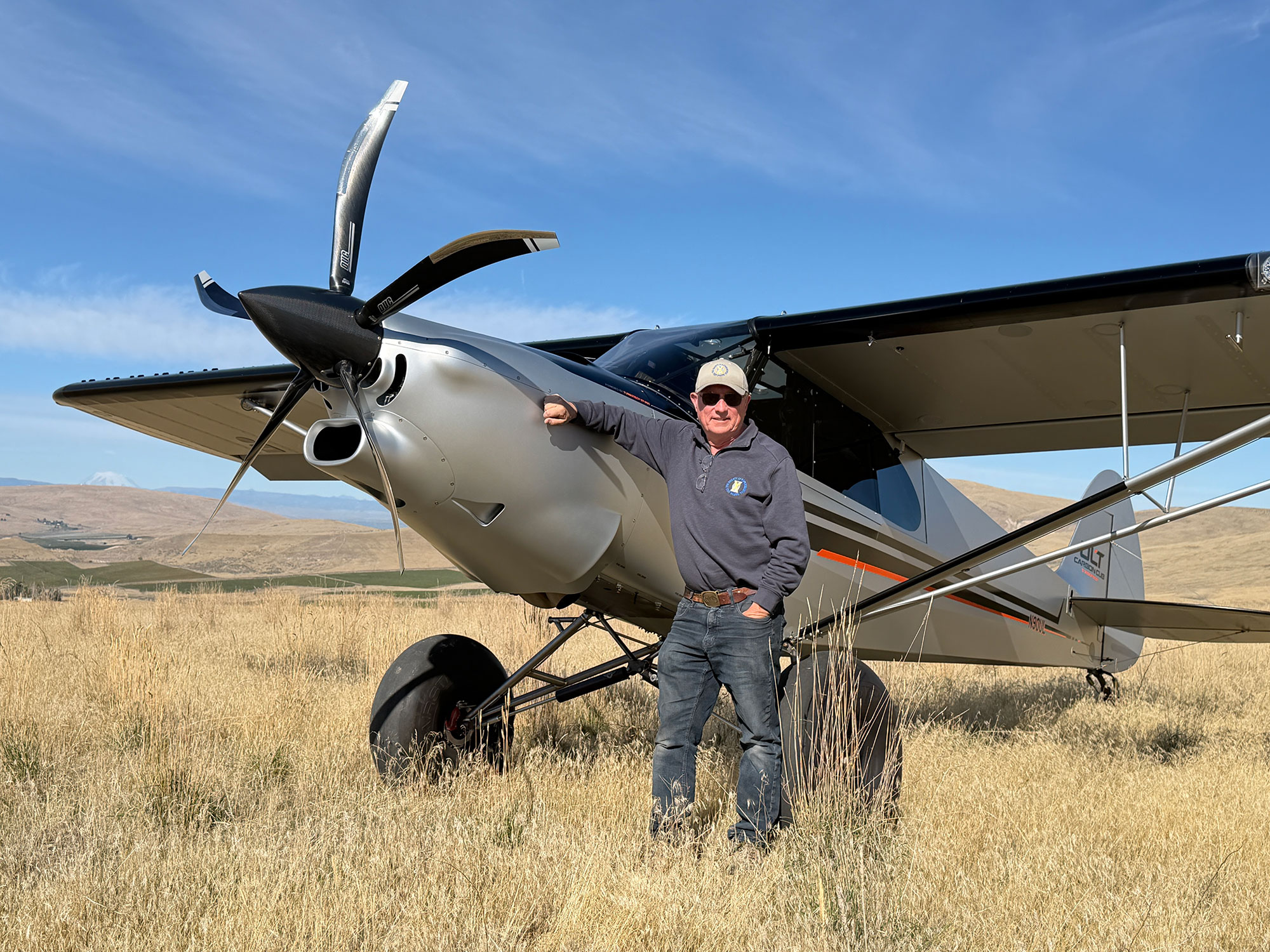
When Brad Damm, Vice President of CubCrafters, calls and says, “Paul, I’ve got something new for you to fly!”, you don’t waste any time getting to Yakima. I have journeyed up there to fly numerous iterations of Carbon Cubs—each of them being an improvement over already improved Cubs—and all of them fun! The most recent “new” machine they asked me to fly—the first E-AB NX-Cub—Damm delivered to my airpark home in Nevada, threw me the keys, and said he’d send someone to pick it up in three weeks. Living with a nosewheel Cub in the West for that time was a pleasure, and we learned a lot about the quality of the product, as well as the fun you can have when you put the little wheel on the “wrong” end of a Cub.
But that was a little over a year ago, and we’ve been watching and waiting for the invitation to fly the LATEST “latest” ever since news leaked of a turboprop backcountry Cub—the ULT. When it was introduced at AirVenture this year, we were asked to put September on our calendar—Brad anticipated the flight testing to be complete by then, and he wanted us to be the first to get in the front seat and really put the airplane through its paces. I mean. Come on … who’s going to turn down something so revolutionary as the first MOSAIC-compliant turboprop?! September in the Mountain West is a beautiful time to fly, and having an airplane that can get in and out of those mountains to explore fall colors and snow-capped peaks? Who could ask for more?

The Airframe
The ULT is (as the name suggests) the CubCrafters UL airframe from the firewall back. This is their LSA airframe designed to be carried aloft by the Rotax 916 iS. This isn’t to be confused with the heavier X-Cub airframe that flies with the beefy Lycoming IO-390 (which is available with either tailwheel or nosewheel). The basic airframe is the same as the C-11, designed for a gross weight of 1,860 pounds. As an LSA, the aircraft has always been limited to the 1,320 pounds that was the limit before MOSAIC—but the new rules have opened that up, and the full capability of the airframe can be used.
CubCrafters’ basic airframe design has shaved hundreds of pounds off the original PA-18 (Super Cub) airframe that Piper designed way back in the middle of the 20th century. For those unfamiliar, they have incorporated a huge number of carbon fiber parts, modern manufacturing techniques, and innovative ideas on cabin and avionics design to produce a modern Cub that has been in high demand for a couple of decades. These are not your grandfather’s Cubs—every detail has been well thought out, the cabins are comfortable while being lightweight, and baggage areas expanded so that two people can go camping for a week in the backcountry. Landing gear options abound, with many (if not most) airframes leaving with oversized bush wheels to allow backcountry access.
The ULT (“T” is for turboprop) uses that same airframe (with all available options), with the engine mount picking up the same hardpoints as a Rotax or Lycoming. Forward of those hardpoints, of course, everything will look quite alien to an old-time piston mechanic.
The Engine
The thing that makes the ULT possible is, of course, the new engine from TurboTech—a French company that has been working on making the engine as fuel efficient as a piston engine of comparable horsepower. The TP-R150 uses a patented heat exchanger to recover energy from the exhaust gases to preheat the fuel and thereby increase the total amount of power recovered from the petroleum.
As revolutionary as it sounds, the idea (and practice) behind regenerative turboprops is not actually new. It has been used in ground-based turbine power systems for many years, so thermodynamics and physics are well understood. The revolutionary part of the TurboTech is making the heat exchanger (the heart of the regenerative process) light enough to create a flight-worthy aircraft powerplant. The result is a 141-hp package that has an installed weight similar to Rotax’s comparable engine in that horsepower range. CubCrafters’ UL airframe—usually delivered with a Rotax—was therefore a perfect candidate to use to bring this powerplant to market.

Piston pilots who have grown up reading how complicated turbine engines can be to operate (after all, doesn’t the FAA require special training and type ratings to fly turbines?) are going to be pleasantly surprised to find out that the modern turboprop is incredibly easy to operate. Aside from turning on the engine master power and fuel pumps, you basically have a start button, a stop button, and a throttle—and the dual-redundant full authority digital engine controllers (FADEC) do everything else. Once the start sequence (about 45 seconds long) is complete, you can fly. When you’re done, press the stop button and you’re finished. In between, just move the throttle back and forth to get the power that you need.
The FADEC computers manage fuel, temperatures, and prop pitch to give you the thrust that you command with the throttle lever. Power is procedurally managed as a “percent throttle”—zero to 100%—where zero is idle. The engine is silky smooth throughout its range, and the prop pitch changes as you ask for more power while the turbine wheel merrily spins at a nearly constant 80,000 rpm. Frankly, this engine deserves an entire article to properly describe—but for now, think of it as a Jet A-burning machine that delivers smooth horsepower to the ULT for flight.


The installation of the TP-R150 looks complex to someone familiar with Lycomings—but then a Rotax 916 iS installation looks equally complex and mysterious to us old-time mechanics. There are lots of wires, hoses, and black boxes that seem to be placed in random positions on the engine and firewall, but once you learn that the motor has basically three segments (compressor, turbine, and heat exchanger) with a gearbox on the front, you have the basic layout. This all mounts to a tubular engine mount that bolts to the firewall in the same spots as the piston engines. Accessories include the FADEC computers, instrumentation signal conditioners, fuel pumps, oil pumps, heat exchangers for oil and fuel—all the little things that you need to make the engine work. Complicated? Yes—but then when I open the hood of my modern car, I really don’t recognize anything from the cars of my youth. As light turbines become more common, we’ll all get used to what their installation entails.

How It Operates
One of the nicest things about transitioning from pistons to modern FADEC-equipped turbines is the complete lack of attention that you have to pay the powerplant once you have it started. Whether it’s a turbojet, turbofan, or turboprop, all the pilot has to do is move the throttle forward and back and let the computer do the rest. Unlike your typical piston engine, there are no CHTs to watch, no oil temp to sweat. The EGTs are all managed by the computer. And in the case of the TurboTech on the Cub, the engine operates in an envelope where it is not close to any limits that you might approach in flight. Start it, fly it—forget it!
Getting the noisemaker started is actually almost as simple. You power up the airplane, then turn on the two fuel pumps. There is a button that you hold for 10 seconds to charge an accumulator, then hit the engine master and watch the dedicated display boot up. When that is up and staring at you, push and hold the start button. Hold it for 45 seconds while the engine goes through its programmed sequence—a little progress number shows you which of the six steps it is on: 1 of 6, 2 of 6, etc. As soon as it hits “6,” the display changes from “Start” to “Flight” mode, and you are ready to fly. There’s nothing more to do—so make sure you have everything else ready by the time you release the button—the engine is now waiting on you.
On our first flight, with Brad demonstrating from the front seat, he asked, “Are you OK if I demonstrated an in-flight shutdown and relight?” Well … uh, if this was my little SubSonex jet, I might object—but this thing has a Cub’s wing, big tires, and we’re over farm fields—so go ahead! Shutdown was a matter of holding the “stop” button for two seconds, and the computer shut off the fuel supply—we were a big-winged glider. Restart, however, is simple. The EGT needs to be below 550° C for the computer to allow a relight, but there is a “ventilator” button you can push, then motor the engine with the start button to pump cool air through the combustion chambers. That brings the temps down quickly—release the button, turn off the ventilator, and hit (and hold) the start button again until the engine rejoins the party—and off you go.
Engine shutdown post-flight is just as simple as doing it in flight—hold the “stop” button for two seconds, and you get that wonderful spool-down sound that turbines are known for. A little scavenger pump ticks away for about 10 seconds to clear the engine of fuel and oil—then when it is finished, turn off the fuel pumps and the electrics—and you’re done.
Still to come—integration of the engine parameters into the Garmin EFIS (a G3X is standard, an AXIS is an upgrade), and that will give the pilot all the interesting fuel flow numbers to integrate into flight planning and monitoring. I must admit I was a little lost on the AXIS because there was no engine data there—but the TurboTech display was easy to read and gave me all that I needed (and more).
How It Flies
There is a cartoon that floats around aviation pages and bulletin boards that has the Wright brothers sitting in front of the 1903 Flyer, with Wilbur saying, “So Orv, how does it fly?” and Orv … answering, “ehh … like a Cub!” That response is so standard among pilots who go back a ways as to be a standing comment on a well-flying, honest airplane that does nothing unexpected and goes where you want it. The only difference with CubCrafters airplanes is that many hundreds of thousands of dollars—and quite a few years and different versions of ailerons —have gone into refining the basic handling characteristics of their Cubs to where they handle much BETTER than a Cub from the Piper company of old. We have flown most of the models CubCrafters has produced, and each generation has lighter, crisper handling in roll, while pitch remains stable and predictable. So, the fact that something flies “like a CubCrafters Cub” is a compliment—and the ULT flies just like its siblings.

The biggest difference you’ll note with the ULT over a UL (or an EX, FX—or any other CubCrafters model) is just how smooth everything feels. The turboprop hums—it doesn’t shake. You add power with a smooth buzz on the runway, lift off, and climb away with no vibration at all. The climb rate was good—there is plenty of power to get over any reasonable obstacle. Stall speed is low enough that if you can’t get over the obstacle, you can probably turn around it with little chance of the wing giving up on you. Our flight out of Yakima included a turn south from midfield, and we easily lofted over the east-west ridge that lies just south of the field. The airplane climbs well and descends equally well (with a predictable full-flap slip as an added bonus if you need it).
Up and away, the airplane banks with little effort, steep turns are simple (with good visibility out the top window), and both lazy 8s and chandelles were easy to coordinate. We slowed it down to 55 knots and did some aggressive maneuvers in slow flight with nary a burble or bobble of a stall. In this regard, with the power back to almost idle, you couldn’t really tell if you were flying the turboprop or a Rotax. The power-off stall was straight ahead, and a recovery with power was quick and easy, with no undue feeling of torque as the power came in. Remember—this isn’t a high-power engine; it is just smooth! So how much power do you lose with altitude? A typical normally aspirated Lycoming (or Continental) loses about 3% of rated horsepower per thousand feet of altitude. The TurboTech gives away about half that, or 1.5% per thousand. (This is, of course, where the turbocharged Rotax shines, since it maintains its horsepower all the way up to the bottom of the flight levels—but that’s for another review!)
Probably the most remarkable thing about flying the ULT in cruise is fuel consumption. It is, in fact, pretty much what you’d expect with a piston engine of similar horsepower. I know, I know … I’m an old aeronautical engineer who takes it as an article of faith that turbine engines guzzle fuel. But the recuperator on the TurboTech engine does exactly what it says it does—recovers significant energy from the exhaust and puts it back into horsepower generation. Damm flew the airplane to AirVenture this past July and told me that his rule of thumb for fuel/power was that you just removed a zero from the percent power to get the fuel burn—100% was 10 gph, 90% is 9 gph, etc. We found this to be roughly true in our hour or two of flying—the fuel flow shown on the engine’s computer display (they don’t have the engine interfaced with the Garmin AXIS EFIS yet) was in liters/hour, but quick division by four gave me a good feel that Brad’s numbers worked.

Landing the airplane was pretty much like landing any of the CubCrafters airplanes—the overhead flap lever is convenient and just where I want it for easy drag control, and carrying just a touch (maybe 5% throttle) of power into the touchdown worked well to cushion the landing. Not having flown the Cubs recently, I tended to be higher in the pattern than expected (I fly lots of low L/D airplanes), so I found myself slipping to make my touchdown point, and it was just as natural as doing it with the flapless J-3s I started in over 50 years ago. Predictable, easy to control, and quick to kick out straight as you get to the runway.
The TurboTech is just as predictable. Power comes in about as quickly as in a piston engine—not slowly or delayed like many a turbojet—but it still pays to think ahead a little and maybe carry a little power if you anticipate sink on approach. The bottom 20% (of throttle) has just a very slight delay when requesting power—but so slight that the average pilot might never notice it. After a few remote landings, we returned to Yakima’s Runway 27 and got touched down and turned off in about 600 feet—and that was with runway end lights that made me touch down about 100 feet beyond the runway threshold. Easy-peasy—this will be a very nice backcountry airplane.


What It Costs To Buy or Build
OK—so you’ve decided that you just have to have a kerosene burner in your quiver—what is the Carbon Cub ULT going to cost you? The good news for homebuilders is that we can tell you that right now, you can order a factory-assisted build with a deposit of $150,000. If you want an ASTM Light Sport Aircraft—ready to fly away from the factory—you’ll have to wait a little while for the guys with the green eyeshades at CubCrafters to come up with that number—and for CubCrafters to finish the Part 22 certification to make it a MOSAIC-legal SLSA.
But for an E-AB with builder assist, you’re looking at a base price of $690,000. That includes everything you need to fly VFR with standard landing gear. As is usual, however, options abound! The prototype aircraft that we flew has the upgraded landing gear, big tires, the upgraded Garmin AXIS EFIS, and the upgraded interior—all told, a fly-away price of $744,000.
A full price calculator is available on CubCrafters’ website for your enjoyment.
Yes, this is a pricey Cub—and yes, CubCrafters already has deposits from enough individuals to make it clear that the project has a future—a strong future. Is this for the typical homebuilder? That’s not really the demographic—but for those looking to have a unique aircraft with a 3,000-hour TBO, it fits the bill. It also makes sense for flight schools that are going to be racking up hours with students who need to show future employers turbine time.
The Future of General Aviation Engines?
The most exciting thing (to this old aeronautical engineer, pilot, and Experimental aircraft guy) is that most engine technologies are scalable, and TurboTech has found a very reliable “launch partner” for their engine technology in CubCrafters. CubCrafters has a mature and robust engineering and marketing capability and probably already has a long line of customers signed up for the ULT. That means that TurboTech can build production engines in quantity, developing their ability to deliver as well as to further refine the design based on significant field experience. Most engine startup companies fail because they can’t build and sell enough to get their legs underneath them financially—so finding a company that will most assuredly buy—and deliver into the field—a large quantity of engines is a huge accomplishment that will help them survive.

And the “scalable” part? Well, that is what’s really exciting to this engineer, because if you prove your technology at 140 horsepower and have the financial capital to scale that engine up to 250 horsepower while maintaining the low specific fuel consumptions, you now have exactly what the light aircraft industry has been desperately looking for —a 200-250 horsepower Lycoming/Continental replacement. The cost of piston engines in that horsepower range has been rising at an unsustainable rate in recent years, making the gap between pistons and turbines much narrower. Throw in a longer TBO (for the turbines), and the gap is even narrower for folks that plan to put enough time on their airplanes. Turbines with a FADEC are incredibly simple to operate, reliable, and good at making lots of power … what’s not to like—assuming you can get the fuel consumption numbers down to what we see with pistons.
You see, while many of us think of turbine engines as just pouring fuel overboard to make thrust, it turns out that if you plot efficiency on a graph with a continuum starting with pistons/props, moving through turboprops, then turbofans, and finally turbojets (and, I guess, rockets …), the absolute sweet spot for efficiency to an aeronautical engineer is the turboprop. If you can make enough of them to bring the costs down —well … you will change the aviation world!
In Summary
The CubCrafters ULT is indeed a significant milestone—not just for backcountry airplanes, but as a potential harbinger of things to come in all segments of light aircraft design and operation. Sure, the TurboTech is expensive—but economies of scale might make it more affordable once the pioneers have paved the way. Will the average light airplane owner save money in the long run? Honestly—probably not, unless you are flying a LOT more than the average number of hours per year. But for those who simply want the convenience and ease of operation and can afford it—the Cub with a turboprop on the nose can be mighty attractive. For operators who put lots of hours on in short periods of time—like flight schools—the TurboTech could be a game changer … especially considering that many students are beginning flight lessons for the sole purpose of ending up in an airline cockpit—so turbine time is important in the logbook. Just as we now have many pilots who have never flown anything that didn’t have a glass cockpit, we’ll eventually have pilots who have never flown anything that didn’t have a turbine and burn Jet A. Last—but not least—let’s remember that in many parts of the world, avgas doesn’t exist—so the ability to burn Jet A is the only way that you are going to go exploring in your light aircraft.
CubCrafters has never shied away from doing things differently from everyone else—that has been why they have often been the leaders in their field. We’ll be watching closely to see how the ULT does—in the market, and in the air!

The cool factor is excellent. In my view, it will not be as safe as a piston-engine model. Throttle response is more important to safety than reliability is. Fuel consumption will suck. I also prefer planes with side-by-side seating. SuperSTOL XL or RV 15 for the win.
Apparently, your reading comprehension sucks, or you are calling the author a liar, because he addressed both throttle response and fuel consumption and was positive about both. But hey, I’m sure you know better than a former NASA astronaut, engineer, flight controller, respected pilot and magazine editor.
I addressed this very issue below. “The throttle response is great… but carry 20% power in case of sink.” Okaaaay. Sure. I trust you.” I’m not saying he was a liar, but it seemed to me he was conflicted and wanted the throttle response to be better than it actually was.
“assuming you can get the fuel consumption numbers down to what we see with pistons.” This is mathematically not possible.
“The throttle response is great… but carry 20% power in case of sink.” Okaaaay. Sure. I trust you.
You actually need to read that more carefully … “and carrying just a touch (maybe 5% throttle) of power into the touchdown worked well to cushion the landing…..”. Followed by a mention in a different paragraph that …. “The bottom 20% (of throttle) has just a very slight delay when requesting power—but so slight that the average pilot might never notice it…” So no, you do NOT cary 20% power in case of sink, and you use a slight touch of power (5%) to cushion the landing. And CubCrafters is still working with TurboTech to finalize the throttle/power/prop response map. Throughout most of the range, the throttle response is very quick – at least as good as most pistons.
Yeah, yeah, I know. But the point still stands. It is the bottom 20% with poor throttle response. The bottom is where you need throttle response in a tailwheel plane. In case you need power in the rollout to prevent a ground loop. And that’s this “most pilots would never notice.” Well, excuuuuse me for being such a dumb pilot.
Hi Andrew,
We can put this to bed pretty quick. I’ve flown this aircraft extensively. You haven’t. Your claims about poor throttle response and excessive fuel consumption are just made up nonsense.
Paul has already corrected your interpretation of his article. Carrying a little power to cushion a landing does not mean carrying 20% power to compensate for poor throttle response. Continuing to repeat that claim after his explanation doesn’t make it accurate.
I have thousands of hours flying Cubs around the world, and this is one of the finest backcountry aircraft I’ve flown. Throttle response is great, fuel consumption is comparable to a piston-powered Cub, and its overall performance has exceeded all of our expectations. I would take it any place I would take a piston cub.
Skepticism is fair. Declaring an aircraft less safe and its reported fuel efficiency “mathematically impossible” requires more than your assumptions. If you have data supporting those claims, share it.
We’re basing our conclusions on actually flying the airplane.
Brad Damm
VP CubCrafters
Nice article but a good comparison of take off, climb performance, minimum landing distance etc would be interesting.
Interesting, but $700K base? Hard pass
Super good article. And I’m guessing turbine response, while already stated as good, will become very comfortable with a bit of experience in the plane. For cost, well expensive yes. But a new even C172 equipped is not far behind now. If I was much younger and much wealthier, I’d put my name on the list. I wish them super success. Thanks.
The odds of the average pilot affording one of these may be low. The odds of the average pilot renting one of these most advanced aircraft is very high. Prior to the mid 70’s most flight schools were ‘Dealers’ not just flight schools. People like me rented most every hour we got. Dealer/Flight Schools had many aircraft on their flight line and many owners leased the aircraft back to the Flt Schools to help offset the payments.
The new Sport Aviation is bringing these glory days back. Renting the latest and greatest technology is coming back and I for one am looking forward to it. 😁
Lot of zip ties on that $750k aircraft. Not throwing stones, as my $20k homebuilt has a lot of zip ties, too. Nice to see that the big $ boys do some things the same way as us little guys.
Does it have beta and reverse like a normal turboprop?
I thought the recuperator heated the intake air. Does it heat the fuel too?
The other thing that this is in helicopter price territory. If you are at this price point, your backcountry machine will be 1000 times better and rotary.
“it turns out that if you plot efficiency on a graph with a continuum starting with pistons/props, moving through turboprops, then turbofans, and finally turbojets (and, I guess, rockets …), the absolute sweet spot for efficiency to an aeronautical engineer is the turboprop” I’ve got $5 that says no such plot exists. More efficient with poorer fuel efficency, especialy down low?I don’t like the whole article because it ducks and weaves to paint a good picture.
3/4 of a million dollars? For a cub? 🤡🤡🤡