

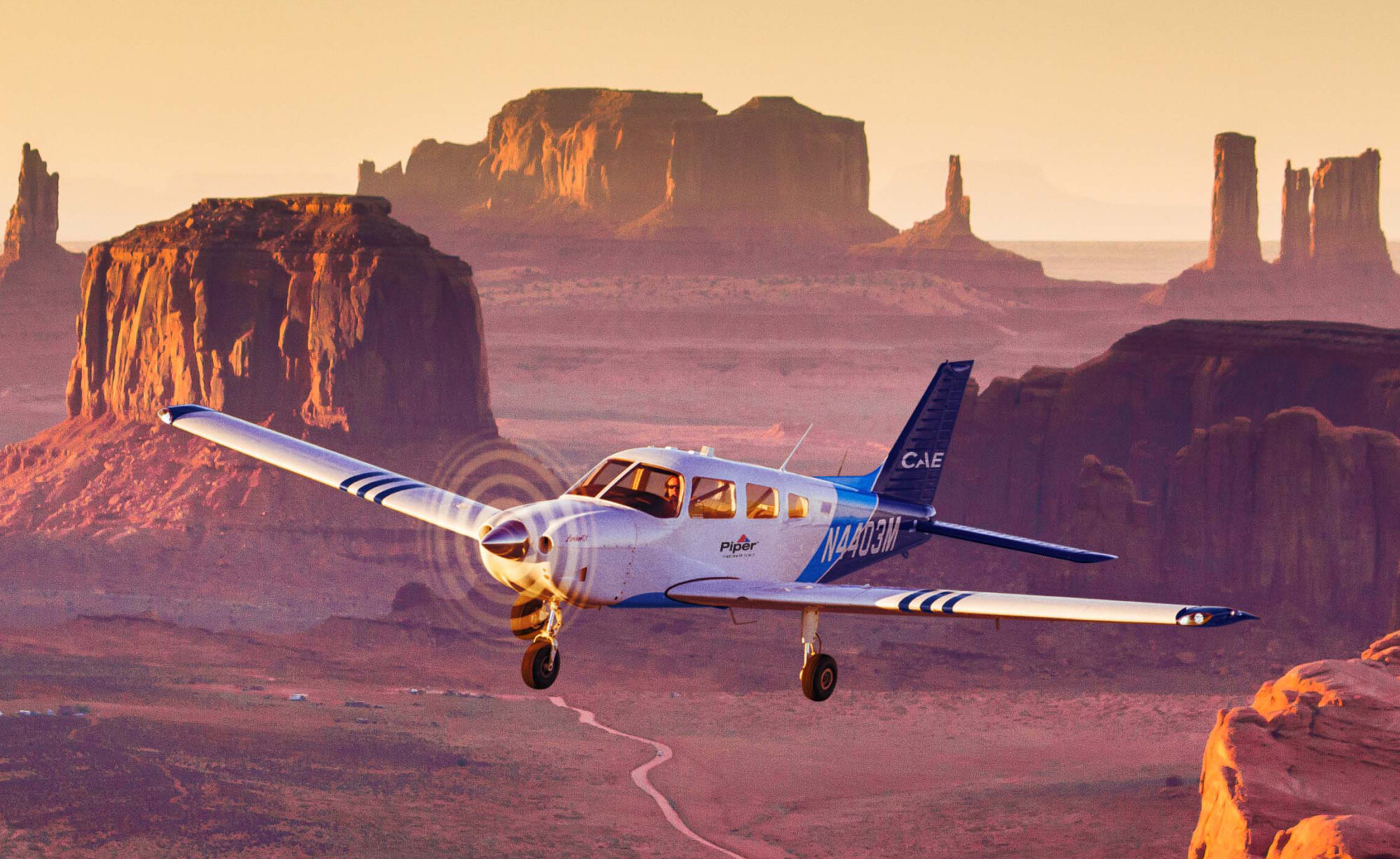
Four years ago, as the electric aircraft scene heated up to a near boil, training conglomerate CAE pulled together a consortium of partners with a cool idea: to electrify one of the most popular single-engine training aircraft ever, the Piper PA-28 series. Now, that project appears to be on hold, according to a report in Aviation Week.
Specifically, the group led by Montreal-based CAE, consisting of Piper, French electric motor manufacturer Safran, and electric powertrain specialist H55 and tapping into the resources of the Canada Quebec Aerospace Cluster, had been pursuing a supplemental type certificate (STC) to put Safran’s ENGINeUS 100 150-kw electric motor into the PA-28-181, replacing the existing 180-hp Lycoming O-360. The motor would be powered by H55’s battery system.
In the intervening years, the project is now echoed across the sustainable aviation landscape, with similar motor and power combinations planned for installation into several light trainers. As one of the largest training organizations flying a Piper fleet across its locations, CAE originally pursued the concept as a way to ensure that fleet would have an upgrade path in a world where piston engines appeared to be going out of style.
The STC wouldn’t serve the entire global fleet of roughly 28,000 PA-28s already in service, but it potentially covered a significant percentage. AvBrief reached out to CAE, and a spokesperson gave us this update: “We completed the initial phase of the electric aircraft program, including the design of an electric training aircraft based on the Piper Archer. We are currently evaluating the best path forward for the next phase of the program, as the project moves into a more advanced stage of development and certification. We are working with industry stakeholders and specialized partners to assess the options available and determine the most effective approach going forward.”
While the discussions are ongoing, no decisions have been made at this time, according to CAE.

So they ran out of money with a little sprinkling of common sense… imagine that…
Surprise!
Those “angel investors” may have asked an aeronautical engineer about the validity of their assumptions. Then the $$$ flow stopped.
I’m wondering if this “evaluating the best path forward” is due to the current economic war between Canada and the U.S. It would be nice if there were some spec’s released now that they’ve completed the design phases.
Nearly broke aircraft companies, thin on engineering to begin with, committing to the latest rage with absolutely no technical plan that shows the energy density of storage, efficiency of propulsion and mass of all this can fly. Not to mention there are no component validation and design standards for the full electrics. A pilot with such decision making skills would be grounded. Remember the smoking Boeing battery fiasco?
It’s just nuts to make vehicles electric. I have seen how many fire departments it takes to put out an electric car fire when the batteries go bazonkers beside the road or in the garage. The explosion alone can send the hood across a parking lot. I’m not about to take that in the sky with me. It would be safer to haul industrial grade explosives. And if they are trying to save the environment, just compare how much land and how many trees have to be destroyed in order to mine the minerals for batteries to the production of gas and oil pipelines.
The energy density of rechargeable batteries must at least quadruple for full electric aircraft to be usable as more than an “air taxi” with <50 mi range.
Maybe they should be doing a market survey and analyze the cost benefit first. I don’t see a booming market for an electric conversion of the Piper Archer. I see a dedicated ground up electric airplane but not a conversion of an existing 100LL aircraft. Even a autogas conversion makes more sense than an electric conversion.
As a recent adopter of an electric car, I’m very impressed with its many advantages over a gas-powered vehicle. That said, EVs are supported by a large and growing infrastructure of charging sites as well as home charging. I would think that the charging or battery swap time for a training aircraft would be excessive.
“We are working with industry stakeholders and specialized partners to assess the options available and determine the most effective approach going forward.”
While the discussions are ongoing, no decisions have been made at this time, according to CAE.”
Translation: CAE has invested in an STC for electric conversion of existing PA-28 fleet. CAE has invested in a potential new version of electric powered PA-28 airframe. CAE knows there is no market for a $750k to 1 million dollar trainer. CAE knows there is no cost effective electric combo that can developed within existing battery technology combined with the US trade war that makes any 5-10 year investment program into emerging, evolving electric technology impossible. Who would make capital investment in Canada with the US challenging Canada’s basic sovereignty by attempting to make Canada a 51st state? No decisions have been made? I would argue CAE has made their decision because there is no viable, profitable, functioning electric option at this time including the foreseeable future in a world of economic, political, and logistical chaos. CAE’s quoted statement was the most politically correct word salad acknowledging the obvious.
If you are correct, and I suspect that you are, I can only assume that the public statement in favor of an electrically powered Archer is designed to garner political support until the future changes the political candidates and climate.
101, that is the reality. With battery technology where it is today, the market for a $750,000 to $1 million electric trainer is close to zero. CAE may say no decision has been made, but the economics have already made the decision for them.
All is lost!!