

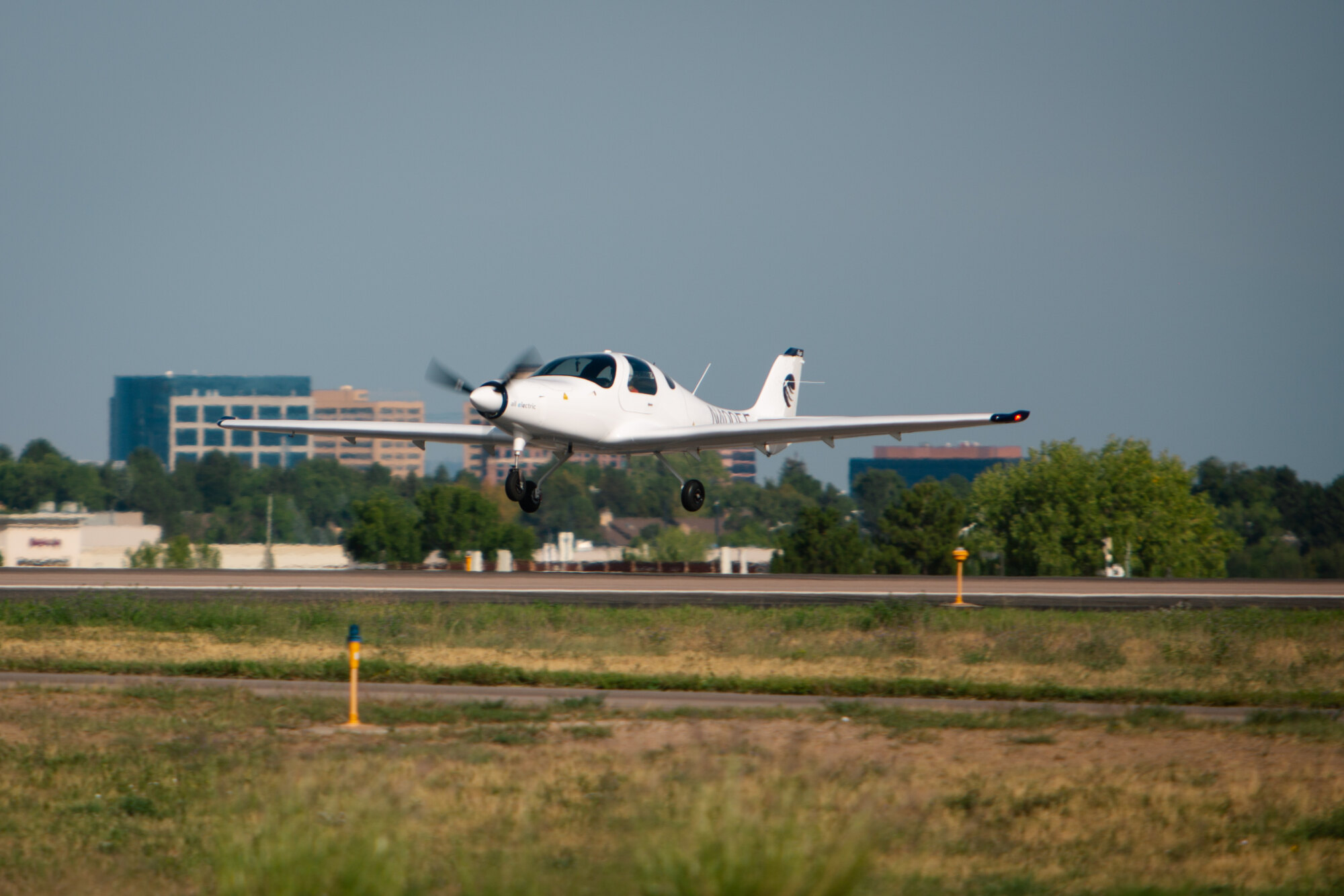
Bye Aerospace flew the conforming prototype of its all-electric eFlyer2 for the first time last week. According to Aviation International News, ADS-B data shows the plane was in the air for five minutes and did one trip around the pattern. According to the company, test pilot Elliot Seguin checked basic flight characteristics on the flight, which occurred at Centennial Airport near Denver. “The eFlyer 2 handled well during the flight and validated the work the engineering team has put into designing and testing the aircraft over the past several years,” Seguin said.
The company said it’s a major milestone toward eventually tackling a 1,000-aircraft combined order book for the two- and four-place versions of the aircraft. The company has orders from most of the U.S.’s largest flight schools and will be gradually expanding the flight envelope for the aircraft. Bye says it will have operating costs about 80% less than a Cessna 172. The aircraft has a projected endurance of more than three hours and a maximum speed of about 135 knots.

If the three hours and 135kts turns out to be true in actual use, believe we’ve got something here.
With claims like this after one five minute once around the patch flight … THIS is why Bye is not serious. NO ONE — not one entity — has an eAirplane that can do that. When he DOES that, THEN he can make that claim! Why didn’t his test pilot circle Centennial for an hour to prove his claims are valid.
Order books aren’t anything more than a sign of interest. MarlH (below) did a great job of financial analysis … too expensive vs a 172.
135 its is the projected maximum speed. It is pretty certain that the three hour range would require a much lower power setting and speed. However, three hours at any speed would be progress.
I’m encouraged that the eFlyer is tackling a conversion to electric flight with an airframe that is “common”… ie, not some futuristic design that requires fairy dust to meet expectations.
What I am most interested in is seeing if the economics of a roughly $800,000 airplane (online estimates of $750 to $815 K point to this as a good starting price point) even with reduced operating costs.
I did a quickie cost analysis for purchasing one at $800K, 20-ish % down and financing the rest….estimating reasonable costs to establish the infrastructure needed to keep the plane at our airport (charging capability, etc…) and using Bye’s roughly $35-50/hr operating costs….. at 100 flt hrs per month, we’d have to have a rental rate of $165-175/hr to cover all expenses and make a meager profit of 1-2%… Add an instructor at $50-75/hr and you are looking at an easy $220ish an hr for primary instruction…..but you HAVE to fly 1200hrs a year to make these numbers practical.
I’m in a rural area of Georgia——-for a small flight “school” around here, 100 hr/month is difficult, if not impossible, so cost per hr would have to be higher for rental—possibly by a significant factor. Costs quickly rule out many of the folks that want to fly—but are not planning a career…..
I sincerely hope that larger schools can make it work—they already do with fleets of Cessnas and Pipers….but are we meeting the needs of the Non-aviation career path folks that want to fly for a hobby and may not want or be able to take part in the programs of large schools??? Can we??.
Promising, but… Who works on the “engine”? An A&P or an electrician?
General characteristics
Performance
Just think of all those 172s that will be on the market after those big schools get these trainers!
I wouldn’t hold my breath for that to happen.
😉
1000 orders? Really?
Orders on future products express interest, not commitments.
How much did Bye collect in actual cash deposits?
The Icon5 was said to cost $100K. Everybody wanted one at that price. Only the first handful cost under $300K. Now China owns the company at low bidded auction price. The eFlyer is just repeating the cycle. Diamond, Continental, Cirrus, Cub Crafter’s Certified Cub and Piper Aircraft is even owned by Government of Brunei.
I’m just hoping the new Sport Aviation Regulations break this cycle.
I would not want to learn with an electric airplane, because I don’t want to fly an electric airplane. Imagine missing all the experience and judgment that comes with training with an airplane with an engine (as opposed to a motor).
Please forgive me Sir …But ???
Well argued?
Doing some research on the Eflyer2, Bye seems to have outsourced the whole project. The Lancair influence is hard to dismiss. Composite Approach is the supplier and builder support of the Evolution. Composite Approach is located at Redmond, OR just like Lancair formerly was. Not the same address but in the same town from which local, skilled, experienced composite labor is available. Makes sense for Composite Approach,
It appears Bye Aerospace financed mating the Safran motor to a long wing, high aspect ratio version of a Lancair Evolution/Legacy. Arion Aircraft (Arion Lightning fame) built the first proof of concept airplane. The Lightening influence on that one is also hard to dismiss. Bye has positioned itself as the leading electric aviation company. To me, it appears they are good at financing others talent, taking a lot of credit for someone else’s work, preserving more future potential investment possibilities because they actually got a couple of electric powered homebuilt designs flying. Elliot Seguin is an outstanding test pilot and aircraft performance evaluator. A five minute test flight is not a sign of success with Seguin at the controls. This tells me, it did not go as planned. Both the Lightening and Lancair Legacy/Evolution have demonstrated excellent handling qualities over a relatively long period of time. So, saying it flies excellent should be of no surprise.
But five minutes, followed with a victory lap suggesting superior Bye Aerospace technology is taking far more credit than deserved. With all that investment in a well proven aircraft platform still makes me wonder why an electric, two place trainer has projected sticker price of $750K plus. That’s a lot of greenbacks for a five minute initial test flight so far.