

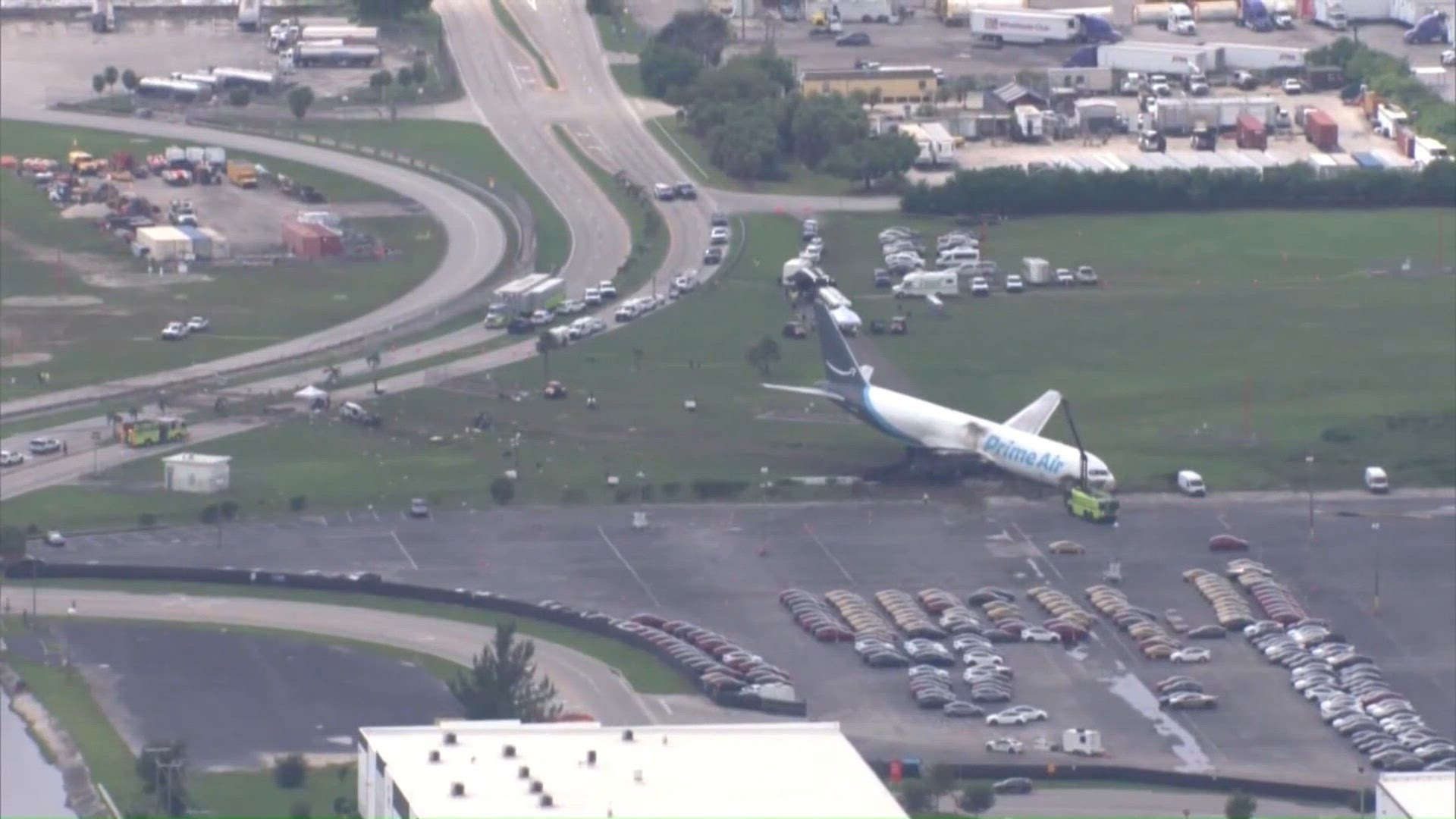
The Amazon Prime Air Boeing 767 that crashed in Miami last month had only 2,730 feet of runway left before its “weight on wheels” parameter switched permanently to its ground mode as the freighter barreled down Runway 30 at 146 knots, according to a preliminary report by the NTSB released Thursday. Five occupants of a van were killed and three others on the ground were seriously hurt. The two pilots suffered minor injuries. The speedbrakes and thrust reversers did not deploy and the wheel brakes slowed the plane for eight seconds to 120 knots before the engines were firewalled in a short-lived go-around attempt with only 930 feet of asphalt left. The throttles were cut four seconds later and the plane was going 113 knots as it entered the 1,000-foot grass overrun, where it took out the localizer and approach lights before going through a perimeter fence and hitting a van and SUV on a road. It finally stopped next to a parking lot full of Tesla autonomous taxis.
The report also shows the first officer started warning the captain, who was the pilot flying, that they were too fast about a minute and 42 seconds before the captain called for the go-around. “There was not a consistent verbal response to the comments about speed.” The crew also apparently did not get a wind advisory that would have told them they had a quartering tailwind of 17 knots gusting to 26. FAA rules say the controller for that runway should have given the winds when he cleared the flight to land.

It’s clear what happened. The pilot ignored speed warnings, and he was not on the vertical approach. If he requested the runway, he ignored the winds. I’m surprised the controller didn’t tell him the winds.
The pilot will pay for his recklessness with his livelihood and possibly his freedom.
The owners of 21 Air should go down with him IF the culture of the company attracted the kind of pilot who would ignore fundamentals.
I watched another analysis that pointed out 11 key points during the arrival where the aircraft was out of position that requires a missed approach. The crew flew past each.
It seems that the definition of a “stabilized approach” varies a bit from one air carrier to the next and I’m not going to try to define that for anyone based on an arbitrary opinion except to say that we all need to have enough standardization so that when a crew flies together they have some solid reference points in order to make appropriate calls. Many definitions of “stabilized approaches” that I’m hearing would completely eliminate the possibility of doing a circling approach, which has always been clearly legal and acceptable based on FAA regulations and approach plate minimums. I think that part of the problem we have these days is a whole generation of airline pilots who never had to respect runway length because they never flew smaller aircraft out of 3000 foot runways. Maybe it would be a good idea for all of these air carriers just to buy a few light piston training twins and pay some brave instructors willing to fly with their crews to teach them respect for what happens if you don’t set it up right on final. Air carrier pilots need to get in a habit of puckering up and treating every runway as if it were only 3000 feet long instead of just sitting there driving it on until they feel the impact and hear the passengers scream and then roll another 7000 feet before burning 🔥 up the brakes.
I can only go with the FAA’s definition of a stabilized approach for jet aircraft in the Airplane Flying Handbook:
…which is consistent with what we taught at the major international bizjet training company where I used to work. The Flight Safety Foundation says that unless the approach is stabilized by 1000 AGL in instrument conditions or 500 AGL in visual conditions, the approach should be discontinued, and this is consistent with FAA guidance. The criteria to be considered as to whether the approach is stabilized are in Table 1 of the FSF document linked above. And based on the reported parameters in the NTSB Preliminary, this approach was unstabilized below 500 AGL, which by these standards would be a mandatory go-around.
As for circling approaches, these issues are the reasons why many Part 121 carriers prohibit circle-to-land maneuvers, and limits landings out of anything other than a straight-in SIAP to visual approaches conducted in VMC. But you can still make a stabilized approach out of a visual if you line up far enough out on final (say, 5 miles or so) since the desired glide path for transport category aircraft puts you at 1000 AGL about 3 miles from the threshold.
I used to watch the Air Force One 747 do circling approaches at Topeka Forbes several decades ago. From the airport, It looked like he was so slow that he was gonna fall out of the sky at full circling bank angle. Just watching the Navy carrier pilots jockeying the throttles and staying within 1 mile of the carrier at 400 AGL brings a whole new perspective to the term “stabilized approach.”
But the Day VFR pattern at the boat was still stabilized from 400 feet and 3/4 mile once we rolled out on final already on-speed and fully configured for landing with the ball centered..
If I may …’Spool-up’ notwithstanding …there’s a world-of (read: SIGNIFICANT) difference between a ‘Light’ (lighter) airplane and a (‘Heavy’) Transport-Category Airliner.
Due to a ‘minor’ property of Physics …’Mass’ …a ‘Stabilized-Approach’ is SIGNIFICANTLY more critical, and essential at an even earlier point during the Approach.
And you made my point very succinctly Flyinb. A Stabilized approach is not the same for every airplane, every operation, or every pilot. An aircraft carrier pilot for example, gets much of his situational awareness by keeping the pattern tight and close to the boat for visual and spatial references. It can be difficult to reorient to the feel and speed of the aircraft for the purpose of landing after sitting at altitude with the autopilot on for a while. All it takes to fix that is a tight maneuvering pattern like a carrier pilot makes.
True, and most importantly, the final segment of the approach to the boat is still done in a stabilized manner — on speed, on glide path (ball), and in the final landing configuration. And it doesn’t matter if you’re flying a tactical jet or the COD.
Correct, but what I posted about the stabilized approach concept is still applicable to light planes and should be (but rarely is) taught from the git-go in primary flight training. The problem is that lack of early training on this concept can influence behavior much later on in one’s aviation career (see “Law of Primacy” in the Aviation Instructor’s Handbook).
That said, I hope nobody thinks the Airplane Flying Handbook is only applicable to light planes. And the FSF document is primarily directed at larger, heavier aircraft than Cessna 172’s and the like.
(Ron & Jay) 200% Agree.
A few years ago, before I hung it up, two of my hanger neighbors were a retired TWA MD80 pilot, he had a PA24 180. The other a retired FedEx MD11 pilot. He had an Aztec. I had an Aeronca Chief. They both would ask me to do a BFR for them every two years. I was honored. I was qualified in their aircraft but certainly not in their jets. They were both so professional in their flying. Felt like I was in the jump,seat of both jets. Watching them fly, reminded me of how sloppy I was in my Aeronca, and the other machines I occasionally flew. I always learned something. Those two guys could have just handed me their log books for pencil whipping. And they were both CFIs also. But they never left their professional discipline behind how they had always flown. Those two guys flying for Amazon were not my hanger neighbors. The FedEx guy fell over dead with a heart attack at the ford dealership while getting an oil change. That was just two months after I had ridden with him on the last BFR. I’ve always wondered how and how fast I might have responded on short final in his Aztec. If at all.
Your observations (and ‘sentiment’)? …Laudible Sir!
It’s just getting disgusting. Who is screening the screeners? Who is screening FAA examiners? Who is screening HR hiring personnel? Who is screening the training departments at all these carriers?
Anybody can make a mistake, but this is becoming a culture of stupid tolerance and a type of look the other way avoidance for really bad trends and attitudes. Gone are the days when a green new hire sat sideways for 10 years and 8000 hours before moving to the copilot seat for another 10 years and another 8000 hours before reaching the left seat in the cockpit. It’s just not worth the big rush to put 4 gold bars on the shoulders of a white shirt, with a green pilot in it so he can run a heavy jet off the end of a runway into brown grass and local commuter traffic.
You can teach accelerate/stop, accelerate/go, ASDA, TODA, mathematical runway length, elevation and temperature calculations all day everyday until pilot calculators need a new battery, and that’s fine, but it’s not going to fix the problem.
(Jay & Roger) 200% Agree!
Something I haven’t seen discussed is the Captain’s duty cycle in days prior to the event. On the day prior, the Captain flew a MIA-Bogota out-and-back arriving at MIA at 0902 EDT after a 4+20 return leg. While the report doesn’t give the details, based on the return flight time, the apparent 1-hour-prior report time, and a 2-hour turnaround (as they had on the 6th), he probably reported for duty for the Bogota flight about 2120 on the 4th and clocked out about 1002 on the 5th. He was then off duty for 19-20 hours before reporting for duty at 0530 on the 6th.
Such a duty cycle would put him way out of whack with his circadian rhythm, and render his mental and physical state significantly degraded upon arrival at MIA at 1355 on the 6th. If so, this could make it a lot harder for him to maintain precision control of the aircraft and slower to process the flight parameters and determine appropriate actions. I know what it was like for me in my F-111 days on the wing battle staff night shift for a week-long exercise, where I’d work a normal 8-5 in the office on Friday and then report for duty Sunday night at 1800 for a 12-hour shift. By the wee hours of Monday morning, I’d be pretty run-down physically and mentally. It would get better during the next few days, but for the final actions on Friday morning I’d be held over until about noon — again, pretty brain-fried.
Such physical and mental degradation due to his work being out-of-cycle with his body clock could explain how he let the flight deviate from appropriate parameters and why he did not respond appropriately to those deviations and the co-pilot’s inputs.
The next question would then why the co-pilot didn’t intervene by taking control on short final when the approach unstabilized below 1000 AGL (which in their FOM probably requires a go-around) and especially below 500 AGL. It will be interesting to read the cockpit transcript and what the copilot says when interviewed, including anything he has to say about his impression of the Captain’s physical and mental state (if they can get him to do that).
Even with calm winds, the approach was not satisfactory and proper pilot judgment would dictate a go around. I think mention of the tailwind and ATC wind advisory as a factor is specious, all of the evidence points to the pilots making awful approach then forcing the aircraft onto the ground too far down the runway with too much airspeed and with predictable results. You can’t just shoot an approach that looks like it was made by a kid flying MS flight sim and shrug and say ATC didn’t give a wind advisory. ATC isn’t omnipotent and you could easily experience localized wind phenomena such as wind shear, a gust front, or microburst with no warning from ATC. The call must be made based on actual aircraft state and being caught off guard isn’t sufficient excuse when there was ample opportunity to go around.
In-Spite-of all that’s been ‘discussed’ here, the Preliminary-Report and some of the glaringly-obvious ‘issues’ noted in the initial report and available video(s), no-doubt still best to await the final report before assessing /coming to a ‘final’ conclusion /judgment …and perhaps, recall an old adage in Aviation:
“There are those who have …and those who will”
…and if we’re lucky (and vigilant) we might continue to avoid that time when it is ‘We’ who will?
2 more crashes.
Mexico Citation I : https://www.aerotime.aero/articles/cessna-citation-crash-western-mexico
Nigeria ATR 42: https://m.youtube.com/watch?v=uNV9NrvB5BE