

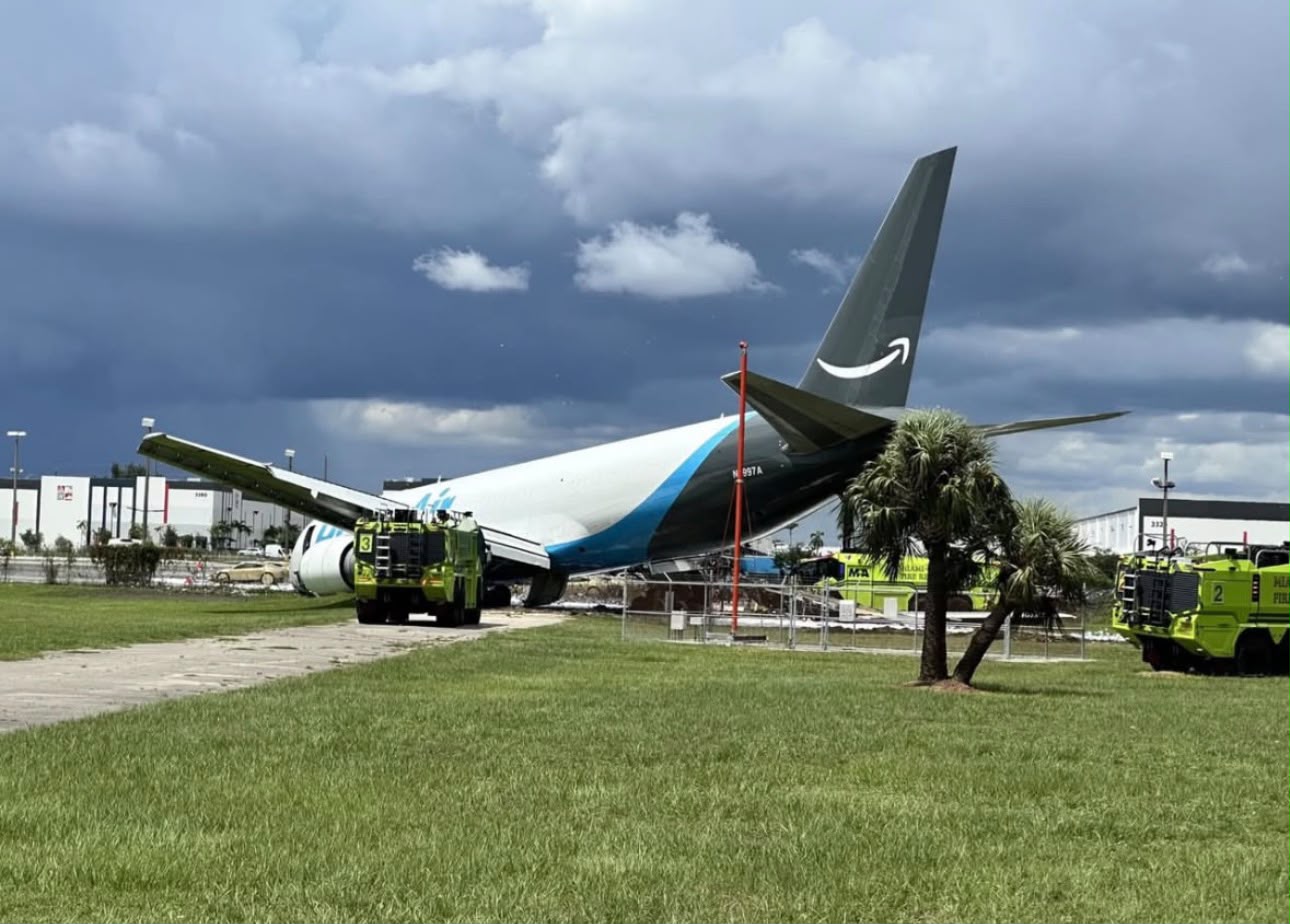
ADS-B data suggests the crew of an Amazon Prime Air Boeing 767 levelled at 1,600 feet AGL for more than a mile as they began their final approach to Miami/Dade County Airport and then tried to salvage the now-unstabilized approach with a much steeper than normal glide on short final. Max Trescott, producer of the popular NTSB Newstalk podcast carried every second Thursday by AvBrief, says that by the time they reached the 965-foot displaced threshold they were 100 feet high and still at 175 knots. Read his full analysis here.
Video shows the 767 apparently landing long and floating for a considerable distance before going off the end of the runway and running into several vehicles killing at least five and injuring five more at Miami International Airport on Sunday. All the dead were in vehicles. The pilots were among those injured. There were thunderstorms in the area when the aircraft arrived from Puerto Rico about 2 p.m. The video shows the big freighter airborne a few feet for hundreds of feet before landing on Runway 30, which is 9,354 feet long. Winds were from the south southwest at between 15 and 20 knots with gusts from 20 to 30 knots at the time of the accident. Winds had been light and from the west for most of the day and picked up from the south just before the plane arrived. Videos below show the landing and the end of the overrun. There is some swearing in the audio.
I was just sent this video. That’s a long ways down the runway. pic.twitter.com/zHg5TJteik
— Combat Learjet (@Combat_learjet) September 6, 2026
The plane barreled through a grass overrun, coming to rest next to a parking lot filled with cars of the same make and model, reportedly new Tesla robotic taxis called Cybercabs. There is no arresting bed of crushable concrete at the end of that runway. The aircraft caught fire, trapping the pilots onboard. There were reportedly people trapped in vehicles and one man had to be rescued from underneath a vehicle. Of the injured, three were reportedly in critical condition and two others were hospitalized with less serious injuries. About 160 flights were canceled and more than 325 delayed because of the crash.
The moment Prime Air Boeing 767 overshots the runway at Miami International Airport – September 6, 2026
by u/Repulsive-Pattern-57 in aviation

Windshear from thunderstorms nearby, plus the typical late airline use of brakes and no reversers is a recipe for a long, high speed overrun. It irks the daylights out of me every time I ride airlines and they roll halfway down the runway without using reverse and then they burn up the brakes in the last 3 seconds before turnoff.
They touched down so late and I couldn’t see if reverse thrust was applied, I wonder if they were thinking (too long) about going around. Is this strip long enough that an overrun arresting bed isn’t required?
Not sure about a 767, but with the main gear squat switch not compressed, (left in this case) most airplanes can’t get reverse anyway. Lots of mistakes made here. Then there’s the possibility that they carried extra ref speed for thunderstorms and wind shear on final to compensate, which made them fast for touchdown when the wind likely shifted.
We must not be watching the same landing, because in the video in the article, the mains weren’t even weight on wheels as it passed the camera, and that didn’t change until after the accident aircraft was too far away to see details in the video. You don’t get reverse thrust until WoW, and brakes won’t help you much if the airplane is still flying and dragging a few main landing gear tires along with barely any weight on them. You can stand on the toe brakes all you want but if you’re still just skimming the tarmac you will hardly decelerate until you have weight on that gear, which is what gives you traction and thus braking effectiveness.
We both saw the same landing video of Prime Air. And I did comment and leave a video about the main gear not being planted yet. Pretty good video toward the bottom of the comments if you want to check it out.
My comment was just an aside about airliners I have ridden in the past and their lack of using reverse thrust on rollout combined with burning up brakes right before turnoff.
Flaps appear to be down in the photo above. Very early for any conclusions. One (of many) possibility is that the crew was severely distracted, or possibly incapacitated by some emergency in the cockpit, such as perhaps smoke or fire….
Let’s not judge airmanship before we have many facts.
Yes, you’re right. Let’s not blame the captain until we’re sure it wasn’t a bag handler, a rental car agent or maybe one of the runway lights was out or something like that. So I’m now wondering about the report that said the crew didn’t report any incapacitation, fire etc.
You don’t know what was happening in that cockpit. Which leaves you free to speculate….
Well, we certainly do need to keep from getting sidetracked from the real issues by our own self interests.
It reminds me of a preacher years ago that told me about the drunk that married a bootlegger.
He said, “she doesn’t cook, she doesn’t sow, she doesn’t clean house and she ain’t much to look at; but even so, I love her (still).”
As I usually do, here I go. Windshift/windshear. Should be easy to determine by checking the recorded gauges. No shame here in guessing. And by me guessing and being my usual wrong, a thought has been suggested about possibility when TRWs are around. So, there.
And the NTSB will likely complete its final report with all the facts for us by the end of next week after 2 or 3 other major crashes have made us forget this one, right?
What really amazes me is this modern generation of pilots who believe that they are not responsible for a crash as long as they did everything legally and by the book.
Talk to these young pilots sometime and see for yourself.
Windshear? Windshear isn’t magic. In the absence of a preexisting emergency (none were declared and there is no evidence of one as of writing) that precludes going around, there’s no possible excuse to float half way down the runway at an obviously excessive airspeed, trying to force the plane onto runway. Not even wind. In day one of flight school your instructor would tell you to go around if a gust front or wind shift or whatever you want to pick out hit as you were rounding out and caused you to start floating down the runway. That doesn’t change at the ATP level, if the approach or landing is outside of acceptable parameters you go around. Anyway, the ADS-B data indicates excessive descent rate and (ground) speed on final, not a peachy approach with a float down the runway like what would occur due to a wind-driven increase in airspeed; the approach was no good, and if there were a sudden tailwind the aircraft wouldn’t float, it would sink. People, the go-around switches are right there, if there’s nothing stopping you from using them, use them.
Oh, TV, you’re just saying that because it’s true. And you said it pretty well actually. If you ever get a chance, watch a YouTube called “You can always go around.” Tom Norton incorporates it into his training program for Phenoms. The video depicts everything from light Cessna’s to jet airliners going around, even after touchdown and partial rollout. Now if we can just teach some of these younger pilots to use the longest runway available, calculating the first 3 inches, make decisions early and stop treating takeoffs and landings as routine, we might see some improvements in safety.
Prime video
https://m.youtube.com/watch?v=u2oVWUZ6Qww