

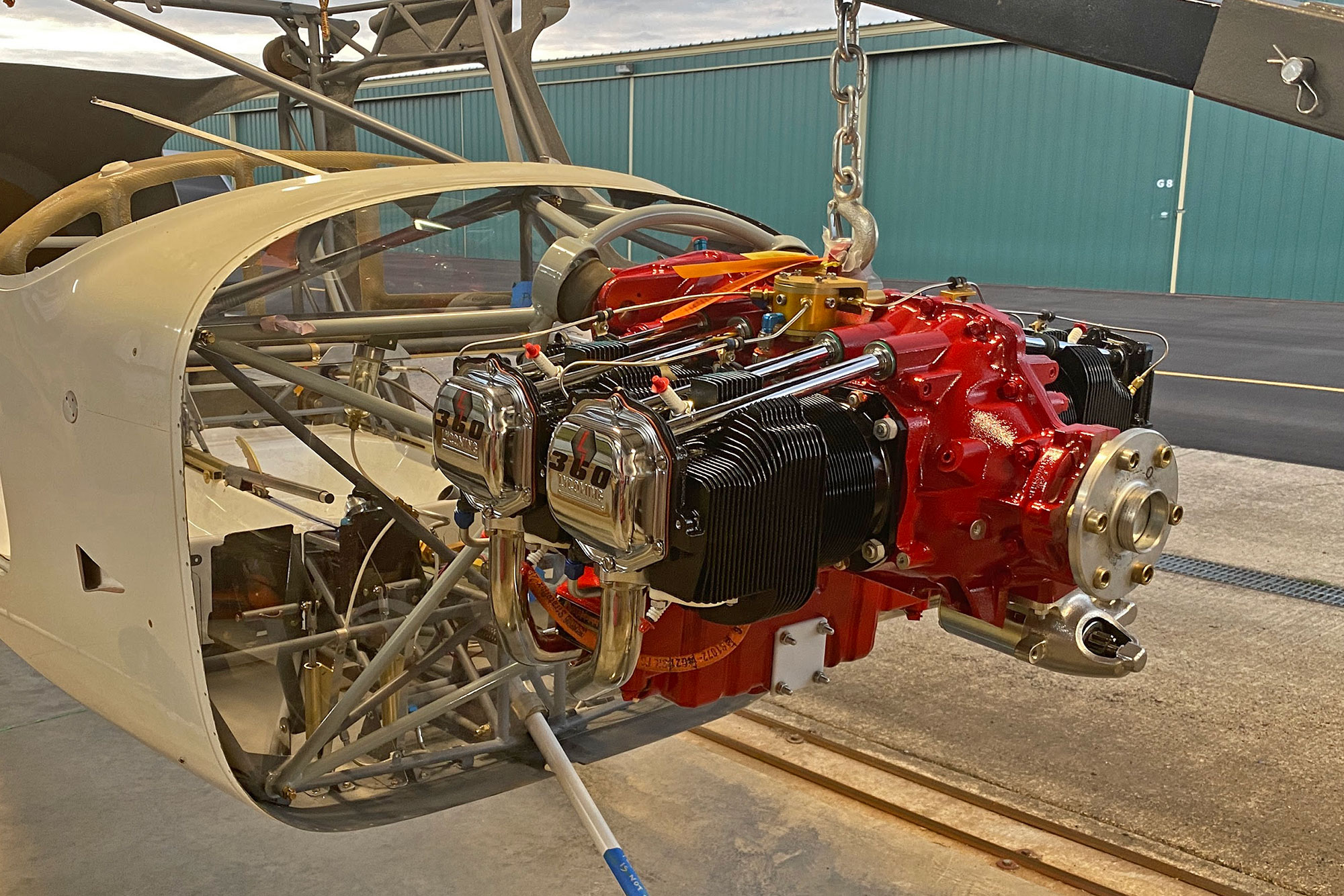
Thanks to near-perfect cars and the preponderance of non-farm, urban living, new pilots and builders typically have scant mechanical knowledge. Call this suboptimal when piloting or building a light aircraft, as a basic understanding of aircraft mechanics makes flying them safer, less expensive, and more enjoyable.
Thus, I’ve been tasked with generating an ongoing stream of mechanical tidbits for those just starting their aviation journey, and I thought to start with piston engines. They are, after all, at least a familiar concept, as that’s how most of us got to the airport, and electric airplanes are still future stuff.
Let’s note the core of an engine is a cylinder, in which a piston slides up and down. The piston is connected to the crankshaft—that’s a shaft with offset “cranks” as in bicycle pedal cranks—by the creatively named connecting rod. When the piston is pushed down by hot, expanding gas in the cylinder, this powerful motion is transferred by the connecting rod to the crankshaft, which then revolves. Bolt a propeller to the crankshaft and the propeller goes around, too. See, nothing to it.

The heart of all this motion is the combustion chamber. That’s the area above the piston, an area enclosed by the cylinder head. The cylinder head is fitted with an intake valve to admit air and fuel into the combustion chamber, one or two spark plugs to light the air/fuel mixture on fire, and an exhaust valve to let out the combusted gasses once the piston has moved to the bottom of the cylinder.
While not immediately obvious, the takeaway concept is a piston engine is an air pump, and air is its working medium. We only add fuel—gasoline or Jet A/diesel—to the air and set it on fire to raise the air’s temperature. The rising temperature makes the air expand (see high school physics) and push down on the piston. Therefore, the more air a piston engine can process, the more power it can make. That’s why larger engines make more power than smaller engines: because larger engines process more air. Make the cylinder larger, add more cylinders, or turn the engine faster and you’ll get more air through and power out (plus weight, complexity, and cost, but that’s for later).
Another basic but important thought is the fire triangle: fuel, oxygen, and source of ignition. This triangle is key to having the engine make its happy noise and keeping us in the air. We’ll talk more about this in future posts, but keep the fire triangle in mind when operating, maintaining, or troubleshooting an engine.

Suck, Squeeze, Bang, Blow — sometimes with only one crankshaft revolution.
A nice basic presentation. To that I’d add that the common Lycoming/Continental piston aircraft engines we operate are quite efficient, effective, have great power to weight, and are reliable. The idea that ‘we can do so much better today’ is just not so. Air cooled engines have lower cooling drag and when well configured, may be more than 40% thermally efficient (about like a Prius). For the experimental folks, it is truly hard to beat an IO360/540 with injection and well tuned electronic ign.
So how does that compare to diesel fueled engines?
Joe,
A well prepared Lycoming or Continental engine actually compares well with a modern diesel engine, it can operate at .39lbs/HP/hr, which is about what a good Diesel engine can do.
The air-cooling helps because there are lower heat losses to a hotter cylinder and cylinder head. Mechanical challenges and issues increase with these higher temperatures though.
If that was true then avgas planes would have nearly as good range as the same plane with a diesel engine. They don’t. It’s not even close. Your “compares well” is doing a lot of heavy lifting.
Andrew,
One of my airplanes achieves 100mpg at150mph TAS.
the other, using a larger 4 cylinder engine achieves > 250 mph at 40mpg.
I also set 4 closed course FAI world records.
Just try try that with any Diesel engine.
Great to see you here Tom! One correction – the piston pushes exhaust gasses out the exhaust valve when it’s at the “top” of the cylinder, not the “bottom”…semantics, I guess.
Let’s call it semantics and the limitation of trying to convey an encyclopedia of information in a few hundred words. Plus, it is surprising how the valves open and close in relation to the piston’s position in the cylinder. But the general idea is exhausting spent gas generally begins after we’ve gotten what we can from combustion meaning the piston has moved to the bottom of the bore.
Tom, great start. Think of the places to go: camshaft operation and valve overlap, variable ignition timing and how this affects combustion temps and power, turbo/super charging. Then you can get into abnormal states that include fuel octane, pre ignition etc. You could spend years on this topic!
David, let’s hope Tom does not get into variable ignition timing. He understands the Suck, Squeeze, Bang, Blow concept but not ignition timing. He has always advocated for magnetos with fixed timing and claimed they make more power. LoL.
As far as I know he always had magnetos on his biplane engine.