

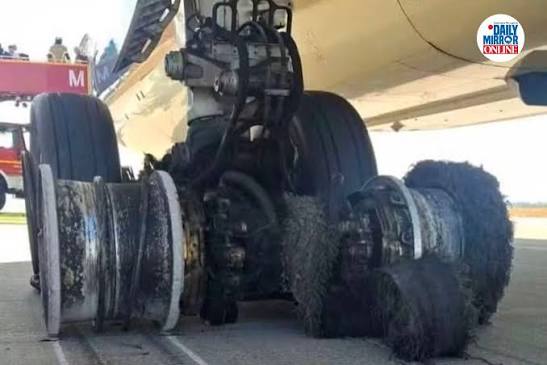
A Vietnam Airlines Boeing 787 used all 13,123 feet of runway plus 125 feet of overrun, striking its tail as the crew hauled it into the air at Munich Airport on Saturday. Video shows the aircraft on the roll for a full minute before the crew over-rotates in a cloud of dust and the aircraft climbs steeply. It stayed in the air for almost two hours dumping fuel after the crew got a tire pressure alert. When the aircraft landed back at Munich, it was clear there was something wrong with the left main gear and still photos showed it badly damaged, likely in the first excursion off the pavement. No one was injured. The airline and German authorities are investigating. New video below shows skid marks at the end of the runway.
More video from Munich/VN34 as airport vehicles pull up to the end of the runway
by u/Brilliant_Night7643 in aviation

There’s a passenger video from ahead of the wing clearly showing it rolling over the over-run and briefly the grass before lifting off.
No flaps on the takeoff roll?
What ever happened to V1 cut
When it’s hot and the aircraft is heavy the conduct, what is referred to, as an Improved Takeoff Performance. Flaps barely extended with Leading Edge Devices.
They would have received a takeoff warning when they applied power for takeoff if the flaps were not extended.
There is additional video showing skid marks from both the left and right bogies beginning well before the end of the runway and continuing into the overrun, indicating brakes were applied to some extent.
https://www.reddit.com/r/aviation/s/OxXvsm2YTl
Commentary elsewhere among 787 pilots and 787 ops knowledgeable people seems to be pointing to issues more subtle and less elementary than simply forgetting flaps and no V1 cut. It’s entirely possible that this crew found themselves in a coffin corner not entirely of their own making shortly after V1. The eventual probable cause might surprise and hopefully cause us to think twice before speculating about elementary mistakes such as bad flap settings and no V1 cuts made by highly trained pilots in airplanes which are unconventionally murphy proof.
While many of us respond to various video reports and respond to uninformed speculation with more uninformed speculation, I am not seeing a single comment about a landing gear design and construction that performed as intended under severely adverse conditions and saved hundreds of lives.
John Caulkins
I look forward to seeing the accident investigation findings on this one. I suspect pilot incompetence will be at the top of the list. I don’t know how you could roll 12,000’ and not realize that something is wrong with either thrust or weight.
It appeared that the wing tip was lifting “many miles” before rotation finally occurred…like they were saying come on, lets fly. Wonder at what speed they finally rotated at the end of the runway. And if it took that long to accelerate to VR, what was wrong with the aircraft. I once took a CFI ME check ride in a Queen Air A65. It was with a GADO. On one of my takeoffs, he yelled, “get you feet off the damn brakes”. And he wasn’t wrong, but passed me anyhow.
And your implication is inadvertent brake application? Why would that affect the rear brakes and not the forward brakes in this case?
Hey John. Have no idea. And actually not implying, just one of my idle thoughts base on a true life adventure.
Oh, Boy… Monday morning (literally) quarterbacking time!
I rewound the video to verify that flaps were extended. My guess, as are all the others until after the investigation is complete, is a possible dragging brake. I don’t know what the density altitude was but I don’t think Munich is high enough to have been a factor. Overloaded, perhaps?
The investigation will tell all.
This is what a takeoff looks like when the parking brake is still engaged. Remarkable an aircraft can survive that error, Boeing builds tough jets!
Park brake set is covered by the takeoff config warning system in the 787. For inadvertent park brake to remain set during takeoff the config warning system would have had to be completely intentionally ignored which, while not impossible is also unlikely.
In the few hours that this story has been up on AvBrief we’ve gotten all manner of speculation about elementary mistakes on the part of the crew based on common mistakes GA pilots make in their GA airplanes. While not impossible, this kind of speculation is unjustified and embarrassingly amateur behavior.
Nobody thought 4 ASIANA pilots would drive a B-777 into the sea wall at SFO, but it happened. As a retired B-767 Captain, I find it hard to believe this could happen as well, BUT stranger things have happened. Asian crews are notorious for never correcting the Captain. Just like the Air India crash, I doubt we’ll ever get the real story.
Oh we’ll get the real story. Germany’s Bundesstelle fur Flugunfalluntersuchung is investigating this one.
In August 1978 I boarded an SAS DC-10 in Copenhagen, bound nonstop for LAX. I had a window seat near a galley. On rotation, there was a very loud BANG and then the jet continued. I wondered if it had been a tail strike. About an hour later, I was startled to see a small fighter, perhaps an F-5, in olive camo just off the wing. I looked right at the pilot, who had a helmet on with dark glare sheild. The fighter then came up off the other wing, moved around some more, and eventually peeled off. About 15 minutes later, the captain came on (in Danish, which I speak) “Ladies and gentlemen…..” and explained that we were going to climb, jettison fuel, and return to Kastrup (the name of the Copenhagen airport). No explanation. As we descended flight attendants instructed us to place our cushions in our laps and bend forward into “crash position” for landing. Not encouraging, and again, no explanation. When we touched down, the plane bounced very high back into the air and began a series of hard bounces along with screeching tires. Dishes from the galley hit the floor and people were screaming and I thought the plane might explode. As we bounced, the jet slung around and finally stopped and it was quiet. I looked out a rows of firefighters with hoses trained on us. Then the captain said the aircraft would not be moving and they’d bring stairs out to the runway. We descended and on the runway I looked at the jet. Many of the tires were shredded and it was facing in a different direction, not sure exactly, can’t remember but maybe more than 90 degrees but less than 180 degrees the wrong way. We boarded buses for the terminal. They told us they’d get another aircraft but our departure kept getting delayed. Eventually they put us up overnight at the SAS Hotel and we departed exactly 24 hours later on the very same aircraft. Upon boarding I made a quick left toward the cockpit and “demanded” to know what happened, since we had been told nothing. Remember he was speaking to a 19-year-old girl, but he said that “on takeoff a front tire exploded and pieces hit the nose cone and knocked out the radar. The jet was sent to assess damage but we decided it was safer to turn back rather than continue over the Arctic Ocean to LA.” In hindsight as a pilot now I admire the pilots’ ability to keep a giant DC-10 on the runway. Nobody was hurt. I didn’t think to look for incident cause until over 40 years later and never did find any official report. But stuff happens. In 2012 on a 767 to the Big Island of Hawaii they lost ALL navigation—ALL screens went dark–over halfway there and turned back. I asked how they navigated and the captain said, “whiskey compass and iPad.” True story; the path is on FlightAware. https://www.flightaware.com/live/flight/UAL989/history/20120827/1610Z/KSFO/PHKO
I wonder how badly the local news got the crew names wrong.
V1, accelerate stop, accelerate go and all that stuff are great reference points. But how about let’s also just look out the front window knowing the conditions and say, “you know what? I don’t think it’s gonna fly and this doesn’t look right!”
This may or may not be germane to this incident, but back some thirty years ago when I flew the 767 internationally as an F/O, of course, we were always heavy. One Captain pretty much knew how long it takes for the Boeing to accelerate past 100 knots when at max gross weight.
He’d call it out “100 knots, speed checks”. Not quite SOP but very effective. Took me by surprise when I first flew with him.
If the two forward tires that are shredded in the photo let go close to or after V1, the amount of additional drag created at the high speeds the plane was going is probably why the plane used up all the runway and overrun. My guess with the pavement disappearing the pilot forced the airplane nose up to get the plane airborne asap. If the tires let go after V1 the pilot may not have had the runway left to try to stop with blown tires. A fully loaded Boeing is not known for short takeoff lengths. The Caption was also probably using a reduced power setting appropriate for the runway length and temp. Very few airliners and airline companies use max power for takeoff. There is an accident years ago in Columbia SC involving a Lear 60 that tried to stop after tires blew and that did not end well. The fact that there were no fatalities on this leaves little reason to criticize the Captain for his actions and a credit to the engineers who designed the landing gear.
One commenter examined ADS-B and noted that, compared to previous take-offs, acceleration was normal up to 140 knots.
If true, then it would appear the electric brakes were activated on the left wheels after V1.
Well we all are tempted to comment about these things when we were not in the left seat, but my comment is, the cause aside, this procedure of allowing aircraft to depart at a greater weight than they can land at is not a good idea. This is why I stopped flight training after AMEL Instrument. I am neither going to allow a corporate bean counter push a stupid procedure on me to make more money, nor am I going to operate anything where a @#$&* computer has opportunity to overrule my decisions. It is not negotiable. This is why I rewired my vehicle to end the start/stop and that circuit that causes the shifter to not respond if the computer thinks the door is not latched. It is a truism, if you cant handle the heat, get out of the kitchen,