To provide the best experiences, we use technologies like cookies to store and/or access device information. Consenting to these technologies will allow us to process data such as browsing behavior or unique IDs on this site. Not consenting or withdrawing consent, may adversely affect certain features and functions.
The technical storage or access is strictly necessary for the legitimate purpose of enabling the use of a specific service explicitly requested by the subscriber or user, or for the sole purpose of carrying out the transmission of a communication over an electronic communications network.
The technical storage or access is necessary for the legitimate purpose of storing preferences that are not requested by the subscriber or user.
The technical storage or access that is used exclusively for statistical purposes.
The technical storage or access that is used exclusively for anonymous statistical purposes. Without a subpoena, voluntary compliance on the part of your Internet Service Provider, or additional records from a third party, information stored or retrieved for this purpose alone cannot usually be used to identify you.
The technical storage or access is required to create user profiles to send advertising, or to track the user on a website or across several websites for similar marketing purposes.



I bet that was an interesting debrief…
One needs to relearn crosswind landing techniques. Back to basics
A lot of pilots worry about scraping an engine pod so they don’t slip the aircraft. It is actually pretty hard to do if landing within the cross wind limits in a 737. This is not the first case of runway departure in a 737 for lack of technique.
One wonders if the previous posters have actually landed a 737 in a 50 mph crosswind?
I was an LCA on the 737. In any event 50 mph exceeds the cross wind limit. At that point attempting to land in those conditions has nothing to do with technique and just exhibits plain poor judgement
Thanks Greg.
200% Agree! (as well as adherence to ‘Limitations’!)
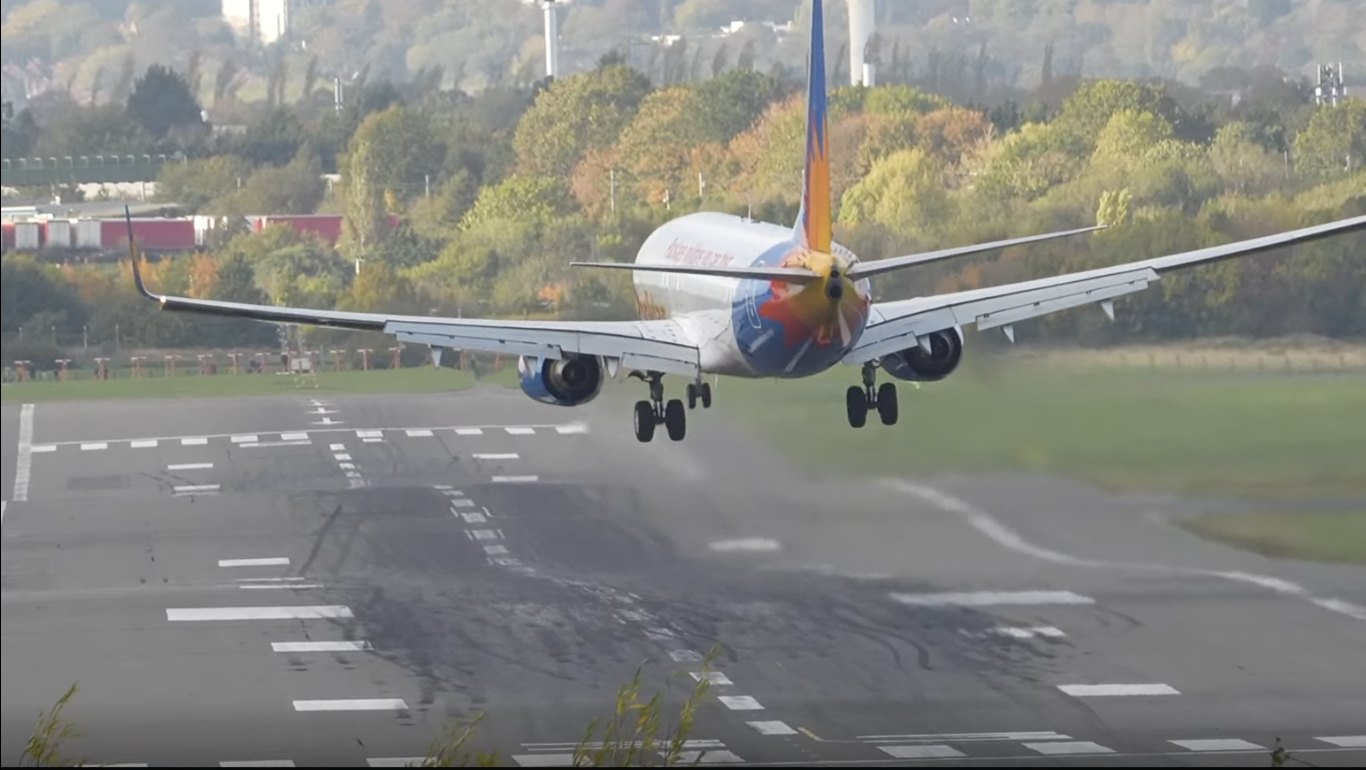
Both the initial crab & trees blowing at the end of the video indicate a left to right xwind. Looks like the pilots weren’t looking out the window after landing while driving off the left side. Pretty mild crab angle for the resulting excursion
I also thought it looked like the wind was from the left… was this pushing the tail to the right (wind-vaning)?
The wind is from the left so don’t quit understand why they departed the runway upwind?
Normally you would expect to drift to the left towards the right edge of the runway?Touchdown was OK but looks like they overcorrected or Captain used too much left correction with the tiller?
They appear to have let it weathervane into the wind. Also, no left aileron applied that I can see.
A tailwheel aircraft will depart to the upwind side of runway resulting in a ground loop which will get the downwind wing and landing gear. This is do to the weathervaning/weathercocking effect of the vertical stabilizer and fuselage trying to turn into the wind. I am almost always on the downwind brake helping the rudder to keeping it on the runway. Sometimes the rudder does not have enough authority to keep the aircraft from drifting off the runway.
Of course upwind aileron into the wind.
I’m sure it’s mostly the compression from the telephoto but the runway has some pretty serious “whoopty doos” in it, looks like a dirt bike track! Nothing to do with the incident just thought it amusing.
it is not unusual for Euro pilots to touchdown in a crab, these boneheads never bothered to straighten themselves out after touchdown. Watch the lack of rudder movement
Agree w/O&G. Too easy to judge – but, looks like the correct amount of adjusted crab, followed by not enough sustained kick…
That is because it is an Airbus thing. You can cross control an Airbus but not effectively until the last 70 feet before touchdown.
Even if that were true, that isn’t an Airbus.
True that, but methodology has a way of creeping across fleets for the purpose of standardization. In addition, previous experience with other types often finds itself on the flight deck of another even if inappropriate.
Just googled a little, “The maximum demonstrated crosswind component for a Boeing 737-800 (NG) is 36 knots”. So with just one runway available in Birmingham I think it should simply not have been attempted in the first place; that’s why there are alternate airports in the flight plan.
As the Birmingham 737 veered left and the left main gear breached the edge of the runway, the video clearly shows that the pilot was pushing hard right rudder. He finally found out what his personal limitations are for a crosswind landing. My guess is that it was a very capable young pilot who was overconfident in his own abilities but lacking experience. If he keeps his job after this incident and a grueling chewing out by the chief pilot, I’ll bet he will make better decisions in the future.
I’ve landed my 172 on grass, but I’ve never seen a 737 do it 🙂
I clicked on the video thinking “pilot error” and I was not disappointed. Yes it was a lot of crosswind – but the right rudder that was so badly needed appeared only briefly only to be forgotten about immediately afterward.
If it exceeded x-wind limitations in POH, both flight crew will be in big trouble with regulating authority. Even if company put pressure on crew to complete flight, it is their certificates on the line. Moral of story… do not deviate from approved flight or maintenance data, EVER.